


Self-employed professionals miss thousands of dollars in tax savings each year by overlooking legitimate deductions. The IRS allows extensive write-offs for business expenses, but many freelancers and entrepreneurs don’t know what qualifies.
We at Clear View Business Solutions have compiled this comprehensive guide to help you identify every self-employed tax deduction available. This checklist covers everything from basic home office expenses to advanced retirement planning strategies.
The home office deduction offers one of the most valuable write-offs for self-employed professionals. The IRS requires exclusive and regular business use of the space, which means no personal activities can occur in that area. The simplified method provides a $5 per square foot deduction up to 300 square feet (maximum $1,500 annually). The actual expense method calculates the percentage of your home that you use for business and applies it to mortgage interest, property taxes, utilities, and maintenance costs. Most taxpayers benefit more from the actual expense method when their home office exceeds 100 square feet or when they face high housing costs.
Business equipment purchases qualify for immediate deduction through Section 179 expensing, which allows business taxpayers to deduct the cost of certain property as an expense when the property is first placed in service. Computers, printers, office furniture, and specialized tools fall under this category. Software subscriptions that include accounting programs, design tools, and project management platforms receive full deduction in the year you purchase them. Professional development costs that include courses, certifications, books, and conference fees qualify as complete deductions when they maintain or improve skills for your current business.

Trade publication subscriptions and industry memberships also qualify as education-related deductions.
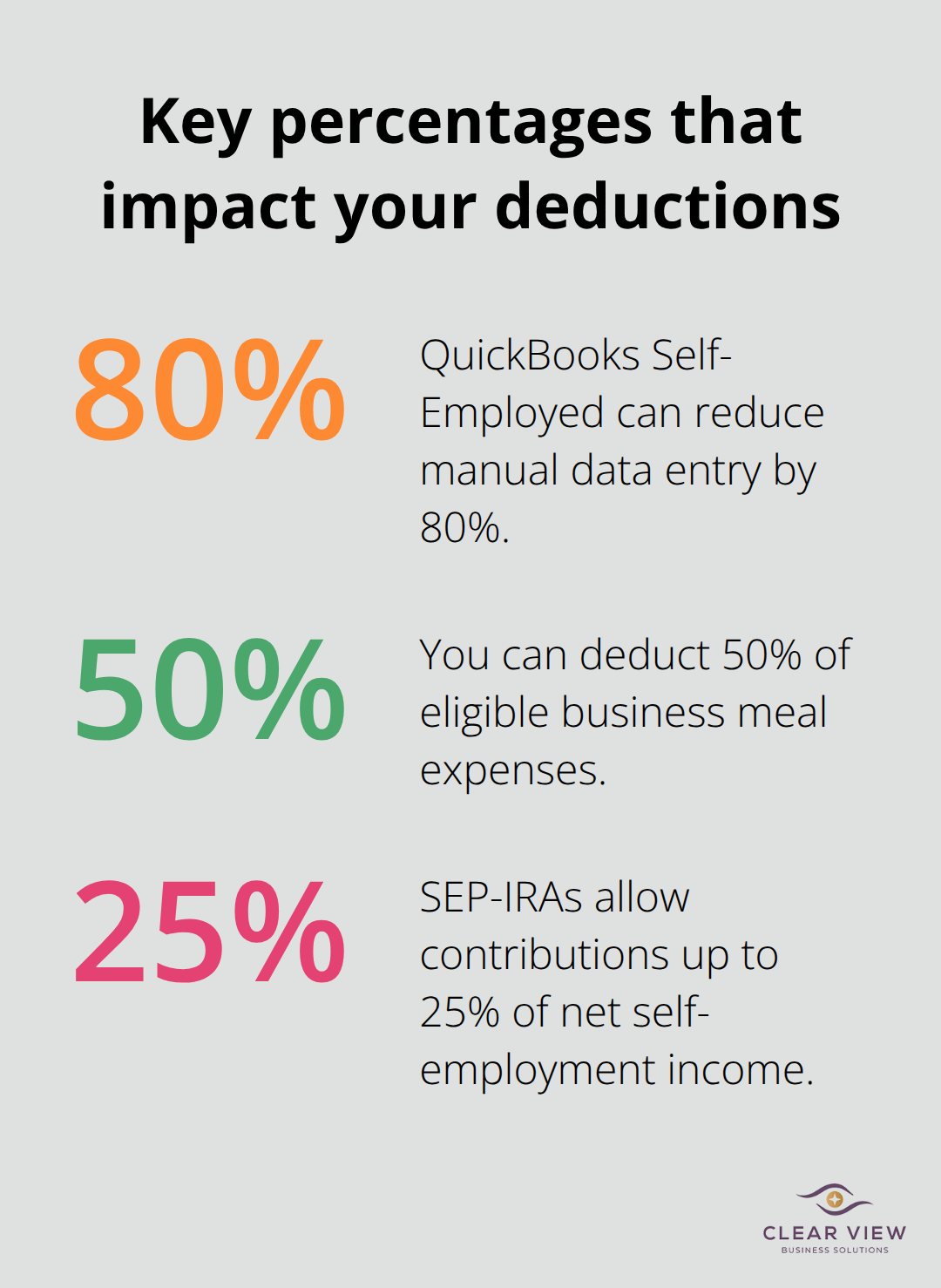
The standard mileage rate for 2025 reaches 70 cents per mile for business vehicle use, though actual expense calculations often yield higher deductions for expensive vehicles. Business travel expenses that include airfare, hotel costs, and meals receive full deduction when the travel serves necessary business purposes. You can deduct 50% of business meal expenses when you or your employee attend the meal and it relates directly to business activities.
Self-employed individuals can deduct 100% of health insurance premiums they pay for themselves, spouses, and dependents, provided they lack eligibility for employer-sponsored coverage elsewhere. This deduction appears on Form 1040 as an adjustment to income and reduces both income tax and self-employment tax liability. Professional service fees that you pay to accountants, attorneys, consultants, and other business advisors qualify for full deduction. Marketing expenses that include website development, advertising costs, and promotional materials count as ordinary business expenses.
These fundamental deductions form the foundation of your tax strategy, but advanced techniques can unlock even greater savings through strategic planning and specialized write-offs.
The actual expense method often beats the standard mileage rate for self-employed professionals with expensive vehicles or high usage. You track all vehicle costs that include fuel, maintenance, insurance, registration, and depreciation, then apply your business use percentage. A $50,000 vehicle used 80% for business generates substantially more deductions through actual expenses than mileage rates. You must keep detailed mileage logs with dates, destinations, business purposes, and odometer readings. GPS apps like MileIQ automatically record business trips and calculate deductions (this eliminates manual logbook maintenance).
Self-employed health insurance deductions reduce both income tax and self-employment tax, which creates double savings that most taxpayers miss. The deduction covers premiums for medical, dental, and long-term care insurance for you, your spouse, and dependents. This above-the-line deduction appears on Form 1040 Line 17 and reduces your adjusted gross income before you calculate other deductions. Health Savings Account contributions provide triple tax benefits through deductible contributions, tax-free growth, and tax-free withdrawals for medical expenses (2025 limits reach $4,300 for individuals and $8,550 for families).
SEP-IRAs allow self-employed individuals to contribute up to 25% of net self-employment income or $70,000 for 2025, whichever is less. Solo 401k plans permit higher contributions through employee and employer components that reach $70,000 plus $7,500 catch-up for those over 50. These contributions reduce current-year taxable income while you build retirement wealth. Defined benefit plans work best for high-income self-employed professionals with consistent income and allow annual contributions that exceed $200,000 in some cases. You calculate contributions with net income from self-employment after you deduct half of your self-employment tax. Retirement tax planning requires careful consideration of contribution limits and timing strategies.
Proper documentation becomes the foundation that supports all these advanced tax planning strategies and protects you during potential IRS reviews.
The IRS requires substantiation for every business expense you claim. Receipts alone don’t provide sufficient documentation. You need receipts plus additional records that show the business purpose, date, amount, and parties involved. Digital receipt storage through apps like Expensify or Receipt Bank captures images automatically and extracts key data, but you must verify accuracy before you rely on these systems.
Paper receipts fade within two years, which makes digital conversion essential for long-term audit protection. The IRS accepts digital copies as valid documentation provided they remain legible and complete. You should maintain separate business and personal accounts to simplify record maintenance and demonstrate clear business intent.
Bank statements and credit card records serve as backup documentation when original receipts get lost, but they lack the business purpose details that auditors demand. You must document the business reason for each expense at the time of purchase to satisfy IRS requirements.

QuickBooks Self-Employed automatically categorizes transactions and tracks mileage, which reduces manual data entry by 80% compared to spreadsheet methods. The software connects directly to bank accounts and credit cards, imports transactions in real-time, and flags potential deductions you might miss.
MileIQ tracks business trips automatically through GPS technology and provides IRS-compliant mileage logs that satisfy audit requirements. The app eliminates manual logbook maintenance while you maintain the detailed records that auditors expect to see.
Professional tax preparation software creates audit trails that demonstrate systematic record maintenance and reduces audit risk compared to manual preparation methods. These digital tools provide the consistency and accuracy that manual systems often lack.
You must maintain contemporaneous records, which means you document expenses when they occur rather than reconstruct them later. Proper documentation becomes essential for self-employed professionals, as inadequate records frequently lead to unfavorable audit outcomes.
Three years of complete records protect you from most IRS inquiries, though certain situations extend the statute of limitations to six years. You should organize records by tax year and maintain both digital and physical backups to prevent data loss.
The IRS expects detailed documentation that includes receipts, bank statements, credit card records, invoices, contracts, and any supporting documentation that validates your reported income and deductions. Missing documentation often results in disallowed deductions and additional tax liability plus penalties.
Self-employed tax deductions represent one of the most powerful tools for reducing your tax burden, yet many professionals leave money on the table through poor planning and inadequate documentation. The average self-employed individual can save $3,000 to $8,000 annually when they implement systematic deduction strategies and maintain proper records throughout the year. Most freelancers and entrepreneurs miss these opportunities because they lack awareness of available write-offs or fail to track expenses properly.
Complex tax situations require professional guidance to navigate advanced strategies like retirement plan optimization and multi-state tax obligations. We at Clear View Business Solutions help self-employed professionals identify legitimate deductions while maintaining IRS compliance. Our team provides comprehensive tax planning services that maximize your savings potential.
Year-round tax planning beats last-minute preparation every time. You should start expense tracking immediately, set up automated systems for receipt capture, and review your deduction strategy quarterly (this proactive approach positions you to claim every legitimate write-off). This systematic method builds the documentation that protects you during potential audits while maximizing your annual tax savings.




At Clear View Business Solutions, we know you want your business to prosper without having to worry about whether you are paying more in taxes than you should or whether your business is set up correctly. The problem is it's hard to find a trusted advisor who can translate financial jargon to layman's terms and who can actually help you plan for better results.
We believe it doesn't have to be this way! No business owner should settle for working with a CPA firm that falls short of understanding what you want to achieve and how to help you get there.
Northwest Location:
7530 N. La Cholla Blvd., Tucson, AZ 85741
Central Location:
2933 N Campbell Avenue, Tucson, AZ 85719
© 2026 Clear View Business Solutions. All Rights Reserved.
At Clear View Business Solutions, we know you want your business to prosper without having to worry about whether you are paying more in taxes than you should or whether your business is set up correctly. The problem is it's hard to find a trusted advisor who can translate financial jargon to layman's terms and who can actually help you plan for better results.
We believe it doesn't have to be this way! No business owner should settle for working with a CPA firm that falls short of understanding what you want to achieve and how to help you get there. With over 20 years of experience serving hundreds of business owners like you, our team of experts combines financial expertise and proactive communication with our drive to help each client achieve results and have fun along the way.
Here's how we do it:
Discover: We start with a consultation to understand your specific goals, what's holding you back, and what success looks like for you.
Strategize & Optimize: Together, we design a customized strategy that empowers you to progress toward your goals, and we optimize our communication as partners.
Thrive: You enjoy a clear view of your business and your financial prosperity.
Schedule a consultation today, and take the first step toward being able to focus on your core business again without wondering if your numbers are right- or what they mean to your business.
In the meantime, download, "The Business Owner's Essential Guide to Tax Deductions" and make sure you aren't leaving money on the table.