


Corporate tax planning strategies can save businesses thousands of dollars annually while maintaining full compliance with tax regulations. Companies that implement structured tax planning reduce their effective tax rates by an average of 15-20%.
We at Clear View Business Solutions see many businesses miss valuable opportunities simply because they lack a systematic approach to tax planning. The right strategies transform tax obligations from a burden into a competitive advantage.
Corporate tax planning revolves around three foundational pillars that separate successful companies from those that pay excessive taxes. The Tax Cuts and Jobs Act reduced corporate rates to 21%, but smart businesses achieve much lower effective rates through strategic execution. More than half of major companies paid less than half of the statutory rate, with some achieving rates as low as 2.2%.
Accelerated depreciation remains the most powerful tax reduction tool available. Equipment placed in service after January 19, 2025, qualifies for 100% bonus depreciation under recent legislation. Manufacturing structures that begin construction between January 2025 and end of 2028 receive full deductibility. Research and development expenses became immediately deductible in 2025, with small businesses receiving retroactive benefits from 2022. The Work Opportunity Tax Credit provides up to $9,600 per qualified employee hire from disadvantaged groups. Companies routinely save substantial amounts annually through accelerated depreciation strategies.
Cash-method accounting gives businesses maximum flexibility for income deferral and expense acceleration. Delay client bills in December to shift revenue to the next tax year when rates may be lower. Accelerate equipment purchases, employee bonuses, and professional services payments before year-end.

Installment sales spread property transaction income across multiple years. The qualified business income deduction allows pass-through entities to deduct 20% of business income, which creates substantial tax savings when properly timed.
Pass-through entities that elect entity-level taxation reduce owners’ federal Schedule K-1 income while they maintain state-level benefits. C-corporations benefit from the flat 21% rate and accumulated earnings advantages. The expanded Qualified Small Business Stock exemption now excludes $15 million in capital gains for stock sales that qualify. Entity selection affects everything from self-employment taxes to retirement plan contributions, which makes structure optimization a high-impact decision that compounds annually.
These fundamentals create the foundation for more sophisticated tax strategies that can further reduce your corporate tax burden.
Expense timing creates the most immediate tax impact for corporations. Companies prepay expenses like insurance, rent, and professional services before December 31st to accelerate deductions into the current year. The IRS permits businesses to deduct prepaid expenses up to 12 months in advance, which means January 2026 rent paid in December 2025 becomes a 2025 deduction.
Software subscriptions, equipment maintenance contracts, and training programs qualify for this strategy. Companies that implement systematic expense acceleration save an average of 8-12% on their annual tax bills. Health reimbursement arrangements offer another powerful tool that allows small businesses to deduct medical expenses while they provide tax-free benefits to employees.
Employer-sponsored retirement plans generate immediate tax deductions while they build long-term employee loyalty. SEP-IRAs allow contributions up to 25% of compensation or $69,000 for 2025 (whichever is lower). SIMPLE IRAs require lower administrative costs and permit employee deferrals up to $16,000 annually.
The key advantage lies in timing – contributions made before the tax return due date count toward the previous tax year. Small business owners can contribute to their own retirement accounts, which creates double tax benefits. Employee stock ownership plans provide additional deduction opportunities while they transfer ownership gradually. Retirement planning with tax strategies maximizes these benefits when properly coordinated with corporate tax planning.
R&D tax credits offer dollar-for-dollar tax reductions that often exceed depreciation benefits. The federal R&D credit provides significant benefits for qualified research expenses above a base amount. Qualified activities include development of new products, improvement of existing processes, and creation of software solutions.

Many businesses overlook that failed experiments and abandoned projects still qualify for credits. Documentation requirements include maintenance of detailed records of research activities, time tracking, and expense allocation. Companies can claim R&D credits retroactively for up to three years, which creates substantial refund opportunities. State R&D credits stack on top of federal benefits, with some states that offer credits exceeding 25% of qualified expenses.
Even the most sophisticated tax strategies can backfire without proper execution, which makes it essential to understand the common pitfalls that derail corporate tax plans.
Poor documentation destroys tax savings faster than any other mistake corporations make. The IRS requires contemporaneous records for all business deductions, which means you cannot recreate documentation after an audit begins. Companies without proper expense tracking lose significant amounts annually in missed deductions.
Digital receipt management systems prevent this costly oversight. Businesses that rely on shoebox accounting face automatic deduction disallowance during IRS examinations. The IRS rejects reconstructed records and estimates, which eliminates legitimate deductions that companies earned through actual business expenses.
Missed quarterly estimated payments generate penalties that compound throughout the tax year, often exceeding the actual tax savings from planning strategies. The IRS charges penalties on underpayments, calculated separately for each quarter. Companies that underpay significantly face automatic penalties, even if they receive refunds at year-end.
Safe harbor rules allow payments based on 100% of prior year tax for smaller corporations. Businesses with income over $1 million must pay 110% of the previous year to avoid penalties. Automated payment systems eliminate this expensive mistake entirely and prevent cash flow disruptions from unexpected penalty assessments.
State and local tax obligations multiply complexity exponentially for multi-state operations. States often reject federal deductions, which creates phantom income that catches businesses unprepared. Sales tax nexus rules now trigger obligations with minimal physical presence, while income tax apportionment formulas vary dramatically between jurisdictions.
Companies that operate in multiple states face higher effective tax rates when they ignore state-specific planning opportunities. Professional guidance becomes mandatory for businesses with operations that cross state lines, as DIY approaches consistently result in overpayments and compliance failures.
The IRS demands specific documentation standards that many businesses fail to meet. Expense receipts must show the business purpose, date, amount, and participants for meals and entertainment deductions. Travel expenses require detailed logs with destinations, business purposes, and duration of trips.
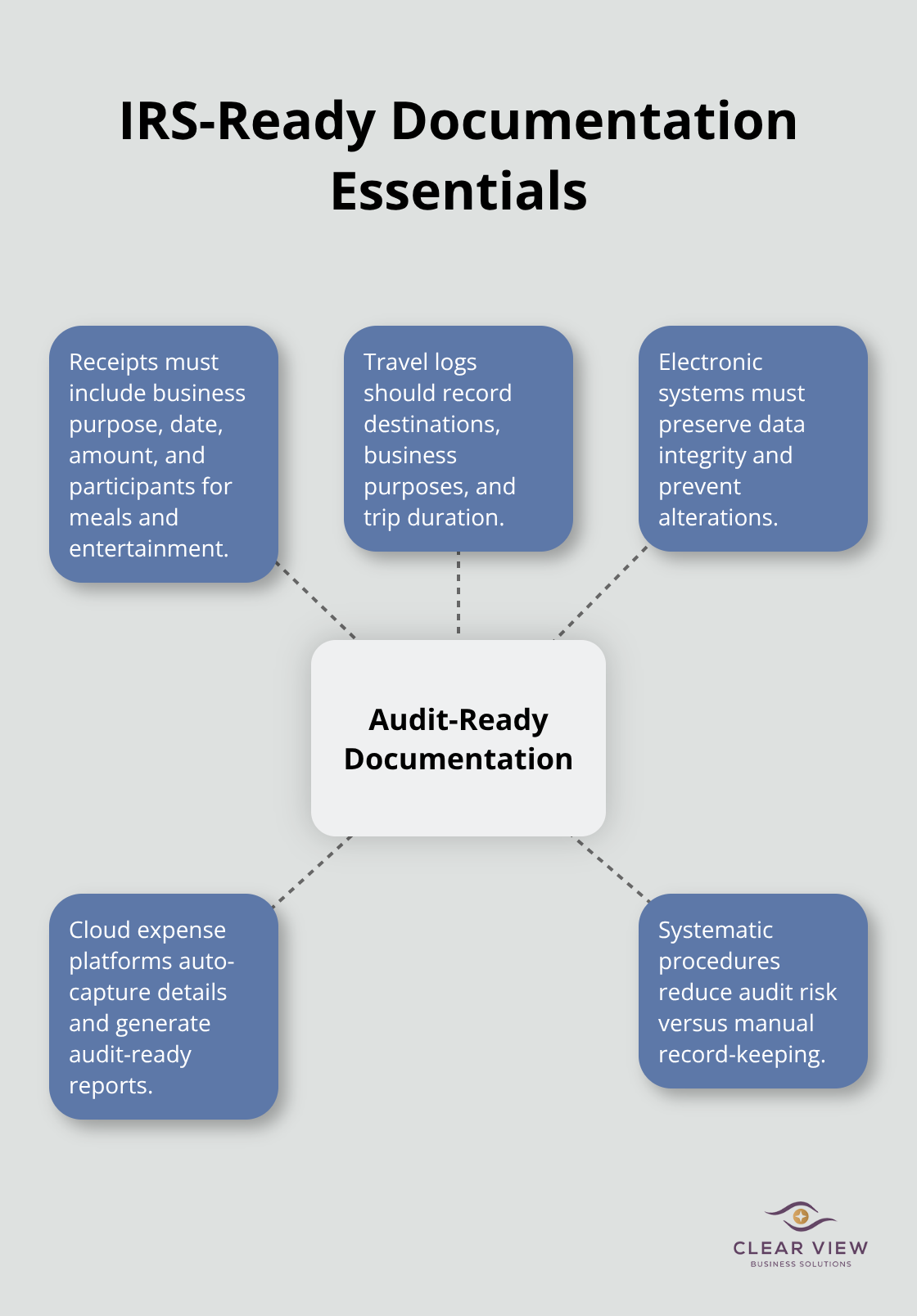
Electronic documentation systems now meet IRS requirements provided they maintain data integrity and prevent alterations. Cloud-based expense management platforms automatically capture required details and create audit-ready reports. Companies that implement systematic documentation procedures reduce audit risks significantly compared to manual record-keeping methods.
Corporate tax planning strategies deliver measurable financial benefits that compound year after year. Companies that implement systematic approaches reduce their effective tax rates by 15-20% while they maintain full compliance. The combination of accelerated depreciation, strategic expense timing, and proper entity structure creates substantial savings that free up capital for business growth.
Professional tax guidance becomes indispensable as regulations evolve and opportunities expand. The Tax Cuts and Jobs Act provisions expire at the end of 2025, which makes expert navigation essential for companies that want to maintain competitive advantages. State tax complexities and documentation requirements demand specialized knowledge that prevents costly mistakes (especially for multi-state operations).
We at Clear View Business Solutions help businesses implement these strategies through comprehensive tax services that maximize benefits while they maintain compliance. Start to implement these corporate tax planning strategies immediately when you review your current deductions, establish proper documentation systems, and schedule quarterly tax planning sessions. The sooner you begin, the greater your annual savings become.




At Clear View Business Solutions, we know you want your business to prosper without having to worry about whether you are paying more in taxes than you should or whether your business is set up correctly. The problem is it's hard to find a trusted advisor who can translate financial jargon to layman's terms and who can actually help you plan for better results.
We believe it doesn't have to be this way! No business owner should settle for working with a CPA firm that falls short of understanding what you want to achieve and how to help you get there.
Northwest Location:
7530 N. La Cholla Blvd., Tucson, AZ 85741
Central Location:
2933 N Campbell Avenue, Tucson, AZ 85719
© 2026 Clear View Business Solutions. All Rights Reserved.
At Clear View Business Solutions, we know you want your business to prosper without having to worry about whether you are paying more in taxes than you should or whether your business is set up correctly. The problem is it's hard to find a trusted advisor who can translate financial jargon to layman's terms and who can actually help you plan for better results.
We believe it doesn't have to be this way! No business owner should settle for working with a CPA firm that falls short of understanding what you want to achieve and how to help you get there. With over 20 years of experience serving hundreds of business owners like you, our team of experts combines financial expertise and proactive communication with our drive to help each client achieve results and have fun along the way.
Here's how we do it:
Discover: We start with a consultation to understand your specific goals, what's holding you back, and what success looks like for you.
Strategize & Optimize: Together, we design a customized strategy that empowers you to progress toward your goals, and we optimize our communication as partners.
Thrive: You enjoy a clear view of your business and your financial prosperity.
Schedule a consultation today, and take the first step toward being able to focus on your core business again without wondering if your numbers are right- or what they mean to your business.
In the meantime, download, "The Business Owner's Essential Guide to Tax Deductions" and make sure you aren't leaving money on the table.