


Small business owners leave thousands of dollars on the table every year by missing deductions they’re entitled to claim. At Clear View Business Solutions, we’ve seen firsthand how strategic tax planning can transform a business’s bottom line.
This guide walks you through actionable small business tax tips that actually work-from home office deductions to timing strategies that reduce what you owe.
The home office deduction remains one of the easiest wins small business owners miss. If you use part of your home exclusively and regularly as your principal place of business, the IRS allows you to deduct the costs tied to that space. The simplified method lets you claim $5 per square foot, up to 300 square feet, for a maximum of $1,500 annually. The regular method tracks actual expenses-rent or mortgage interest, utilities, insurance, repairs, and depreciation-allocated to your office. Most owners underestimate their space or assume the deduction is too complicated. Track your square footage precisely and keep receipts for every utility bill and maintenance cost.
Vehicle expenses follow the same pattern of overlooked savings. The standard mileage rate for 2025 sits at 70 cents per mile, and this applies only to business-related driving. Personal commutes don’t count. If you drive 10,000 business miles annually, that’s $7,000 in deductions.
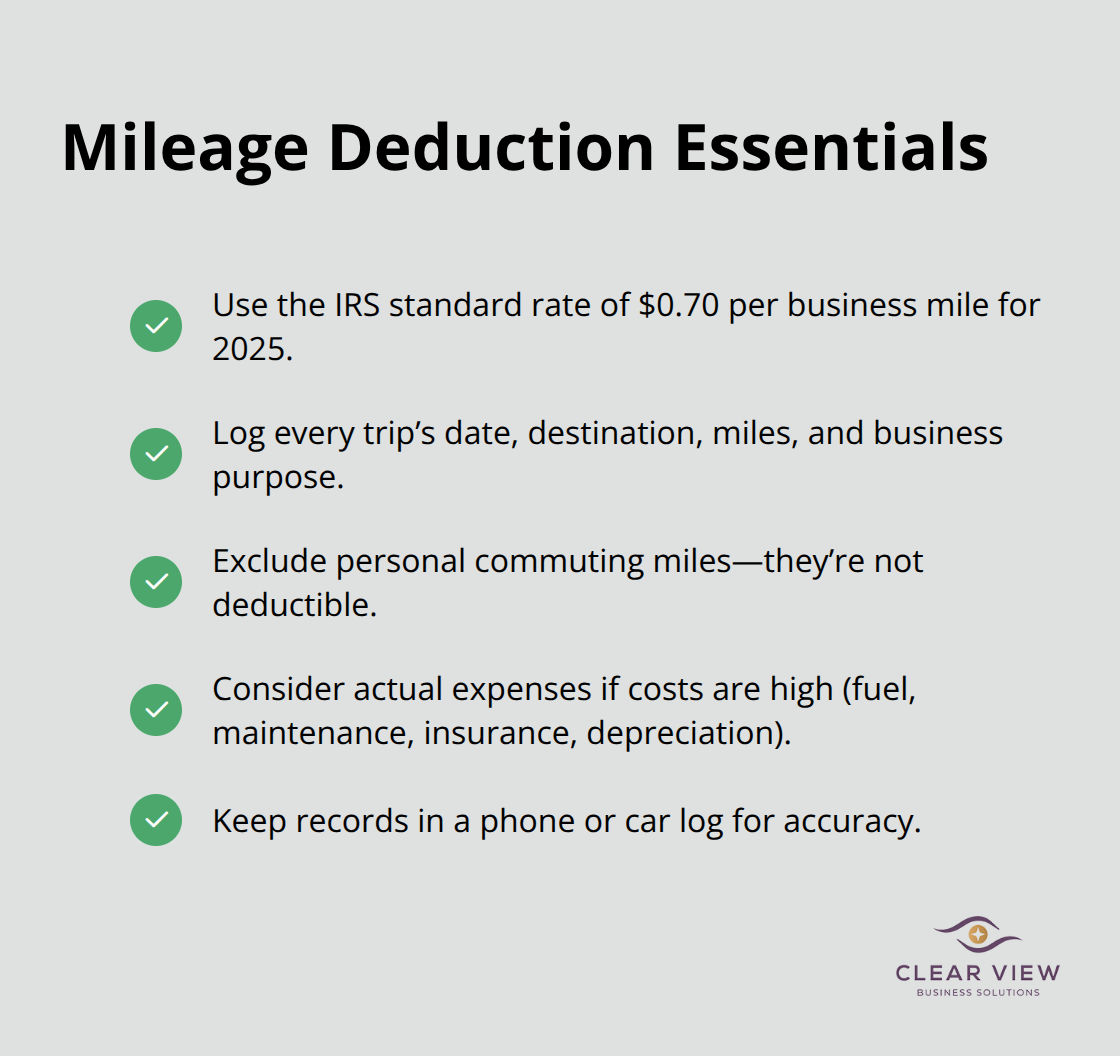
Actual expense tracking-fuel, maintenance, insurance, depreciation-can yield higher deductions if your vehicle costs run steep, but the mileage method requires far less paperwork. Keep a log in your phone or car documenting each trip’s date, destination, miles, and business purpose. Many owners fail to separate personal and business miles, which costs them thousands in legitimate deductions.
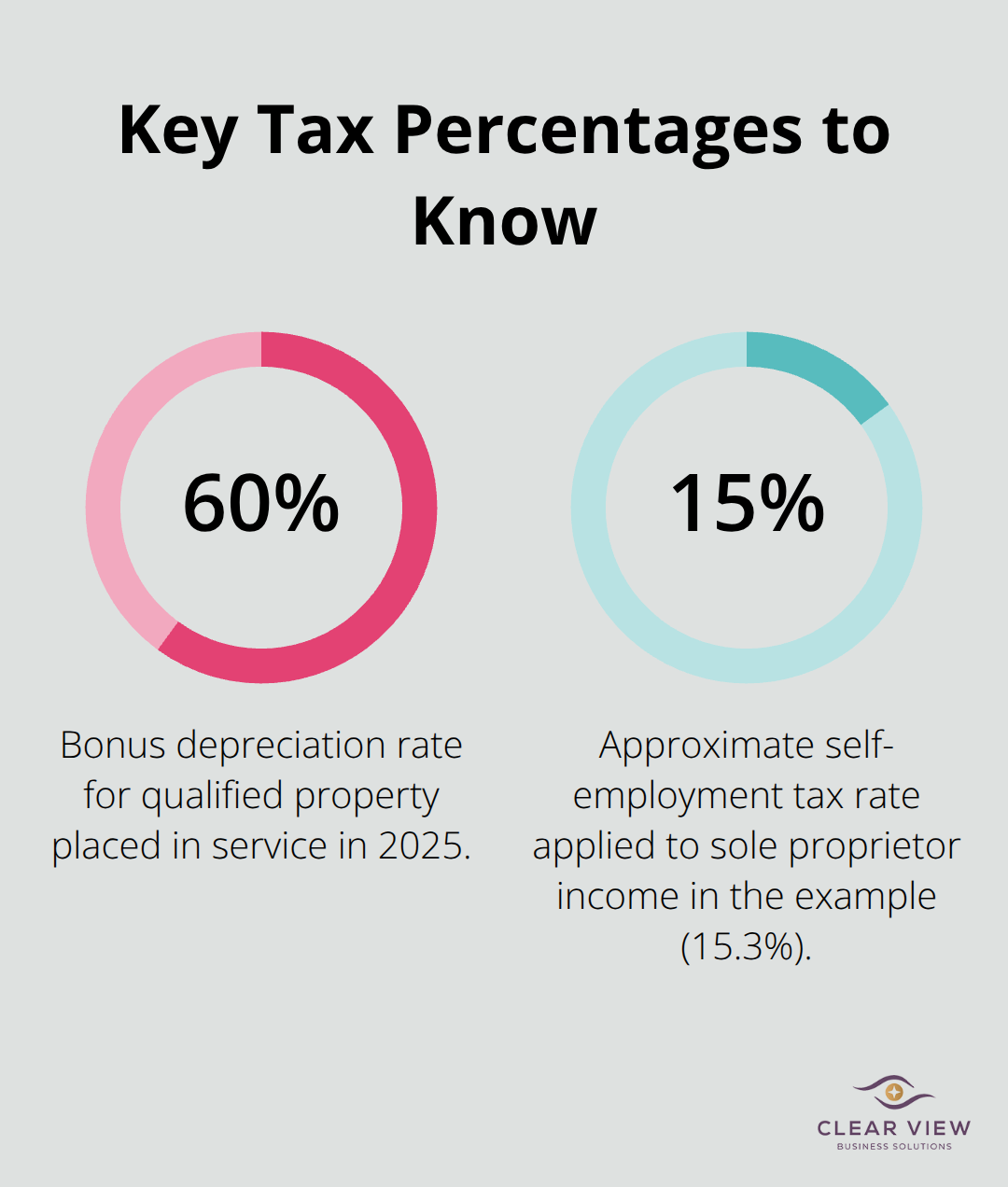
Section 179 expensing lets you deduct equipment purchases in the year they are placed in service without spreading deductions across multiple years. That means if you buy a $15,000 server or software system, you write off the full amount immediately rather than depreciating it over five years. Bonus depreciation covers 60% of qualified property placed in service in 2025, with the percentage shifting in future years. If your business needs computers, machinery, furniture, or tools, timing these purchases before December 31 maximizes current-year deductions. Many owners delay purchases into the new year without realizing they forfeit thousands in tax savings.
Vehicles used 100% for business qualify for first-year depreciation up to $12,200 plus up to $8,000 in bonus depreciation. SUVs weighing 6,000 to 14,000 pounds may qualify for 100% bonus depreciation in 2025, making them a smarter purchase than lighter vehicles if your business needs exist. Software subscriptions, cloud storage, accounting tools, and hardware all count as deductible business expenses when used exclusively for work. Document everything with purchase receipts and a clear business purpose, and consult IRS Publication 946 to confirm which assets qualify for accelerated depreciation.
These deductions form the foundation of tax savings, but timing matters just as much as identifying what you can claim. Strategic planning throughout the year-not just at tax time-separates owners who pay what they owe from those who pay far more than necessary.
The difference between paying thousands in unnecessary taxes and keeping that money in your business often comes down to timing decisions made in November and December. Most small business owners treat tax planning as a January activity, but that’s far too late. The real savings happen when you control when income and expenses hit your books.
If you operate on a cash basis, you gain genuine flexibility: delaying an invoice by a few days pushes income into the next tax year, while accelerating equipment purchases before December 31 locks in current-year deductions. A business that nets $150,000 in income can reduce that figure substantially by moving a $20,000 software purchase or equipment upgrade into the current year rather than waiting until spring.
The IRS allows this strategy as long as you remain consistent with your accounting method and document everything properly. Section 179 expensing limits cap at $2.56 million in 2026, making year-end purchases especially powerful because you write off the full amount immediately instead of spreading deductions across years. If bonus depreciation applies to your assets, that benefit shifts in 2026 to 60% from the current year’s rates, making purchases before year-end even more valuable.
Quarterly estimated tax payments deserve far more attention than most owners give them. The IRS requires estimated payments if you expect to owe $1,000 or more in taxes for the year, and missing these deadlines triggers penalties that accumulate quickly. The Thomson Reuters Institute found in 2025 that limited tax help increases penalty risk substantially, meaning owners who skip professional guidance often face surprise bills.
Calculate your estimated tax by projecting annual income, applying your effective tax rate, and dividing by four to determine quarterly payments due April 15, June 15, September 15, and January 15. Many owners underestimate these payments and scramble in April, but accurate projections early in the year prevent cash flow surprises.
Your business structure matters tremendously for tax outcomes. An S-corporation election reduces self-employment taxes compared to pass-through entities because you can pay yourself a reasonable salary and take remaining profits as distributions that avoid the self-employment tax hit. A sole proprietor earning $100,000 pays roughly 15.3% in self-employment taxes on that income, while an S-corp owner might structure $60,000 as salary and $40,000 as distributions, reducing self-employment taxes substantially.
The tradeoff involves more paperwork and payroll processing, but the savings often justify the complexity. Consult a tax professional before changing your structure because elections must align with your actual business operations and cash flow patterns. The right structure transforms how much you retain after taxes, making this decision one of the highest-impact choices you’ll make for your business.
DIY tax filing works fine for straightforward situations, but the moment your business involves multiple income streams, equipment purchases, or strategic timing decisions, the cost of a mistake outweighs the savings from filing alone. A tax professional catches deductions you miss, structures your business to minimize self-employment taxes, and handles IRS correspondence if problems arise. The real question isn’t whether you can file taxes yourself-many owners can-but whether you’re willing to risk leaving thousands in deductions unclaimed or facing audit penalties because a detail fell through the cracks.
A CPA or enrolled agent costs between $1,500 and $5,000 annually for small business tax work, yet the deductions they identify typically exceed that fee by multiples. Owners who invest in professional guidance during the planning phase, not just at filing time, retain significantly more income. If your business generates over $75,000 in annual income or involves multiple entities, property depreciation, or employee payroll, professional help becomes essential rather than optional.
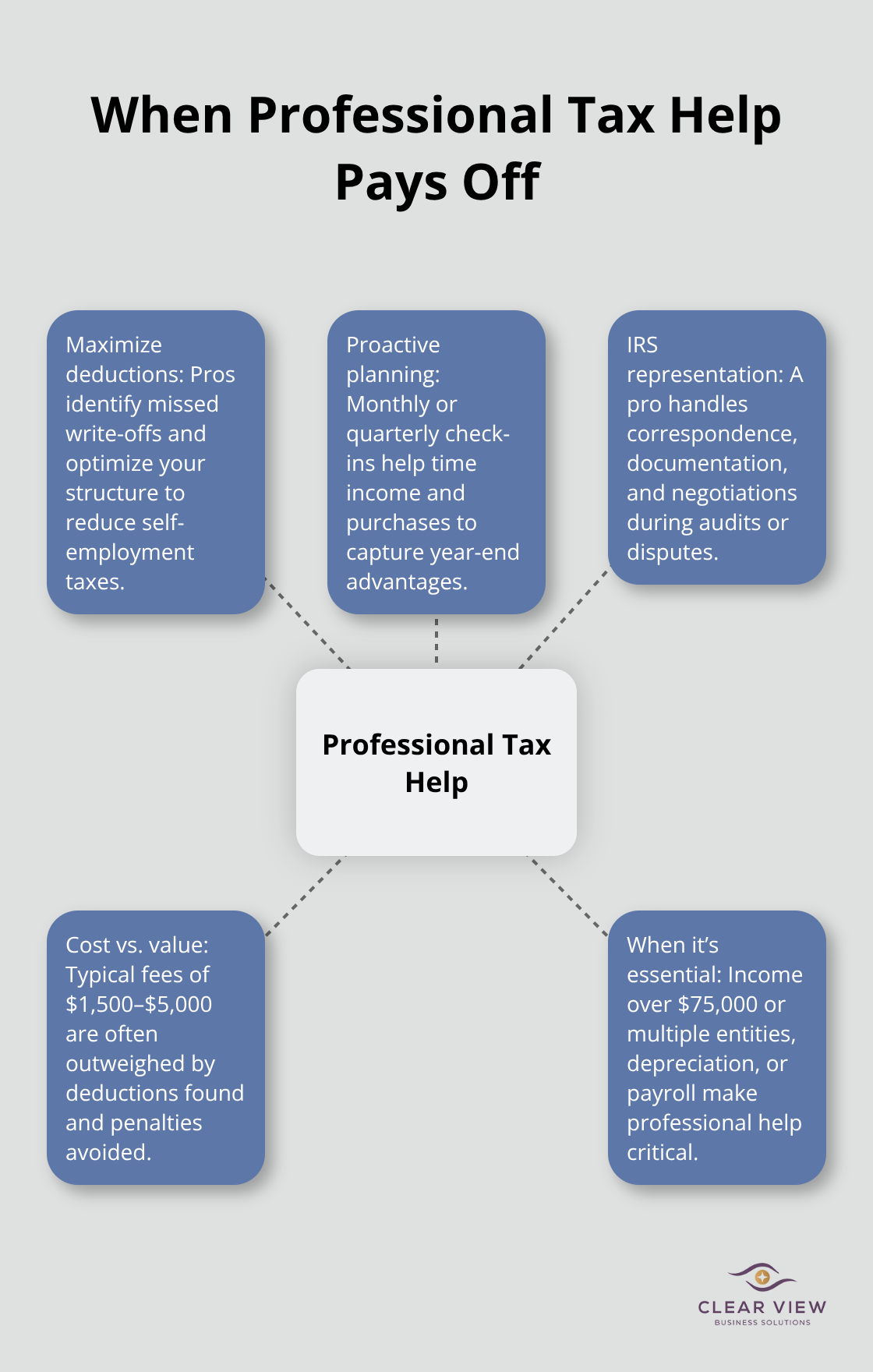
Year-round tax planning with an accountant transforms how you operate throughout the year. Monthly or quarterly check-ins let you adjust income timing, plan equipment purchases before tax-advantaged deadlines, and catch potential issues before they become expensive problems. Many owners meet with accountants only in March or April, then wonder why their tax bill exceeded expectations. This approach leaves money on the table that strategic planning would have captured.
IRS representation matters most when the agency contacts you about an audit or tax dispute. A tax professional handles all communication, submits required documentation, and negotiates on your behalf-a service that protects both your time and your business reputation. Without representation, you navigate IRS procedures alone, risk saying something that complicates your position, and miss opportunities to resolve issues favorably. Clear View Business Solutions provides IRS representation as part of comprehensive tax services for Tucson small business owners, handling everything from routine correspondence to audit defense.
Small business tax tips only matter when you implement them throughout the year. Tracking your square footage, maintaining a mileage log, and timing equipment purchases before December 31 transforms these strategies from theory into real tax savings. The owners who reduce their tax burden most aggressively treat tax planning as an ongoing operation, not a once-yearly scramble in March or April.
Start by auditing your current deductions and identifying what you missed in the past year. Set up a simple system now: a dedicated business checking account, a mileage tracking app on your phone, and a folder for receipts. These three habits eliminate most of the friction that causes owners to leave thousands of dollars on the table.
Schedule a conversation with a tax professional before year-end, not after. A CPA or enrolled agent can review your business structure, project your income, and recommend timing strategies that fit your specific situation. We at Clear View Business Solutions work with Tucson small business owners to handle tax planning and IRS representation year-round, identifying savings opportunities throughout the year so you keep more of what you earn-contact us today to learn how personalized tax planning can transform your bottom line.
At Clear View Business Solutions, we know you want your business to prosper without having to worry about whether you are paying more in taxes than you should or whether your business is set up correctly. The problem is it's hard to find a trusted advisor who can translate financial jargon to layman's terms and who can actually help you plan for better results.
We believe it doesn't have to be this way! No business owner should settle for working with a CPA firm that falls short of understanding what you want to achieve and how to help you get there.
Northwest Location:
7530 N. La Cholla Blvd., Tucson, AZ 85741
Central Location:
2933 N Campbell Avenue, Tucson, AZ 85719
© 2026 Clear View Business Solutions. All Rights Reserved.
At Clear View Business Solutions, we know you want your business to prosper without having to worry about whether you are paying more in taxes than you should or whether your business is set up correctly. The problem is it's hard to find a trusted advisor who can translate financial jargon to layman's terms and who can actually help you plan for better results.
We believe it doesn't have to be this way! No business owner should settle for working with a CPA firm that falls short of understanding what you want to achieve and how to help you get there. With over 20 years of experience serving hundreds of business owners like you, our team of experts combines financial expertise and proactive communication with our drive to help each client achieve results and have fun along the way.
Here's how we do it:
Discover: We start with a consultation to understand your specific goals, what's holding you back, and what success looks like for you.
Strategize & Optimize: Together, we design a customized strategy that empowers you to progress toward your goals, and we optimize our communication as partners.
Thrive: You enjoy a clear view of your business and your financial prosperity.
Schedule a consultation today, and take the first step toward being able to focus on your core business again without wondering if your numbers are right- or what they mean to your business.
In the meantime, download, "The Business Owner's Essential Guide to Tax Deductions" and make sure you aren't leaving money on the table.