


Starting a business in Tucson means juggling countless financial decisions before you’ve built a track record. Most early-stage founders struggle with cash flow, tax rules, and budgeting without historical data to guide them.
At Clear View Business Solutions, we’ve seen firsthand how the right financial systems and planning separate thriving startups from those that stumble. This guide walks you through the core strategies for startup financial management in Tucson and beyond.
Cash flow problems destroy profitable businesses faster than bad products. The U.S. Small Business Administration identifies inadequate financial records and poor cash management as top reasons small businesses close, and Tucson startups face this reality head-on. You need weekly or monthly cash flow tracking, not year-end scrambling. A rolling 13-week cash flow forecast lets you spot gaps before they become crises, giving you time to arrange credit lines or adjust spending.
Seasonal swings hit hard in Tucson-summer surges and November slowdowns catch founders off guard without planning. You cannot afford to ignore these patterns.
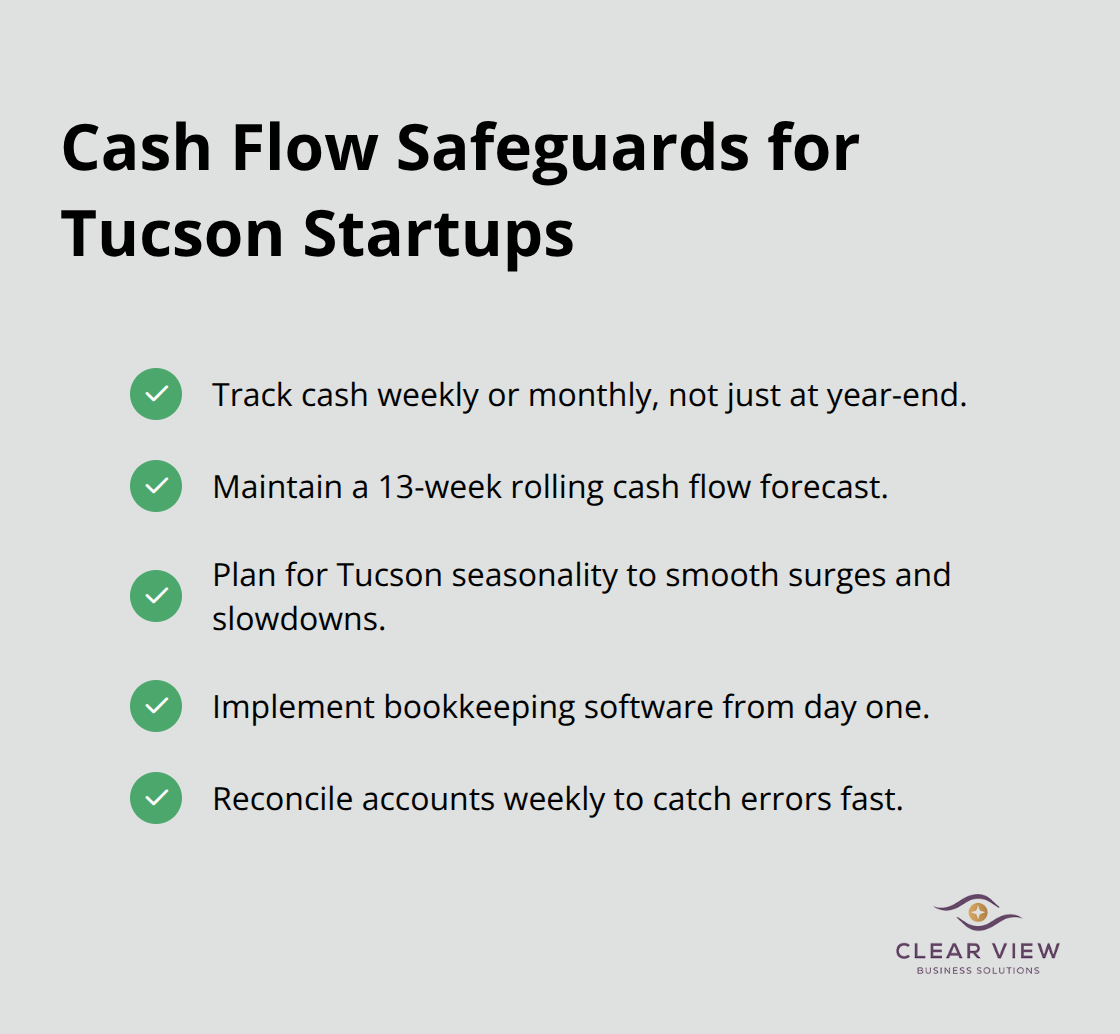
Set up bookkeeping software immediately, not later. Weekly reconciliations catch missing invoices or duplicate payments within days, eliminating surprises that tank your cash position.
Tax complexity hits startups hard. Arizona allows flexible entity formation under ARS 29-3101 with strong liability protection, but choosing between S-Corp and LLC structures before year-end matters enormously for your tax bill. A business owner earning $120,000 annually can reduce tax liability by roughly $8,000 to $12,000 through timing decisions and structure optimization alone.
Revenue recognition timing and strategic expense acceleration or deferral within the year compound these savings. Without tax planning, you leave thousands on the table while scrambling at tax time. Year-round tax planning beats reactive decisions every time.
Budgeting without historical data feels impossible, but it is not. Segment your projected sales by channel or service line to identify what actually makes money. Many startups throw resources at low-margin work simply because they have not tracked profitability by segment. Real-time visibility into profitability by service line helps you price correctly and allocate resources to high-margin opportunities instead of guessing.
Tucson’s micro-business concentration means about 80% of local startups employ ten or fewer people, making lean cash management non-negotiable. You cannot afford sloppy financial controls or reactive tax decisions. The trio of clean records, year-round tax planning, and cash forecasting creates control over your business rather than leaving you reactive to problems. These three elements form the foundation for the financial systems you need to build next.
QuickBooks stands as the industry standard for early-stage businesses in Tucson, offering real-time visibility into cash position and profitability without the complexity of enterprise systems. You need current records immediately, not six months in, because scrambling at tax time costs time and money you do not have.
Set up QuickBooks within your first month of operation and train yourself or a bookkeeper on data entry standards. Weekly reconciliations take one to two hours but catch missing invoices or duplicate payments within days, preventing the cash surprises that derail growth plans.
Accrual-based accounting works best for businesses with inventory or credit sales, since it reflects true profitability rather than just cash movement. Many Tucson startups mistakenly use cash-basis accounting, which masks profitability problems until they hit a wall. Accrual accounting shows you the real picture: a customer who owes you $10,000 counts as revenue even if payment arrives later, and your vendor invoice counts as an expense when you receive it, not when you pay. This matters enormously when you forecast cash flow and tax liability.
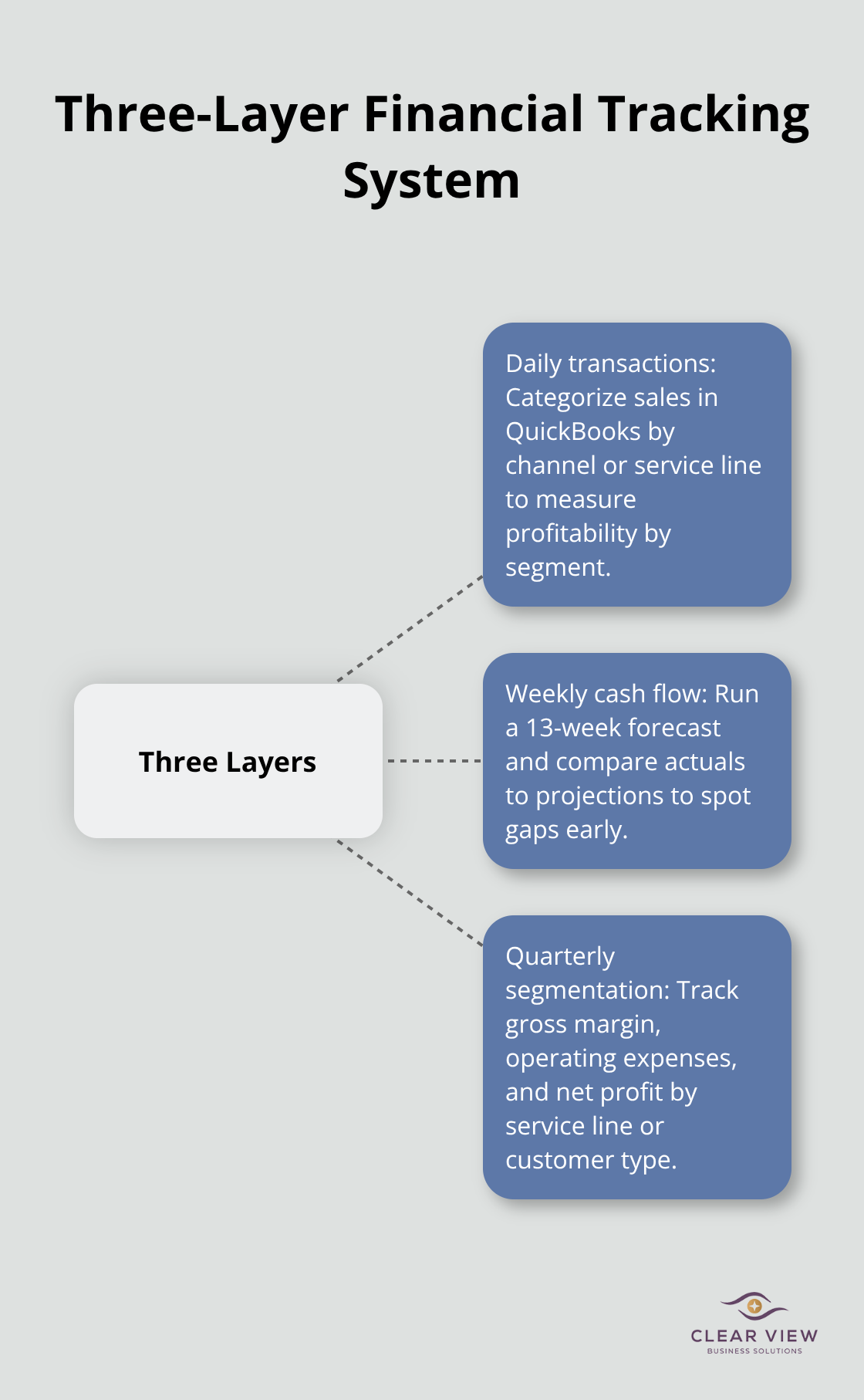
Layer one tracks daily transactions in QuickBooks by category-separate sales by channel or service line so you can measure profitability by segment, not just total revenue. Layer two runs a 13-week cash flow forecast every Friday, comparing actual cash inflows and outflows against projections to spot gaps before they become emergencies. Layer three segments your books quarterly to measure gross margin, operating expenses, and net profit by service line or customer type.
A Tucson contractor who tracked revenue by project type discovered that one service line generated 60% of revenue but only 20% of profit, forcing a repricing decision that increased overall profitability by 18% within six months. Without segmented tracking, that contractor would have continued throwing resources at low-margin work. The goal is not perfection-it is actionable data. Clean books give you control over pricing, hiring, and capital decisions instead of leaving you guessing.
Full-cycle bookkeeping with QuickBooks training and ongoing support ensures your financial records stay clean while you focus on operations. Clear View Business Solutions provides this support for Tucson startups, ensuring compliance and maximizing tax benefits through personalized service. With accurate financial data in place, you now have the foundation to plan strategically for growth-which means projecting realistic revenue, controlling operating expenses, and positioning yourself to capture every tax deduction available to you.
Realistic financial projections separate founders who secure funding from those who pitch vaporware. Most Tucson startups build projections based on optimistic assumptions rather than market data, which kills credibility with investors and lenders. Start by researching your actual addressable market, not theoretical demand. If you launch a service business targeting Tucson’s 80% micro-business concentration, calculate how many of those businesses actually need your service and what percentage you can realistically capture in year one. Conservative projections that prove accurate earn trust faster than optimistic ones that miss.
Build three scenarios: conservative, realistic, and optimistic. Your realistic scenario should assume you hit 60% to 70% of your first-year revenue target. The conservative scenario cuts that to 40%. This range gives investors confidence you understand your market and have thought through downside risk.
Next, separate your revenue projections against fixed costs and variable costs. Fixed costs like rent or salaries stay constant regardless of sales volume, while variable costs like materials or contractor fees scale with revenue. A Mesa landscaper projecting $200,000 in first-year revenue discovered that his fixed costs consumed 45% of revenue, meaning he needed to hit $180,000 just to break even. Without this breakdown, he would have hired too early and burned cash.
Track your gross margin, operating expenses, and net profit separately in your projections. Gross margin shows what percentage of revenue remains after direct costs of goods sold. Operating expenses include everything else.
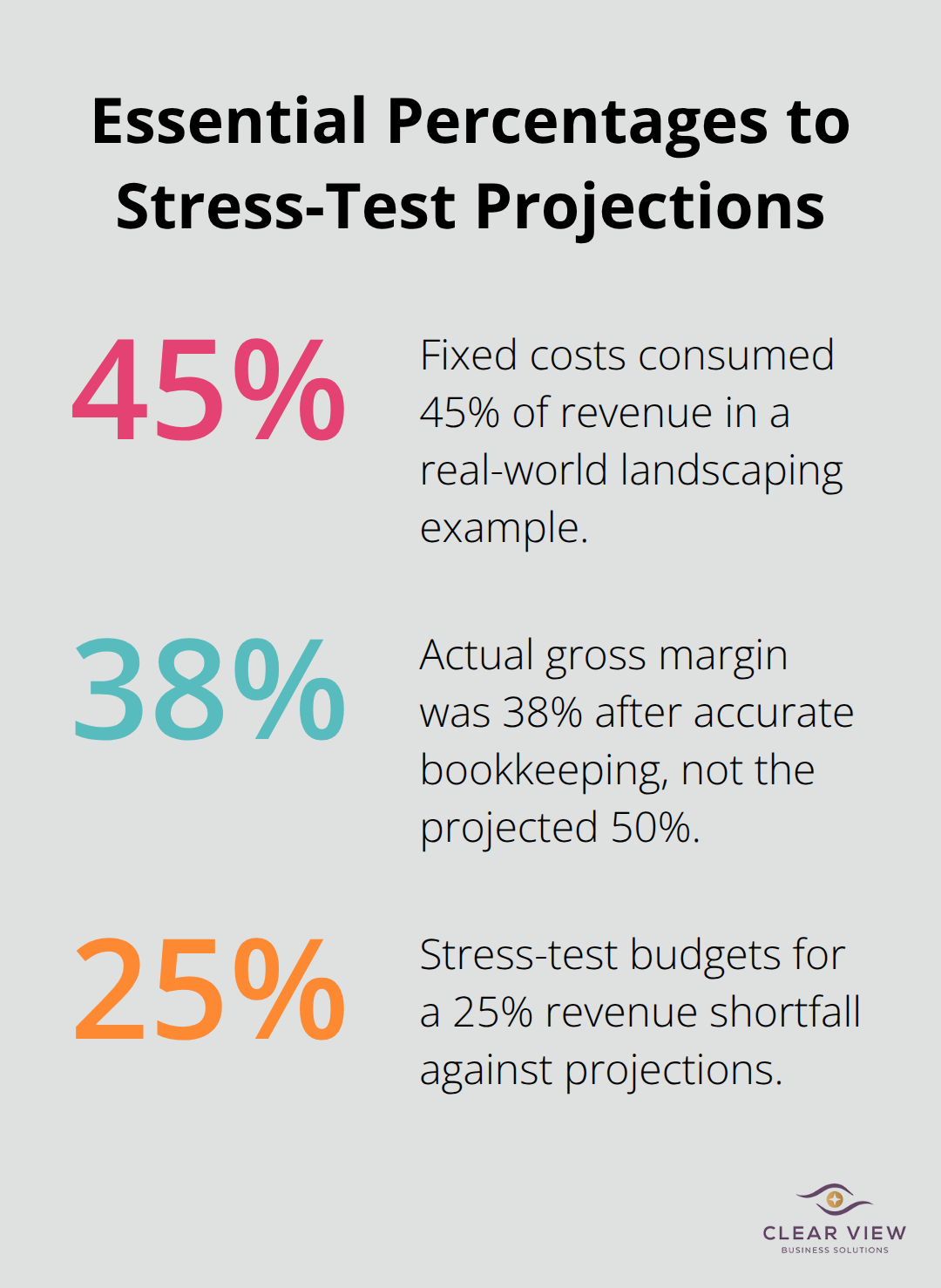
A Tucson contractor initially projected 50% gross margin but discovered through actual bookkeeping that his true margin was 38%, forcing him to either raise prices or cut overhead. Your projections need this level of specificity to guide real decisions about hiring, pricing, and spending.
Operating expenses compound fast, so create a detailed monthly expense budget for your first 24 months, not a vague annual estimate. Include payroll, rent, software subscriptions, insurance, utilities, and professional services. Most founders forget to budget for accounting and tax preparation, which costs $2,500 to $5,000 annually for a startup with clean books. Many also underestimate software and tool costs, which easily reach $500 to $1,500 monthly for a modern tech-enabled business.
Once you build your expense budget, stress-test it. Ask yourself what happens if revenue falls 25% below projections. Can you cut expenses fast enough to survive, or do you have fixed commitments that will drain cash? Seasonal businesses face particular pressure here. If you operate in Tucson and experience summer surges and November slowdowns, your cash position swings wildly, requiring either a credit line or aggressive expense management during low-revenue months. According to CB Insights, the top reason for startup failure is running out of cash, often due to poor cash flow management and inadequate budgeting.
Your tax obligations deserve equal attention in financial planning. Decide your entity structure immediately because S-Corps, LLCs, and C-Corps carry different tax treatments. A $120,000 income generates vastly different tax liabilities depending on your structure and timing decisions. The Financial Accounting Standards Board recommends accrual-based accounting for businesses with inventory or credit sales, which means you owe taxes on revenue you have not yet collected.
Plan for quarterly estimated tax payments rather than scrambling at year-end. Many Tucson startups owe $3,000 to $8,000 in surprise tax bills because they did not set aside money throughout the year. Set aside 25% to 35% of net profit monthly into a separate tax reserve account. This removes the shock of a large tax bill and gives you flexibility to accelerate or defer expenses strategically within the year to improve tax outcomes. Work with a tax professional early to map out these decisions before you incur expenses, because tax planning after the fact costs far more than proactive planning.
Startup financial management in Tucson succeeds when you build three core systems from day one: clean bookkeeping, year-round tax planning, and cash flow forecasting. These three elements separate founders who control their business from those who react to crises. You now understand why cash flow kills profitable businesses, how tax structure decisions save thousands, and why segmented profitability tracking guides smarter resource allocation.
Professional guidance accelerates this process dramatically. A tax advisor helps you optimize your entity structure and plan revenue recognition timing before year-end scrambling costs you money. A bookkeeper trained in QuickBooks eliminates data entry errors and gives you weekly visibility into cash position and profitability. We at Clear View Business Solutions provide exactly this support for Tucson startups through full-cycle bookkeeping with QuickBooks training, personalized tax planning, and IRS representation.
Set up QuickBooks this week, segment your first revenue projections by service line or channel, and schedule a conversation with a tax professional to lock in your entity structure before year-end. If you operate in Tucson and want personalized guidance tailored to your startup, Clear View Business Solutions specializes in helping early-stage founders build financial stability and capture every tax benefit available. The founders who act now on these fundamentals are the ones who secure funding, scale confidently, and build lasting businesses.
At Clear View Business Solutions, we know you want your business to prosper without having to worry about whether you are paying more in taxes than you should or whether your business is set up correctly. The problem is it's hard to find a trusted advisor who can translate financial jargon to layman's terms and who can actually help you plan for better results.
We believe it doesn't have to be this way! No business owner should settle for working with a CPA firm that falls short of understanding what you want to achieve and how to help you get there.
Northwest Location:
7530 N. La Cholla Blvd., Tucson, AZ 85741
Central Location:
2933 N Campbell Avenue, Tucson, AZ 85719
© 2026 Clear View Business Solutions. All Rights Reserved.
At Clear View Business Solutions, we know you want your business to prosper without having to worry about whether you are paying more in taxes than you should or whether your business is set up correctly. The problem is it's hard to find a trusted advisor who can translate financial jargon to layman's terms and who can actually help you plan for better results.
We believe it doesn't have to be this way! No business owner should settle for working with a CPA firm that falls short of understanding what you want to achieve and how to help you get there. With over 20 years of experience serving hundreds of business owners like you, our team of experts combines financial expertise and proactive communication with our drive to help each client achieve results and have fun along the way.
Here's how we do it:
Discover: We start with a consultation to understand your specific goals, what's holding you back, and what success looks like for you.
Strategize & Optimize: Together, we design a customized strategy that empowers you to progress toward your goals, and we optimize our communication as partners.
Thrive: You enjoy a clear view of your business and your financial prosperity.
Schedule a consultation today, and take the first step toward being able to focus on your core business again without wondering if your numbers are right- or what they mean to your business.
In the meantime, download, "The Business Owner's Essential Guide to Tax Deductions" and make sure you aren't leaving money on the table.