


Estate taxes can take a significant bite out of your wealth if you’re not prepared. The federal government taxes estates over $13.61 million in 2024, and many states add their own levies on top of that.
At Clear View Business Solutions, we’ve seen firsthand how proper estate tax planning protects families from unnecessary tax burdens. This guide walks you through the strategies, mistakes to avoid, and actionable steps to align your estate plan with your broader financial goals.
The federal estate tax exemption sits at $15 million per person in 2026 or $30 million for a married couple. This sounds generous until you realize that rising property values since 2019 have pushed many estates past state thresholds without owners knowing it. If you own real estate, a business, investment accounts, and retirement savings, your total estate value climbs faster than you think.
The real problem isn’t the federal tax-it’s state-level estate taxes that catch people off guard. States like Oregon, Massachusetts, and Washington impose estate taxes with exemptions as low as $1 million, meaning your estate could owe state taxes even if you’re nowhere near the federal threshold. Your state of residence matters enormously. If you live in a state with an estate tax, you need a strategy years before death, not weeks before.
The federal exemption also sunsets in 2026, meaning it’s scheduled to drop back to roughly $7 million per person unless Congress acts. This creates urgency for high-net-worth individuals to act now while the exemption is elevated. Calculate your total estate value now, including home equity, to see where you actually stand. Many people underestimate their net worth and miss critical planning windows.

Your estate includes far more than your investment accounts. It includes your home at fair market value, retirement accounts like 401(k)s and IRAs, life insurance death benefits, business interests, vehicles, art, and any assets titled in your name alone. The IRS values assets at their fair market value on the date of death, not what you paid for them.
This matters because a home purchased for $400,000 in 2015 might be worth $650,000 today. That $250,000 increase counts toward your estate tax threshold. Life insurance death benefits also count toward your estate, which surprises many people who think life insurance is tax-free. It is income-tax-free to beneficiaries, but it’s included in your taxable estate.
Jointly owned property with right of survivorship counts at full value in the estate of the first spouse to die, then potentially again when the second spouse dies. You need professional help to value a business accurately because the IRS won’t accept a guess. Business valuation requires a formal appraisal, and getting this wrong creates tax exposure or missed deductions.
Start now by listing every asset you own and its approximate current value. This simple exercise often reveals that your estate is larger than you thought. Once you understand what counts and how much you actually have, you’re ready to explore the strategies that reduce what your heirs owe in taxes.
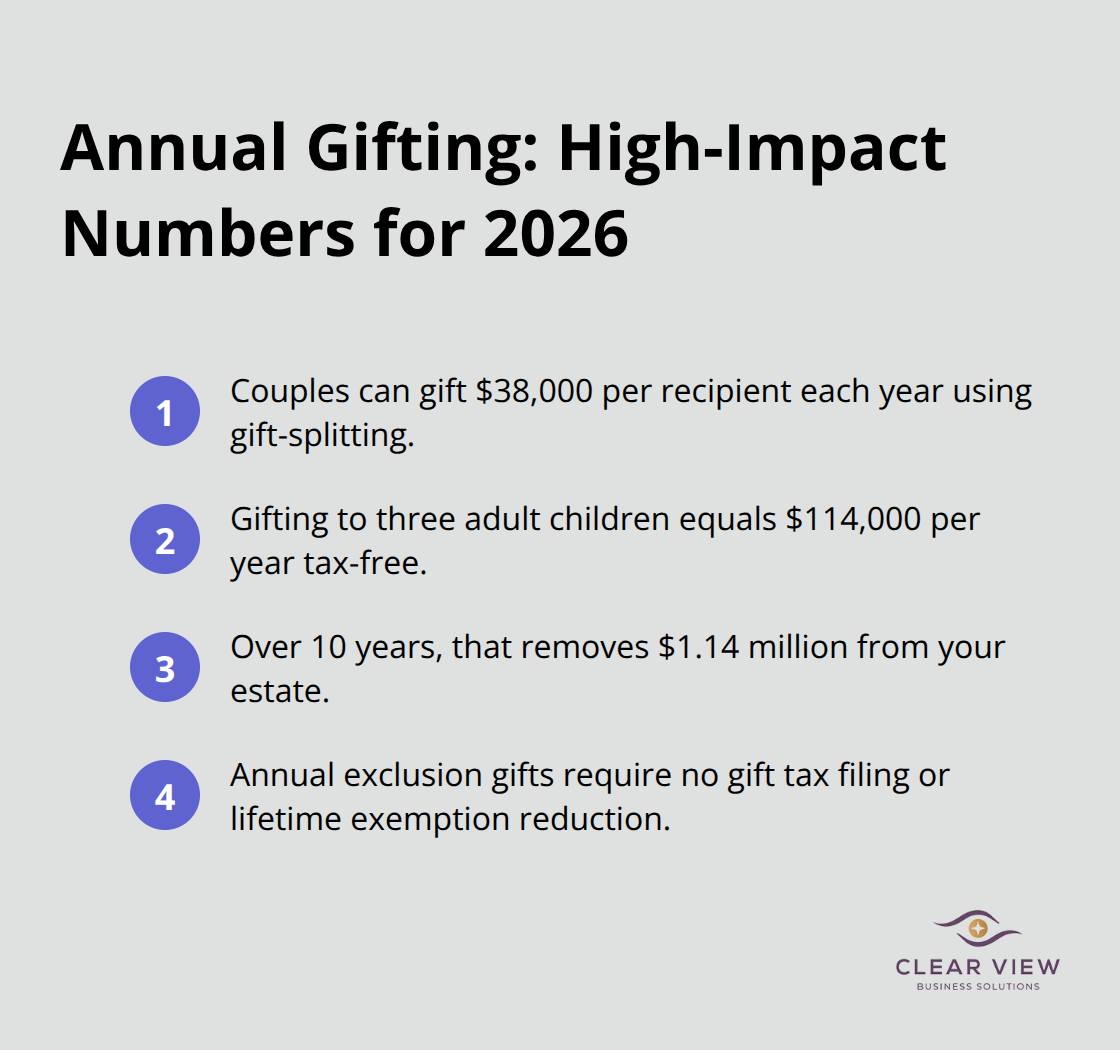
The annual gift tax exclusion of $19,000 per recipient in 2026 gives you a powerful tool to shrink your taxable estate starting right now. Married couples can gift up to $38,000 per recipient each year using gift-splitting, and these gifts trigger no gift tax filing or reduction to your lifetime exemption. The math works in your favor: if you have three adult children, a married couple can gift $114,000 annually tax-free. Over ten years, that totals $1.14 million removed from your estate before federal taxes apply.
This strategy works best when you have consistent income and assets you don’t need for your own retirement. Many high-net-worth individuals hesitate to gift because they fear running short later, but professional cash flow modeling removes that guesswork. Start with a realistic picture of your retirement spending needs, then gift the surplus. Your heirs benefit from tax-free transfers, and you watch your wealth transfer happen while you’re alive to see the impact.
A 529 education savings plan lets you front-load five years of annual exclusions into a single account-you can contribute $95,000 per donor per beneficiary without gift tax. The funds and all growth inside the account stay excluded from your estate entirely. This matters enormously if you have grandchildren or want to fund a child’s education while reducing estate taxes.
The SECURE 2.0 Act added a new feature: after the 529 account has been open for at least fifteen years, you can roll up to $35,000 of accumulated 529 assets into a Roth IRA for the same beneficiary, subject to annual Roth contribution limits. This creates a dual tax benefit-education costs funded outside your taxable estate, and remaining balances converted into tax-free retirement accounts. If your state offers a state income tax deduction for 529 contributions, you also cut your current year tax bill while building education wealth.
Donating appreciated securities instead of cash eliminates capital gains taxes and increases the after-tax value for both you and the charity. If you own stock worth $50,000 with a cost basis of $10,000, giving the stock directly avoids the $8,000 capital gains tax you’d owe if you sold it first. You receive a charitable deduction for the full fair market value, and the charity receives the stock tax-free.
Donor-advised funds work similarly: you make a tax-deductible contribution, receive an immediate deduction, then recommend grants to charities over time. This strategy lets you bunch charitable deductions in years of high income to exceed the standard deduction threshold, lowering your taxable income significantly. Assets left to qualified charities at death reduce your gross estate dollar-for-dollar, which directly lowers estate tax exposure.
Charitable giving isn’t just about philanthropy-it’s a core tax and estate planning tool that aligns your values with your tax strategy. The strategies above work best when coordinated with your investment allocation, retirement withdrawals, and lifetime gifting plan. Your CPA, financial advisor, and estate attorney need to work together to ensure that each charitable gift, 529 contribution, and annual exclusion gift fits into your broader financial picture. Without this coordination, you might miss tax deductions, trigger unintended consequences, or fail to reach your estate planning goals. The next section covers the mistakes that derail even well-intentioned plans and how to avoid them.
Estate plans fail not because the strategies are flawed, but because people treat them as one-time documents instead of living plans that need regular maintenance. Life changes constantly: you marry, divorce, have children, acquire property, sell a business, or move to a different state. Each event can render your carefully built plan obsolete. A client updates their will in 2015 after their second marriage, but never adjusts beneficiary designations on their 401(k) or IRA. When they pass away, their ex-spouse from the first marriage receives $400,000 in retirement accounts because the old beneficiary designation controls the transfer, not the will. The new spouse and children get nothing from those accounts. This happens because beneficiary designations supersede wills entirely. If you’ve had any major life event in the past five years, your beneficiaries are likely wrong. Check them now, not when it’s too late.
Beneficiary designations on 401(k)s, IRAs, and life insurance policies control who receives those assets at your death. Your will has no power over them. A divorce, remarriage, or birth of a child can make your old designations catastrophic. Many people forget they named a former spouse as beneficiary on a life insurance policy taken out years ago. That policy pays directly to the ex-spouse, bypassing your current family entirely. The solution is simple: review every beneficiary designation on every account any time something significant changes in your life, and immediately after any major life event. Update them in writing with the financial institution holding the account. Don’t assume your will handles this-it doesn’t.
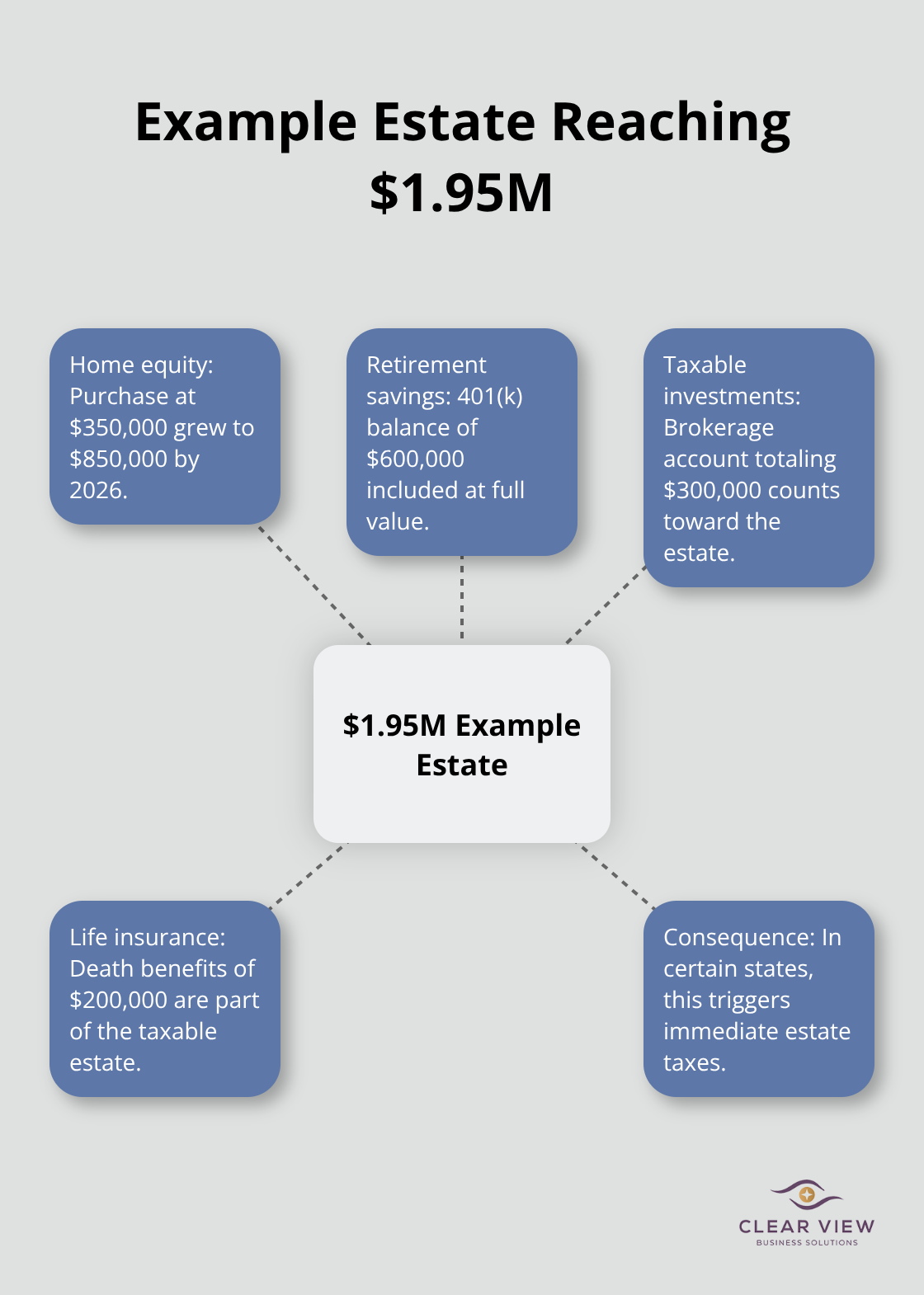
Many people think they’re nowhere near the federal exemption threshold and skip planning entirely, then discover too late that rising home values and accumulated retirement savings pushed them over state tax limits. A homeowner who bought their house for $350,000 in 2010 might watch it appreciate to $850,000 by 2026 without consciously building wealth. Add a $600,000 401(k), a $300,000 investment account, and $200,000 in life insurance death benefits, and suddenly a modest-seeming estate totals $1.95 million. In Oregon, Massachusetts, or Washington, that estate pays state estate taxes immediately. You cannot fix this problem after death.
The federal exemption also sunsets in 2026, meaning it drops back to roughly $7 million per person unless Congress acts. This creates urgency for high-net-worth individuals to act now while the exemption remains elevated.
Your CPA files taxes separately from your financial advisor, who operates independently from your estate attorney. Nobody connects the dots. A Roth conversion that makes sense for reducing Medicare premiums might trigger unintended estate tax consequences. A large charitable gift might waste deductions if your income drops that year. Annual gifting might interfere with Medicaid planning for long-term care. These strategies work brilliantly when coordinated and fail when isolated. The solution requires your CPA, financial advisor, and attorney working from the same playbook, reviewing your situation annually, and adjusting as tax laws and your circumstances change.
Estate tax planning works only when your CPA, financial advisor, and attorney operate as a coordinated team. Fragmented advice from separate professionals creates gaps, missed deductions, and unintended tax consequences that erode your estate’s value. Your tax strategy must align with your investment decisions, retirement withdrawals, and lifetime gifting plan.
The mistakes outlined earlier-outdated beneficiary designations, underestimated estate values, and uncoordinated planning-are entirely preventable. Start now to calculate your actual estate value today, including home equity and all retirement accounts. Review every beneficiary designation on every account, then bring your advisors together to build a plan that reduces taxes across your lifetime and at death.
Acting now matters more than waiting, since the federal exemption sunsets in 2026, state taxes already affect estates far smaller than the federal threshold, and property values continue climbing. We at Clear View Business Solutions help individuals and small business owners align their tax strategy with their broader financial goals through coordinated estate tax planning that protects your wealth for the next generation.



At Clear View Business Solutions, we know you want your business to prosper without having to worry about whether you are paying more in taxes than you should or whether your business is set up correctly. The problem is it's hard to find a trusted advisor who can translate financial jargon to layman's terms and who can actually help you plan for better results.
We believe it doesn't have to be this way! No business owner should settle for working with a CPA firm that falls short of understanding what you want to achieve and how to help you get there.
Northwest Location:
7530 N. La Cholla Blvd., Tucson, AZ 85741
Central Location:
2933 N Campbell Avenue, Tucson, AZ 85719
© 2026 Clear View Business Solutions. All Rights Reserved.
At Clear View Business Solutions, we know you want your business to prosper without having to worry about whether you are paying more in taxes than you should or whether your business is set up correctly. The problem is it's hard to find a trusted advisor who can translate financial jargon to layman's terms and who can actually help you plan for better results.
We believe it doesn't have to be this way! No business owner should settle for working with a CPA firm that falls short of understanding what you want to achieve and how to help you get there. With over 20 years of experience serving hundreds of business owners like you, our team of experts combines financial expertise and proactive communication with our drive to help each client achieve results and have fun along the way.
Here's how we do it:
Discover: We start with a consultation to understand your specific goals, what's holding you back, and what success looks like for you.
Strategize & Optimize: Together, we design a customized strategy that empowers you to progress toward your goals, and we optimize our communication as partners.
Thrive: You enjoy a clear view of your business and your financial prosperity.
Schedule a consultation today, and take the first step toward being able to focus on your core business again without wondering if your numbers are right- or what they mean to your business.
In the meantime, download, "The Business Owner's Essential Guide to Tax Deductions" and make sure you aren't leaving money on the table.