


Small businesses in Tucson are stuck with accounting systems that slow them down. Spreadsheets break, data gets lost, and scaling becomes a nightmare.
Cloud accounting changes that. We at Clear View Business Solutions have seen firsthand how the right platform transforms how Tucson firms manage their finances-cutting costs, improving accuracy, and letting teams work from anywhere.
Real-time financial visibility stops being optional once your business grows beyond a handful of transactions. The U.S. Small Business Administration reports that nearly half of all startups fail within the first five years, and cash flow issues are a primary factor. When your bookkeeper updates a spreadsheet once a week or once a month, you make decisions on stale data. Cloud accounting platforms sync with your bank accounts automatically, showing you exactly where your cash stands at any moment. Tucson firms using cloud systems track income and expenses as they happen, catch cash flow problems before they become crises, and adjust spending decisions with current information instead of guesses. A delayed payment from a client or an unexpected vendor invoice no longer catches you off guard because you see it in real time.
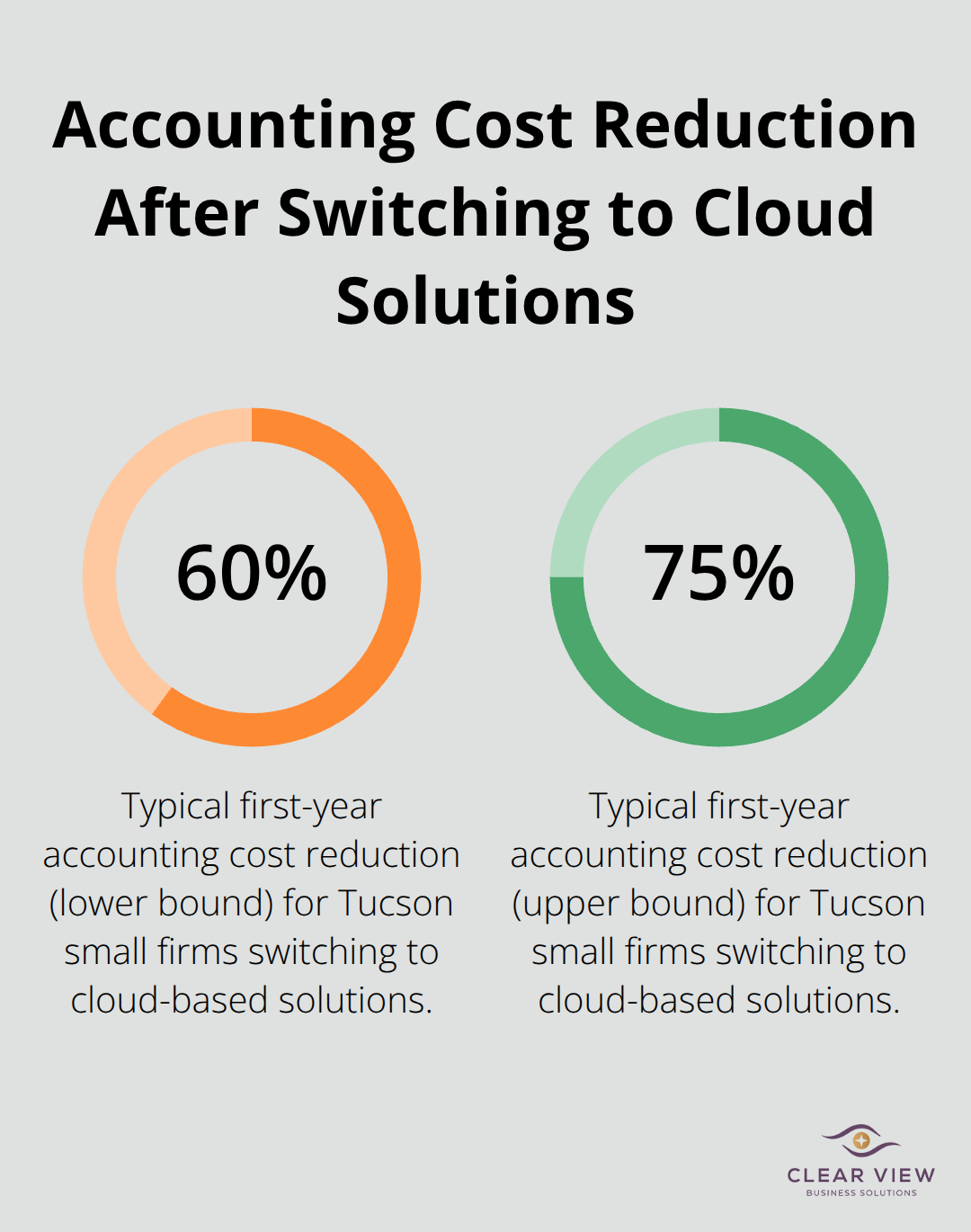
Hiring a full-time bookkeeper in Arizona costs between $45,000 and $65,000 annually, plus benefits, taxes, and desk space. Cloud accounting platforms range from $10 to $300 per month depending on features and user count. That difference amounts to thousands of dollars per year, and the math strengthens further when you factor in that traditional bookkeepers typically deliver financials weeks after month-end, while cloud systems close your books in hours. You also avoid the overhead of onboarding, training, and replacing staff when someone leaves. Tucson small firms that switch from in-house bookkeeping to cloud-based solutions typically see their accounting costs drop by 60% to 75% within the first year.
The money saved flows directly to hiring, marketing, or operational improvements that actually grow revenue.
Cloud accounting grows with you without forcing you to rebuild your entire financial system. Adding new users, processing more transactions, or tracking additional revenue streams happens within the platform you already know. If you start with Wave or FreshBooks handling basic invoicing and expenses, you can layer in QuickBooks Online or Xero as your firm expands into payroll, inventory, or multi-entity operations. You never face the painful choice of outgrowing your system and migrating everything to a new platform midyear. Tucson businesses scaling from 5 to 50 employees can keep the same accounting infrastructure that worked at startup stage, just with more integrations and reporting depth. This flexibility means your accounting system supports growth instead of becoming a bottleneck that forces difficult decisions about when to upgrade.
The right cloud accounting solution depends on your business stage, available time for finances, and the level of ongoing support you require. Service-based firms benefit from platforms like FreshBooks, which excel at invoicing, time tracking, and expense management. Businesses with inventory or multi-currency needs find Xero’s 800+ integrations and automatic currency conversion more valuable. QuickBooks Online serves firms that need robust payroll and tax integrations built into one system. Wave works well for startups with minimal transaction volume and tight budgets, offering free invoicing and expense tracking with optional paid upgrades. Each platform handles the core functions-bank reconciliation, expense categorization, and financial reporting-but the differences in user experience, integration depth, and pricing matter when you’re selecting a system you’ll use daily for years.
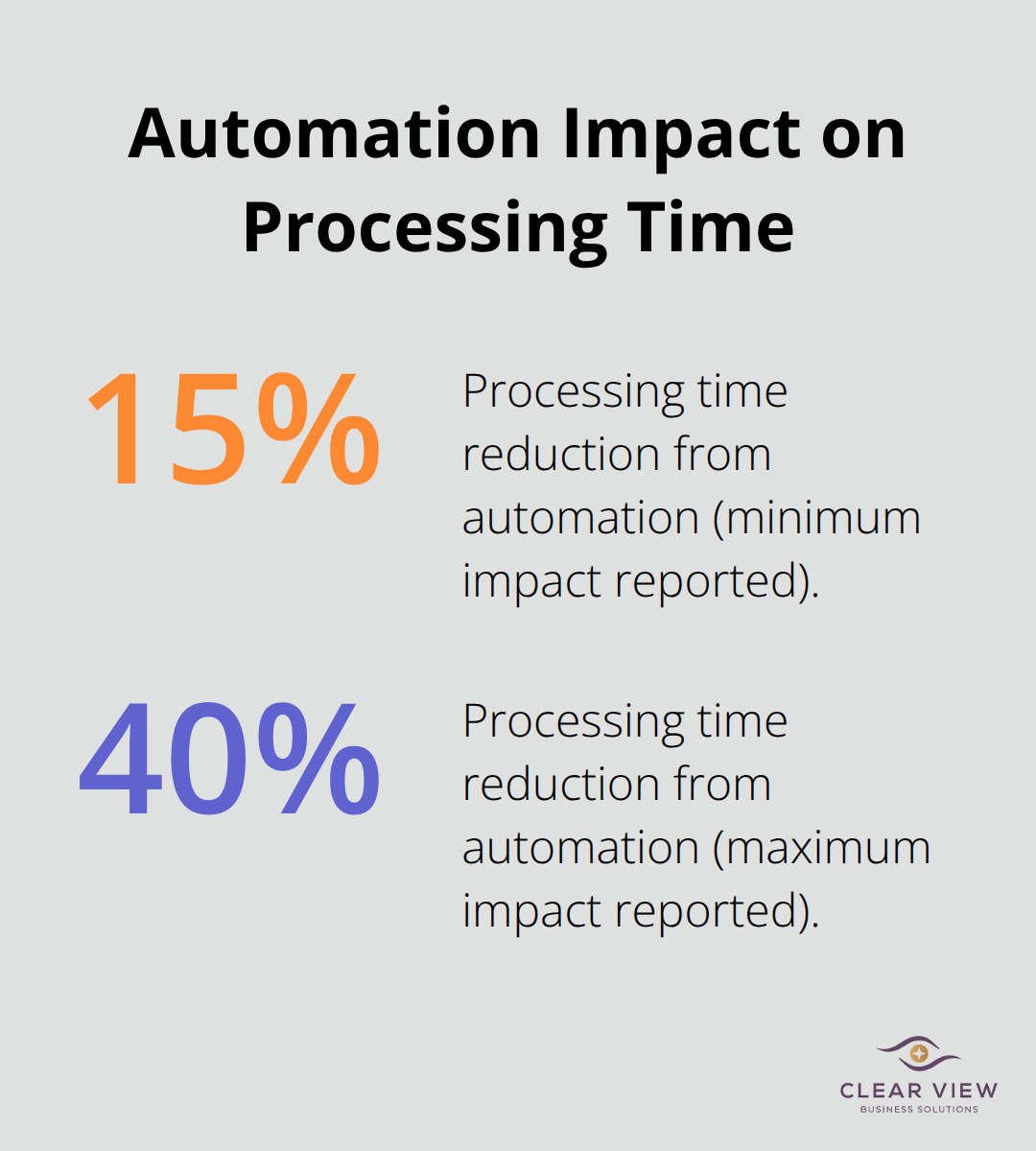
Cloud accounting platforms automate the work that traditionally consumed weeks of manual effort. When you connect your bank account to QuickBooks Online or Xero, transactions import and categorize themselves based on rules you set once. A vendor payment for office supplies automatically tags as an expense. A client invoice payment deposits and matches to your accounts receivable. This automation cuts processing time by 15 to 40 percent, and more importantly, it eliminates the backlog that forces you to wait until the 15th or 20th of the following month to understand your financial position.
Tucson firms using cloud platforms close their books within hours instead of days, meaning you and your accountant see accurate, reconciled financials by the 10th of the month rather than scrambling in January. The compliance piece matters just as much. Arizona’s transaction privilege tax system is more complex than standard sales tax, and cloud platforms built for Arizona businesses track these obligations automatically rather than leaving them to manual spreadsheets where errors multiply. Your tax filings become cleaner because the data feeding into them gets categorized correctly from day one, not adjusted and reclassified at year-end when your CPA discovers missing receipts or misclassified transactions.
Native bank integrations prevent the data silos that plague businesses relying on manual entry or disconnected tools. When FreshBooks syncs with Stripe, Shopify, or PayPal, your invoices, payments, and deposits flow into one system without manual reconciliation. Service firms in Tucson that invoice clients daily no longer waste time copying invoice numbers and amounts into accounting software. Time tracking converts to invoices with a single click. Expense receipts photograph and categorize themselves through mobile apps. This integration depth matters because it reduces the friction that causes small business owners to delay their bookkeeping entirely. The longer transactions sit unrecorded, the harder it becomes to maintain accuracy and the more likely you are to miss tax deductions or warning signs about cash flow problems. Real-time bank syncing also catches fraud or duplicate charges immediately rather than weeks later when you finally review statements.
Multi-user access means your bookkeeper, accountant, and finance team work on current data simultaneously instead of emailing spreadsheets and creating version-control nightmares. Role-based permissions let you control who sees payroll data, client information, or sensitive financial reports. When an employee leaves, you disable their access in seconds rather than spending days changing passwords and recovering documents from shared drives. This collaborative structure transforms how Tucson small firms handle their finances-your accountant no longer waits for you to compile year-end records, and your bookkeeper no longer works in isolation updating disconnected systems. Everyone operates from the same source of truth, which accelerates month-end close and reduces the back-and-forth emails that slow down financial reporting. The next step involves selecting a platform that matches your specific business structure and growth trajectory, which determines how smoothly your team adopts cloud accounting and whether the system scales with you as you add complexity.
Selecting a cloud accounting platform feels overwhelming because every vendor claims to be the best fit, but the decision narrows quickly once you map your actual business structure against platform capabilities. Start by listing the specific financial tasks you perform monthly: Do you invoice clients and need time tracking built in, or do you primarily receive payments on a fixed schedule? Do you manage inventory, or are you a service-based firm? Do you operate across state lines or internationally, requiring multi-currency support? Do you run payroll, or are you still solo? The answers eliminate at least half the options immediately.
FreshBooks excels for freelancers and service firms that invoice constantly and need mobile expense capture; it’s the wrong choice if you manage inventory or complex payroll. QuickBooks Online handles payroll integrations and multi-entity accounting better than FreshBooks but feels clunky for simple invoicing-only workflows. Xero shines for multi-currency operations and integrates with 800+ apps, making it ideal for growing firms with complex workflows; it’s overkill for a solo consultant with ten monthly invoices. Wave offers free invoicing and expense tracking, which works perfectly for pre-revenue startups or minimal-transaction businesses, but lacks the reporting depth and automation you need once you hit consistent monthly revenue.
The second step requires calculating your true annual cost, not just the advertised monthly price. A $20-per-month platform becomes expensive fast when you add payroll processing at $50 per month, tax software at $200 per year, and a second user at $15 per month. Map out the actual tools you’ll need for a full 12 months, including payment processing fees if you accept credit cards through the platform, and compare total cost of ownership across options rather than focusing on entry-level pricing. This approach reveals which platform actually fits your budget once you account for all the features you’ll use.
Security matters more than most Tucson business owners realize, but the basics are straightforward: verify that your platform uses 128-bit SSL/TLS encryption and AES-256 encryption for stored data, requires multi-factor authentication for all users, and maintains automated daily backups stored separately from the live system. Ask whether the vendor conducts third-party security audits and request their SOC 2 compliance certification, which confirms they’ve passed rigorous security testing.
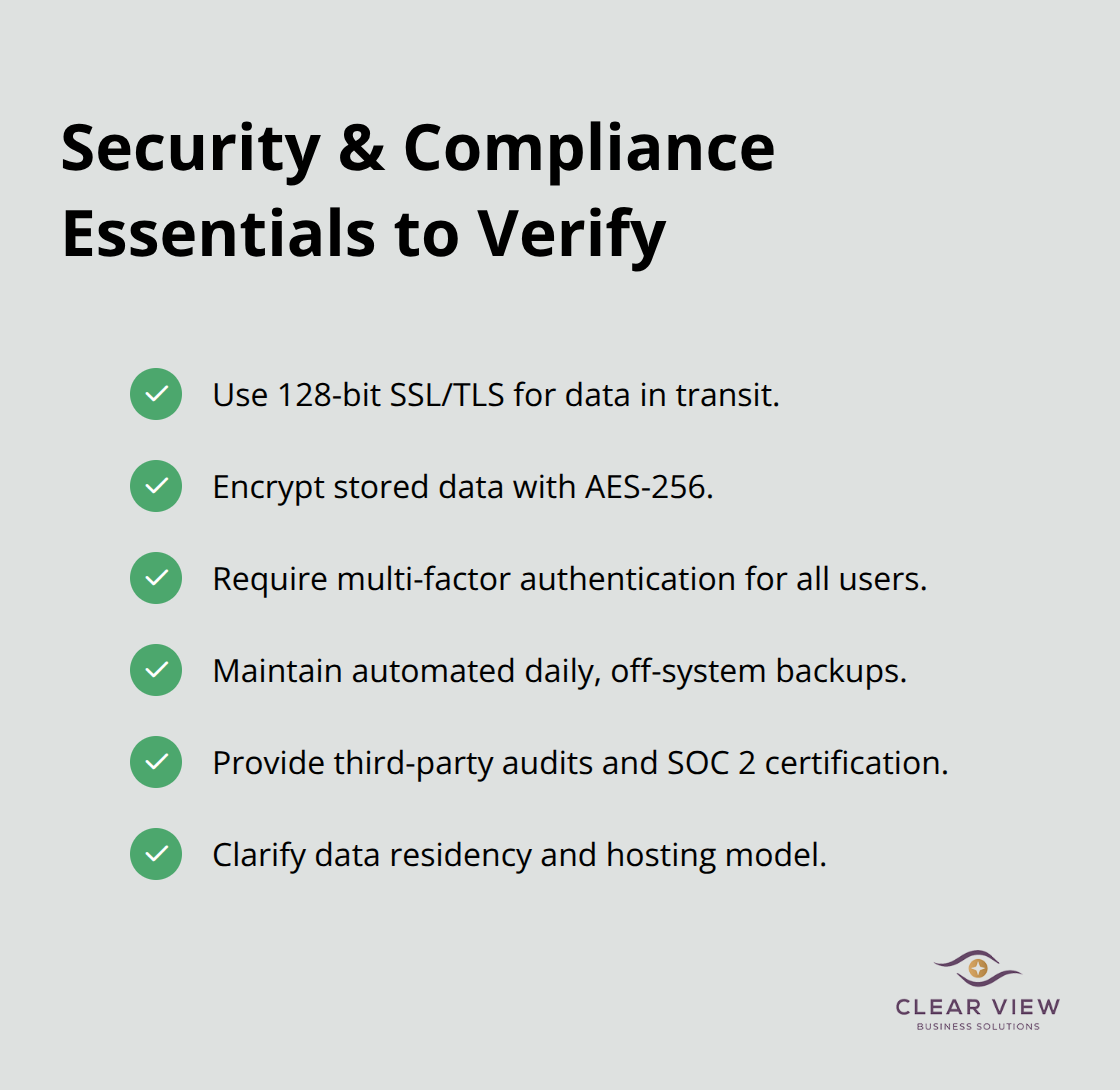
If you handle sensitive client data or operate in regulated industries, ask specifically about data residency and whether your information stays on shared servers or private infrastructure.
Many Tucson firms overlook support quality until they hit a problem mid-month and can’t reach anyone who knows their system. Test the vendor’s support before committing: call their support line, submit a chat question, and time how long you wait for a response. Free trials exist partly to let you experience their support responsiveness when you’re not yet a paying customer. Platforms that offer dedicated onboarding calls and training sessions for your team reduce adoption friction significantly compared to vendors who provide only email support and knowledge bases. Try scheduling a consultation with any platform vendor before signing a contract, specifically asking whether they train your team on setup and ongoing best practices. The difference between a platform that holds your hand through implementation and one that ships you documentation and leaves you to figure it out determines whether you adopt the system fully or abandon it halfway through month two.
Cloud accounting transforms how Tucson small businesses manage finances, but selecting the right platform requires more than picking the cheapest option. FreshBooks, QuickBooks Online, Xero, and Wave each solve real problems for different business structures, and the one that works best depends entirely on your invoicing patterns, growth stage, and support needs. Real-time visibility into cash flow, automated expense categorization, and collaborative access for your team compound over months and years, turning accounting from a monthly burden into actionable business intelligence.
Start your cloud accounting Tucson transition by auditing your current financial tools first. List what you actually do each month, calculate your true annual cost across all features you’ll need, and test the vendor’s support responsiveness before committing (most platforms offer free trials so you can experience their interface without risk). Schedule onboarding calls with your top two choices and ask directly how they train teams and handle implementation.
We at Clear View Business Solutions help Tucson small businesses navigate this transition smoothly. Our team provides QuickBooks training, full-cycle bookkeeping, and tax planning tailored to Arizona’s specific requirements, and we work with your chosen platform to eliminate the messy catch-up work that derails many implementations. Schedule a consultation with Clear View Business Solutions to discuss your specific situation and next steps.




At Clear View Business Solutions, we know you want your business to prosper without having to worry about whether you are paying more in taxes than you should or whether your business is set up correctly. The problem is it's hard to find a trusted advisor who can translate financial jargon to layman's terms and who can actually help you plan for better results.
We believe it doesn't have to be this way! No business owner should settle for working with a CPA firm that falls short of understanding what you want to achieve and how to help you get there.
Northwest Location:
7530 N. La Cholla Blvd., Tucson, AZ 85741
Central Location:
2933 N Campbell Avenue, Tucson, AZ 85719
© 2026 Clear View Business Solutions. All Rights Reserved.
At Clear View Business Solutions, we know you want your business to prosper without having to worry about whether you are paying more in taxes than you should or whether your business is set up correctly. The problem is it's hard to find a trusted advisor who can translate financial jargon to layman's terms and who can actually help you plan for better results.
We believe it doesn't have to be this way! No business owner should settle for working with a CPA firm that falls short of understanding what you want to achieve and how to help you get there. With over 20 years of experience serving hundreds of business owners like you, our team of experts combines financial expertise and proactive communication with our drive to help each client achieve results and have fun along the way.
Here's how we do it:
Discover: We start with a consultation to understand your specific goals, what's holding you back, and what success looks like for you.
Strategize & Optimize: Together, we design a customized strategy that empowers you to progress toward your goals, and we optimize our communication as partners.
Thrive: You enjoy a clear view of your business and your financial prosperity.
Schedule a consultation today, and take the first step toward being able to focus on your core business again without wondering if your numbers are right- or what they mean to your business.
In the meantime, download, "The Business Owner's Essential Guide to Tax Deductions" and make sure you aren't leaving money on the table.