


Small businesses leave thousands of dollars on the table every year by not claiming tax credits they qualify for. At Clear View Business Solutions, we’ve seen firsthand how tax credits for small business can transform a company’s bottom line.
The good news is that claiming these credits doesn’t have to be complicated. This guide walks you through the credits available, how to qualify, and strategies to maximize your savings.
The Research and Development Tax Credit stands out as the most valuable opportunity most small businesses overlook. You can claim this credit for wages paid to employees who work on qualifying research, plus costs for supplies and contract research related to developing new products, processes, or software. The IRS allows eligible small businesses to offset payroll taxes with this credit.
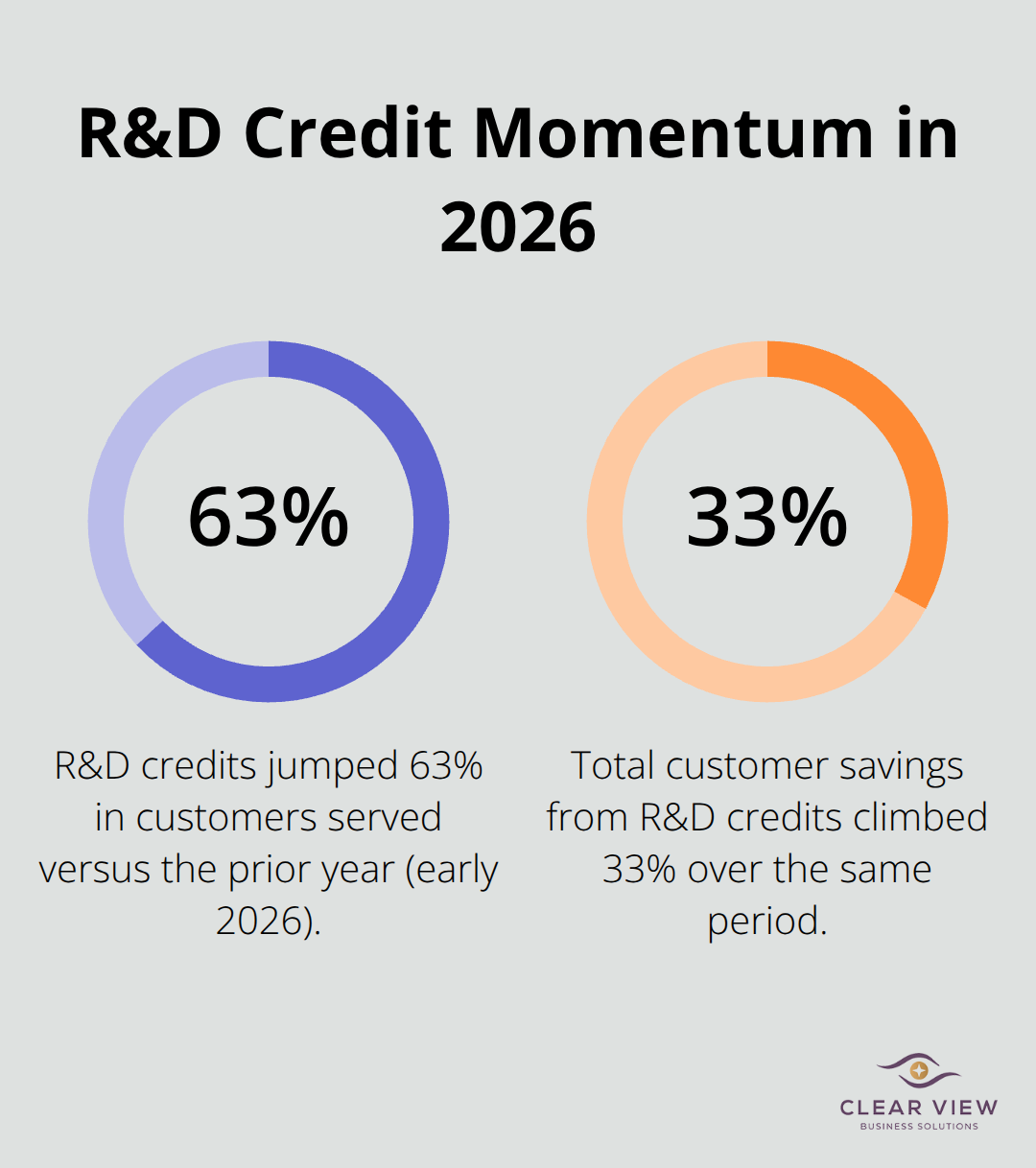
Gusto data from early 2026 shows R&D credits jumped 63% in customers served compared to the prior year, with total savings climbing 33%. What makes this credit powerful is that it applies beyond tech companies. A pool equipment manufacturer named Cabana Pools claimed a first-year R&D credit of $49,000 and watched it grow fivefold within a year as their engineering team scaled.
If your business pays developers, builds custom software, or iterates on product designs, you likely qualify but haven’t claimed it yet.
The U.S. Chamber of Commerce reports that fewer than 30% of eligible small businesses actually claim this credit, meaning thousands of dollars sit on the table annually. This gap exists because many owners assume their work doesn’t count as research or that the paperwork burden outweighs the benefit.
The Work Opportunity Tax Credit and Employee Retention Credit address different hiring scenarios but deliver concrete per-employee savings. WOTC provides up to $2,400 per qualified employee, rewarding you for hiring from specific populations like veterans, long-term unemployed workers, or people with disabilities.
The Employee Retention Credit, while facing processing backlogs at the IRS, still recovers substantial refunds for businesses that retained employees during qualifying periods. The IRS modernized Form 941-X and pushed electronic filing to reduce backlogs, so filing electronically now speeds up processing significantly.
Documentation makes or breaks both credits. You need payroll records, hiring documents, and clear evidence that employees meet the program requirements. Many small business owners assume they need expensive consultants to navigate these credits, but the real work involves gathering accurate payroll data and maintaining records that prove eligibility.
Start with a review of your hiring patterns over the past three years and cross-reference them against the target groups each credit covers. This exercise often reveals qualifying employees you overlooked, turning a simple audit into immediate tax savings. The next chapter covers the specific documentation you’ll need and how to organize it for maximum impact.
Gathering the right paperwork is where most small business owners stumble. The IRS doesn’t care about your good intentions-it wants proof that your employees or activities qualified for the credit. For the Research and Development Tax Credit, you need detailed records showing what work employees performed, how many hours they spent on qualifying projects, and what materials or contract research costs you incurred. This means payroll records tied directly to project timesheets, engineering logs, or development notes that connect compensation to research activities.
Cabana Pools succeeded partly because they maintained engineering documentation showing exactly when their team worked on proprietary software development, making their credit defensible. Without that connection, the IRS sees only payroll expenses with no qualifying activity attached. Create a separate folder for each credit type and store hiring documents alongside payroll records for the relevant tax year.
For the Work Opportunity Tax Credit targeted group eligibility, documentation requirements shift to hiring records. You need the original job application, proof that the candidate belonged to a targeted group (hiring certification forms for qualified veterans, documentation of unemployment status, or disability records), and payroll records showing hours worked and wages paid. Most small business owners already collect these materials during onboarding-the challenge is organizing them in a way that proves eligibility if audited.
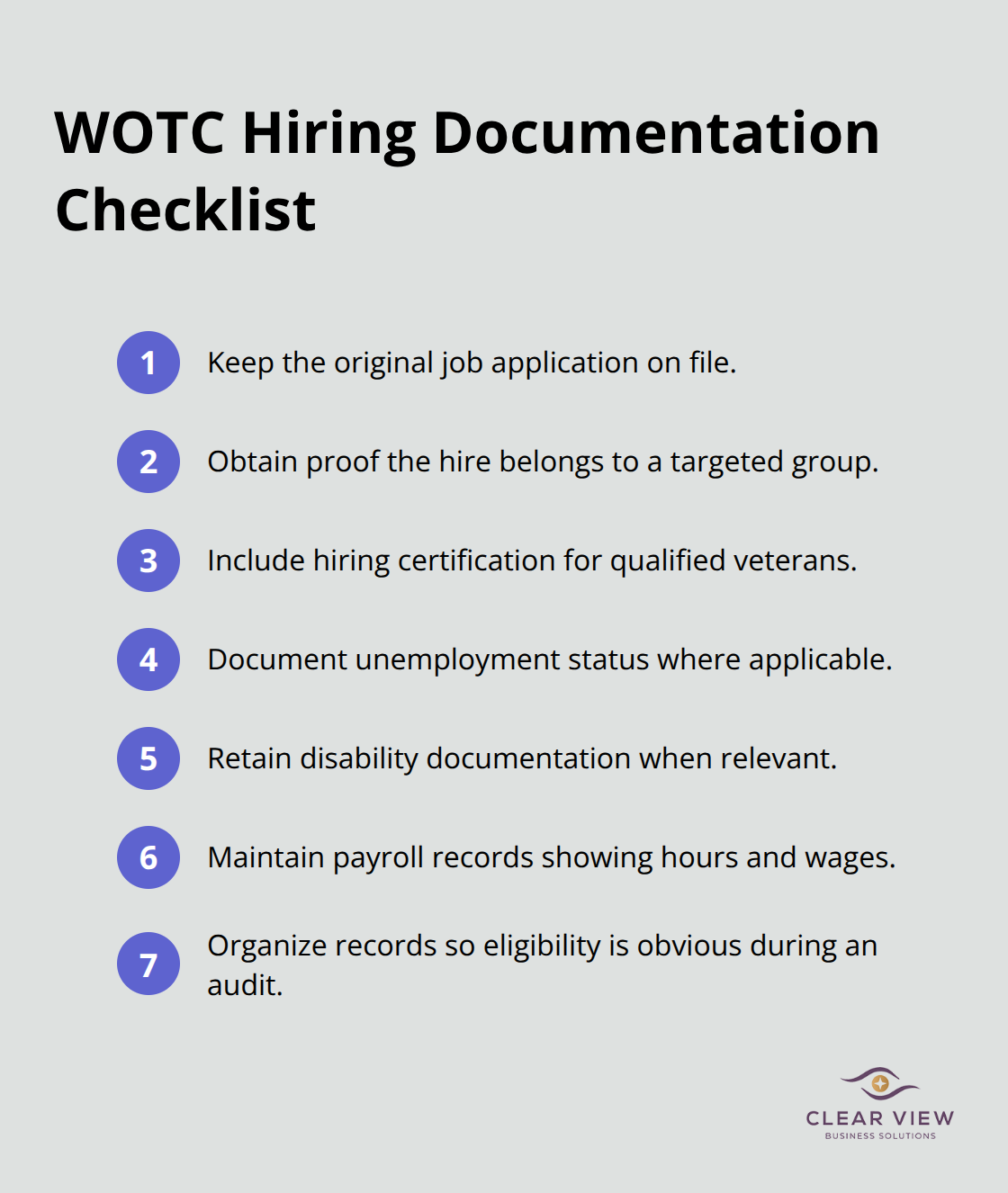
The IRS expects to see a clear audit trail connecting the employee to the credit category and the wages claimed. Store these documents in a way that makes the connection obvious to anyone reviewing your file, whether that’s an IRS agent or your tax professional.
Electronic filing through Form 941-X accelerates processing significantly compared to paper submissions, cutting typical backlogs from months to weeks. The IRS modernized this process specifically to handle the volume of claims filed in recent years, so submitting electronically isn’t optional if you want timely refunds. This single step removes months of waiting time from your refund timeline.
Common mistakes happen when owners claim credits for activities that don’t qualify or for employees who don’t meet the program requirements. The Work Opportunity Tax Credit has strict definitions for each targeted group-hiring someone who happens to be a veteran doesn’t automatically qualify unless you can prove they were long-term unemployed or faced other barriers. Similarly, R&D credits require that the work involve developing something new or improving an existing process through experimentation; routine software maintenance or standard product updates don’t count.
Many owners also claim wages for supervisors or management staff who directed research but didn’t perform hands-on qualifying work themselves, which the IRS disallows on audit. Start by reviewing the IRS guidance on Form 3800, which summarizes multiple credits on a single return, to understand exactly what qualifies.
If your business operates across multiple states, some credits stack with state-level incentives, multiplying your total savings-but claiming state and federal credits requires coordinated documentation to avoid conflicts. Filing amended returns within three years allows you to recover credits you missed in prior years, so don’t assume your opportunity expired. This coordination step separates businesses that capture maximum savings from those that leave money on the table.
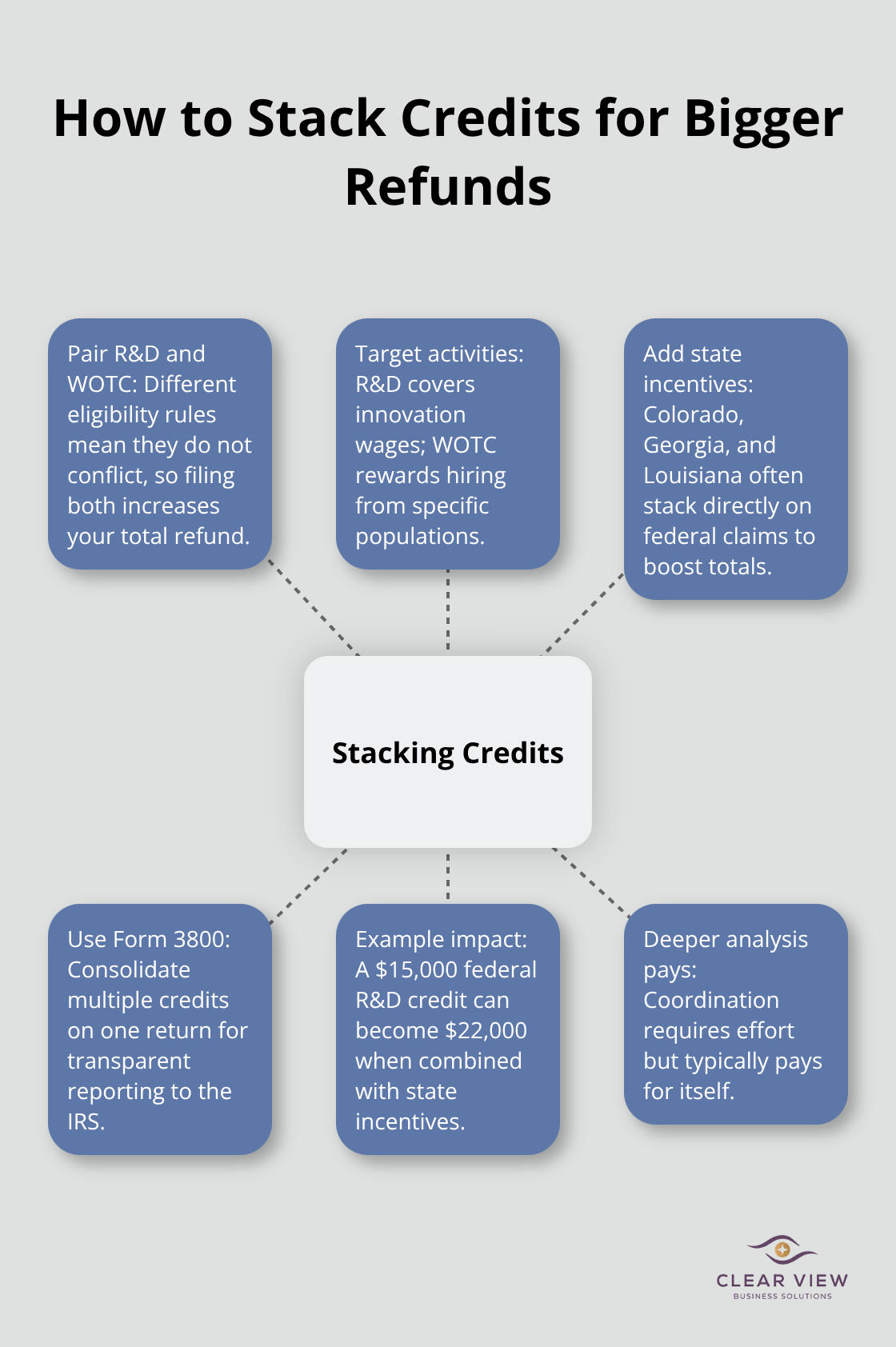
Most small business owners claim one credit at a time, missing the compounding effect of combining multiple credits in a single tax year. We see clients increase refunds by 40% to 60% simply by coordinating R&D credits with Work Opportunity Tax Credit claims on the same return. The R&D credit covers wages for research activities, while WOTC rewards hiring from specific populations-these credits operate on different eligibility rules and don’t conflict, so filing both simultaneously multiplies your total refund. The mechanics work because each credit targets different business activities: R&D focuses on innovation spending, WOTC focuses on hiring decisions, and state-level credits often reward job creation in specific regions. If you operate in Colorado, Georgia, or Louisiana, state credits stack directly on top of federal claims, turning a $15,000 federal R&D credit into a $22,000 total refund when combined with state incentives. The filing process uses IRS Form 3800 to consolidate all credits on a single return, making the stacking transparent to the IRS rather than hiding it.
Many tax professionals avoid this coordination because it requires deeper analysis of your payroll and operations, but the extra effort pays for itself in the first year.
Filing amended returns within three years unlocks credits you missed in prior years, but most owners wait until they discover a credit opportunity rather than conducting a systematic audit upfront. If you hired qualifying employees in 2023 and didn’t claim WOTC then, filing Form 941-X this year recovers that refund plus interest. Cabana Pools grew their R&D credit from $49,000 in year one to $245,000 within five years by consistently documenting engineering activities and updating claims annually-they didn’t hit maximum savings in a single year but instead built a sustainable process. The IRS modernized Form 941-X specifically to handle amended claims electronically, cutting processing time from six months to four to six weeks. Filing in February or March, immediately after year-end closes, accelerates refund timing and lets you reinvest savings into hiring, equipment, or runway.
Tax professionals who specialize in credits earn their fees by identifying qualifying activities you overlooked and building defensible documentation before the IRS questions anything. A generalist CPA files what you provide and claims obvious credits; a specialist reviews three years of payroll, engineering logs, and hiring records to uncover hidden opportunities. OnCentive and similar firms operate on contingency models where they capture a percentage of realized credits rather than charging hourly fees, aligning their incentive with your refund outcome. The trade-off is that specialists typically require minimum annual revenues or credit thresholds, so firms under $2 million in revenue sometimes find hourly consultation more cost-effective than contingency arrangements. Many small business owners hesitate to engage specialists because they assume the cost outweighs the benefit, but a $5,000 consulting fee that uncovers $35,000 in missed credits pays back sevenfold. The documentation burden also shifts from your shoulders to the specialist’s team, freeing internal resources to focus on running the business rather than chasing receipts and timesheets.
Tax credits for small business represent real money that flows into your account when you claim them strategically. The three credits covered in this guide-Research and Development, Work Opportunity, and Employee Retention-recover thousands of dollars annually for businesses that document their activities properly and file electronically. Most small business owners leave these savings unclaimed simply because they assume the process requires expensive consultants or that their work doesn’t qualify, when the reality is far simpler: organized documentation, timely filing, and coordinated claims across federal and state programs unlock refunds that transform your bottom line.
Your next step depends on where you stand today. If you’ve never claimed tax credits, review your payroll records from the past three years and identify employees who match the Work Opportunity Tax Credit targeted groups or projects that involved developing new products or software. If you’ve claimed credits before, file amended returns for any years you missed opportunities-the IRS allows three years to recover past refunds, and electronic submission through Form 941-X accelerates processing from months to weeks.
At Clear View Business Solutions, we help small business owners in Tucson navigate tax planning and maximize benefits through comprehensive financial advisory and accounting services. Whether you need guidance on credit eligibility, help organizing documentation, or full-cycle bookkeeping support, our team simplifies the process so you can focus on running your business. Contact us at Clear View Business Solutions to discuss your tax credit strategy and start capturing the savings you’ve earned.




At Clear View Business Solutions, we know you want your business to prosper without having to worry about whether you are paying more in taxes than you should or whether your business is set up correctly. The problem is it's hard to find a trusted advisor who can translate financial jargon to layman's terms and who can actually help you plan for better results.
We believe it doesn't have to be this way! No business owner should settle for working with a CPA firm that falls short of understanding what you want to achieve and how to help you get there.
Northwest Location:
7530 N. La Cholla Blvd., Tucson, AZ 85741
Central Location:
2933 N Campbell Avenue, Tucson, AZ 85719
© 2026 Clear View Business Solutions. All Rights Reserved.
At Clear View Business Solutions, we know you want your business to prosper without having to worry about whether you are paying more in taxes than you should or whether your business is set up correctly. The problem is it's hard to find a trusted advisor who can translate financial jargon to layman's terms and who can actually help you plan for better results.
We believe it doesn't have to be this way! No business owner should settle for working with a CPA firm that falls short of understanding what you want to achieve and how to help you get there. With over 20 years of experience serving hundreds of business owners like you, our team of experts combines financial expertise and proactive communication with our drive to help each client achieve results and have fun along the way.
Here's how we do it:
Discover: We start with a consultation to understand your specific goals, what's holding you back, and what success looks like for you.
Strategize & Optimize: Together, we design a customized strategy that empowers you to progress toward your goals, and we optimize our communication as partners.
Thrive: You enjoy a clear view of your business and your financial prosperity.
Schedule a consultation today, and take the first step toward being able to focus on your core business again without wondering if your numbers are right- or what they mean to your business.
In the meantime, download, "The Business Owner's Essential Guide to Tax Deductions" and make sure you aren't leaving money on the table.