


Running a small business in Tucson means juggling multiple financial responsibilities at once. Without solid accounting practices, cash flow problems sneak up fast and derail growth plans.
We at Clear View Business Solutions help Tucson business owners build financial foundations that actually work. This guide covers the accounting strategies that matter most: managing cash flow, planning taxes smartly, and scaling profitably.
Cash flow is the difference between when money enters your business and when it leaves. A Tucson business can be profitable on paper but run out of cash due to timing mismatches between receivables, payables, and inventory turnover. The U.S. Small Business Administration reports that cash management issues can result in business failure. This isn’t theoretical-it happens to real businesses every month. You need weekly or monthly visibility into when money actually enters and leaves your operation, not just what your profit-and-loss statement says at year-end.
Most Tucson business owners wait until tax season to examine their finances closely. That delay costs thousands. Weekly reconciliation catches missing invoices or duplicate payments within days, not months. Set aside 30 minutes every Monday morning to match your bank deposits against customer invoices and flag any gaps. If a client hasn’t paid, you know immediately instead of discovering it in March. If you accidentally paid a supplier twice, you catch it before that money disappears into next quarter’s cash shortage. Reconstructing months of neglected transactions after the fact costs thousands in accounting fees and management time.
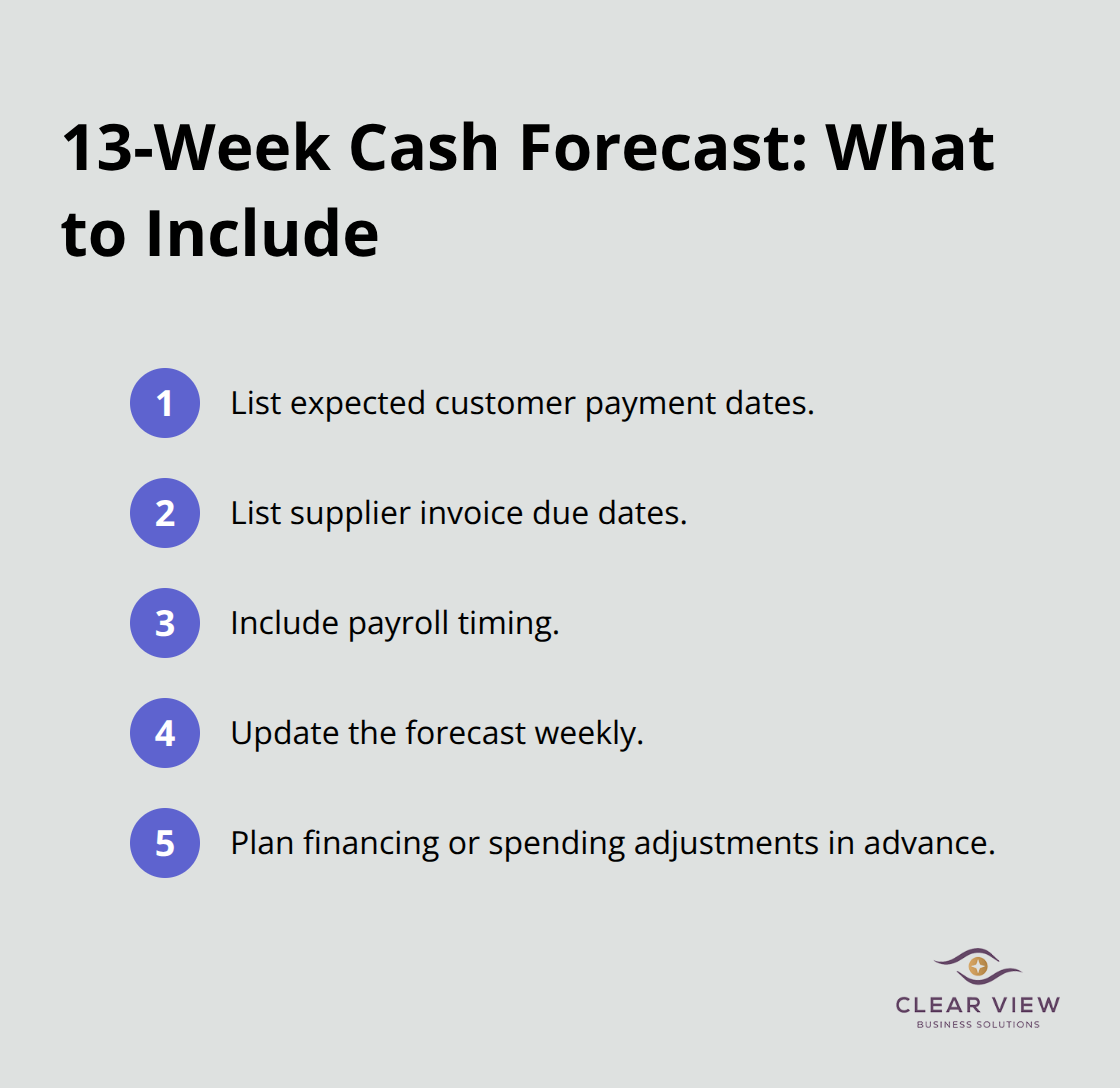
A rolling 13-week cash forecast anticipates gaps and lets you plan financing or spending adjustments in advance, especially for seasonal or project-based work. You build this forecast by listing when you expect customer payments, when supplier invoices are due, and when payroll hits. Update it every week as actual numbers come in. This single practice prevents the scramble for emergency loans when cash runs dry.
Many Tucson small business owners use cash-basis accounting because it feels simpler-you record money only when it moves. Accrual-based accounting provides a more complete financial picture for businesses with inventory or credit sales. If you invoice a client in January but they pay in March, accrual accounting shows the January revenue and January expenses together, giving you an accurate picture of that month’s profitability. Cash accounting would show January as a loss month and March as inflated profit, making your financial decisions unreliable.
Accrual accounting also reveals which customers or service lines are actually profitable after you account for all costs, not just which ones paid fastest. This insight lets you redeploy resources toward high-margin work and away from drains on profitability. Segmenting sales by channel or location shows you exactly where to focus your efforts for maximum return.
Accurate records keep your finances current and provide real-time visibility into your cash position, profitability by service line, and expense patterns. When you handle bookkeeping yourself while running operations, accuracy suffers and gaps widen. A professional bookkeeper or CPA catches errors that drain cash silently-duplicate payments, missed invoices, or expense miscategorizations that distort your true financial picture. This foundation of accurate records feeds directly into smarter tax planning and cash flow decisions, creating a feedback loop that strengthens your entire financial operation.
Year-round tax planning helps small business owners save thousands annually through proactive strategies. Most Tucson business owners wait until January to think about taxes, then scramble to gather documents and miss obvious deductions. When you plan taxes throughout the year, you spot deduction opportunities as they happen-equipment purchases, home office expenses, vehicle use, professional development-instead of forgetting them by tax time. You also optimize timing decisions that matter: whether to take a large expense in December or January, when to invoice clients for maximum tax efficiency, and how to structure owner distributions.
Accurate bookkeeping forms the foundation that makes tax planning exponentially more effective. Records that match revenue to expenses accurately let you identify which customers or service lines generate real profit after all costs. This clarity transforms tax planning from guesswork into strategy.
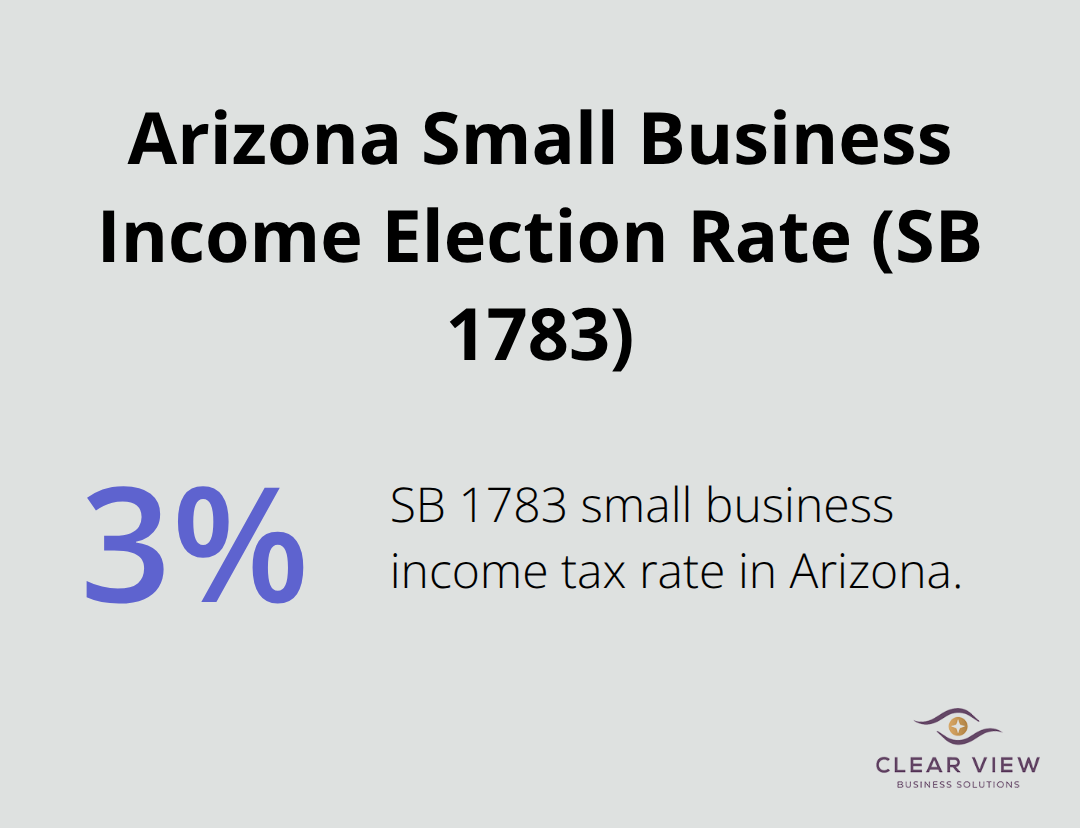
Arizona offers a specific advantage through Senate Bill 1783, which allows small business owners to elect taxation of Arizona small business gross income on a separate return at a rate of 3.0 percent. This election applies to income from Schedule C, Schedule E, Schedule F, and certain capital gains, and it can meaningfully reduce your overall Arizona tax liability compared to standard individual rates. The election must be made on a timely filed return and cannot be filed separately from your regular Arizona return, so getting this decision right during planning season matters more than most owners realize.
Quarterly estimated tax payments follow from solid planning. If you know your projected annual income and deductions, you calculate what you actually owe each quarter instead of guessing. Most Tucson business owners either overpay significantly and tie up cash unnecessarily or underpay and face penalties. Working backward from your 13-week cash forecast shows exactly how much profit you will generate, which drives accurate estimated payments that neither drain your operating cash nor create year-end surprises.
Entity structure shapes your entire tax picture, yet many owners never revisit this decision after forming their business. An S-corporation election can help eligible domestic corporations avoid double taxation, but this only works if your bookkeeping separates payroll from distributions cleanly. An LLC taxed as an S-corp requires more compliance and payroll processing, so the tax savings must outweigh the administrative burden based on your specific income level and business type.
A sole proprietorship or single-member LLC offers simplicity but no liability protection and potentially higher self-employment taxes. Partnership structures introduce complexity around basis, distributions, and partner-level taxation that requires professional guidance. The decision depends on your income, liability exposure, state tax implications, and growth plans. Evaluating these options based on actual numbers-not generic advice-reveals which structure fits your situation, since your circumstances differ from your competitor’s down the street.
Growth exposes financial weaknesses that stayed hidden when your business was smaller. A Tucson business owner managing five clients personally catches most cash gaps through sheer attention, but at fifty clients, that same attention dissolves into chaos. Systems fail silently until you discover months of missed invoices or supplier overpayments during tax prep. The solution isn’t working harder-it’s building financial infrastructure that scales with your revenue.
QuickBooks becomes non-negotiable as you grow beyond basic spreadsheets, since it tracks customer profitability, automates invoice reminders, and flags cash gaps before they become crises. Set up separate accounts for different revenue streams or locations from the start, not as an afterthought once you’ve mixed everything together. This separation prevents the chaos of untangling commingled finances later and gives you immediate visibility into which parts of your operation generate cash fastest.
Train someone on your team to handle bookkeeping tasks weekly rather than accumulating months of data for one person to sort later. This distributed responsibility prevents bottlenecks and catches errors faster. Many Tucson business owners resist outsourcing bookkeeping because they think it costs too much, but the real cost is what happens when accurate records don’t exist-missed deductions that cost thousands, undetected cash drains, and time spent reconstructing transactions instead of serving clients.
Profitability at scale requires knowing which parts of your business actually generate profit after all costs. A construction company might think its largest contracts are most valuable, but if those contracts require expensive subcontractors and materials, they may generate lower margins than smaller specialized jobs. Segment your sales by service line, customer type, or project size to see which segments are genuinely profitable. Compare gross margin against operating expenses for each segment, not just revenue.
One Tucson business owner discovered their highest-revenue customer was actually their lowest-profit customer once labor and overhead were allocated properly-that insight shifted their entire growth strategy toward more profitable work. Update this analysis quarterly as your business evolves, since the most profitable segment today may shift as you scale.
Link profitability insight directly to your cash forecast: high-margin work that pays quickly generates cash faster than high-revenue work with slow payment cycles. This feedback loop between profitability analysis, cash forecasting, and operational decisions separates businesses that scale sustainably from those that grow themselves into insolvency. High-margin work means nothing if customers pay in 90 days while your payroll hits every two weeks (the timing mismatch drains cash regardless of profitability). Conversely, fast-paying work with thin margins may keep cash flowing but won’t fund growth or weather downturns.
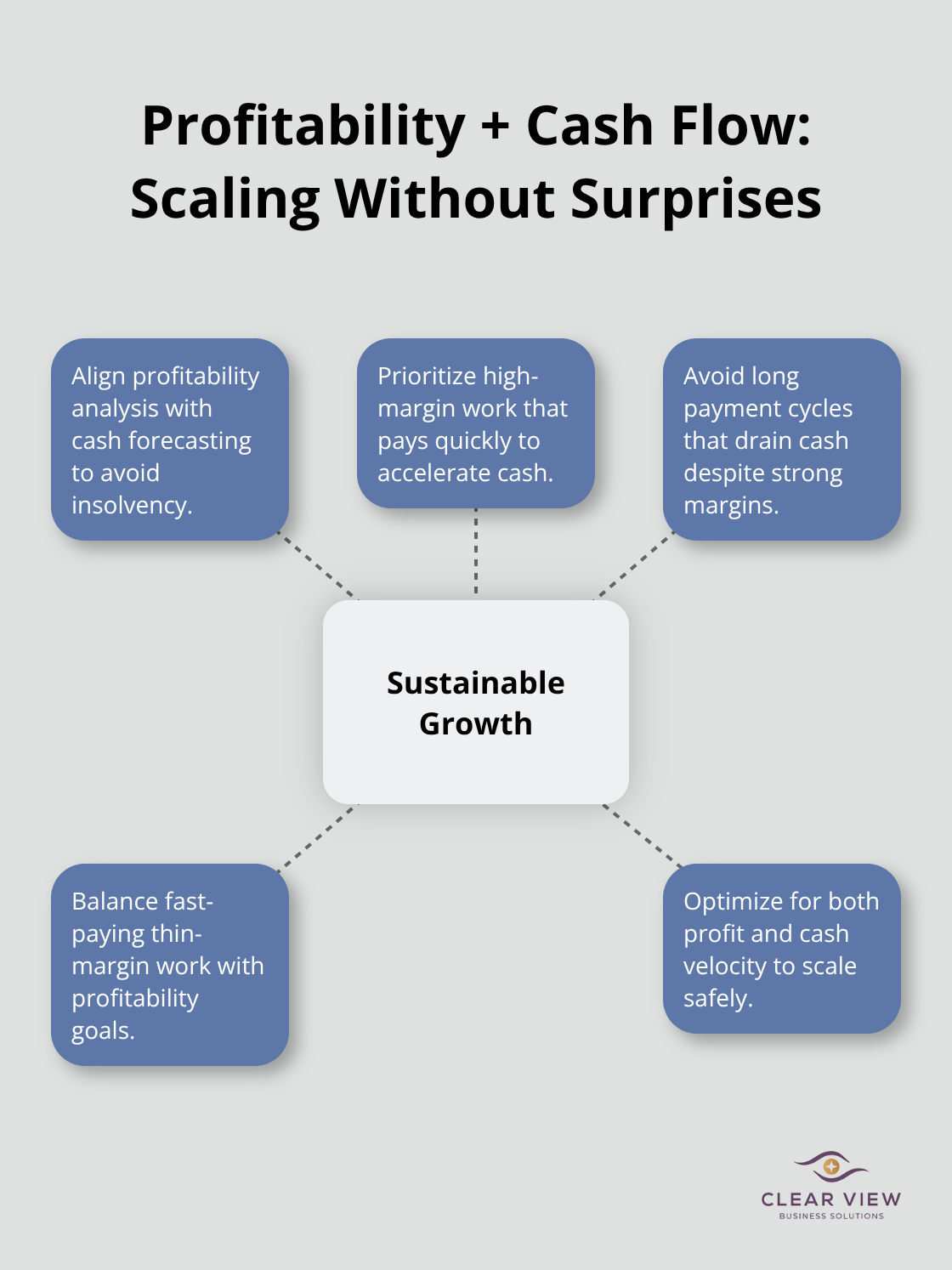
The businesses that scale successfully optimize for both profitability and cash velocity together.
Proper accounting transforms how you make decisions about your business. When you track cash flow accurately, plan taxes year-round, and monitor profitability by service line, you stop reacting to financial surprises and start steering your growth intentionally. The businesses that scale successfully in Tucson share one trait: they treat accounting as a strategic tool, not a compliance burden.
Your financial foundation determines what’s possible. Accurate bookkeeping reveals which customers and service lines actually profit, which timing decisions matter most, and where your cash position stands this week, not six months from now. This visibility lets you make pricing decisions, hiring decisions, and growth decisions based on reality instead of guesswork. Small business accounting in Tucson works best when it’s current, accurate, and connected to your operational decisions.
We at Clear View Business Solutions help Tucson small business owners implement the accounting systems that actually work. We handle full-cycle bookkeeping, QuickBooks setup and training, year-round tax planning, and IRS representation so you can focus on operations and growth. Schedule a free consultation to assess what your business needs to move forward with confidence.
At Clear View Business Solutions, we know you want your business to prosper without having to worry about whether you are paying more in taxes than you should or whether your business is set up correctly. The problem is it's hard to find a trusted advisor who can translate financial jargon to layman's terms and who can actually help you plan for better results.
We believe it doesn't have to be this way! No business owner should settle for working with a CPA firm that falls short of understanding what you want to achieve and how to help you get there.
Northwest Location:
7530 N. La Cholla Blvd., Tucson, AZ 85741
Central Location:
2933 N Campbell Avenue, Tucson, AZ 85719
© 2026 Clear View Business Solutions. All Rights Reserved.
At Clear View Business Solutions, we know you want your business to prosper without having to worry about whether you are paying more in taxes than you should or whether your business is set up correctly. The problem is it's hard to find a trusted advisor who can translate financial jargon to layman's terms and who can actually help you plan for better results.
We believe it doesn't have to be this way! No business owner should settle for working with a CPA firm that falls short of understanding what you want to achieve and how to help you get there. With over 20 years of experience serving hundreds of business owners like you, our team of experts combines financial expertise and proactive communication with our drive to help each client achieve results and have fun along the way.
Here's how we do it:
Discover: We start with a consultation to understand your specific goals, what's holding you back, and what success looks like for you.
Strategize & Optimize: Together, we design a customized strategy that empowers you to progress toward your goals, and we optimize our communication as partners.
Thrive: You enjoy a clear view of your business and your financial prosperity.
Schedule a consultation today, and take the first step toward being able to focus on your core business again without wondering if your numbers are right- or what they mean to your business.
In the meantime, download, "The Business Owner's Essential Guide to Tax Deductions" and make sure you aren't leaving money on the table.