


Starting a business in Tucson means making dozens of financial decisions before you’ve even opened your doors. Most startup founders focus on their product or service, but weak accounting foundations create problems that compound quickly.
At Clear View Business Solutions, we’ve seen firsthand how the right startup accounting guidance in Tucson prevents costly mistakes down the road. This guide walks you through the accounting systems, tax strategies, and financial practices that actually work for new businesses.
Most Tucson startups make their first accounting error within the first month, and it costs them money they’ll never recover. The SBA reports that about 20% of startups fail within the first year, and poor financial management ranks among the top reasons. The mistakes aren’t complicated, but their consequences compound faster than founders expect.
The first major error is mixing personal and business finances. When you pay business expenses from your personal account or deposit revenue into your personal bank account, you create a nightmare for tax time and audit readiness. The IRS expects clean separation, and commingling finances triggers scrutiny that can cost thousands in penalties and accounting fees to unwind.
Opening a dedicated business bank account takes 30 minutes and costs under $10 per month, yet most founders skip this step. When your business and personal money flow together, you lose the ability to track actual profitability, you can’t verify cash flow accurately for investors or lenders, and you make tax deductions harder to defend. Every transaction becomes a question mark instead of a clear record.
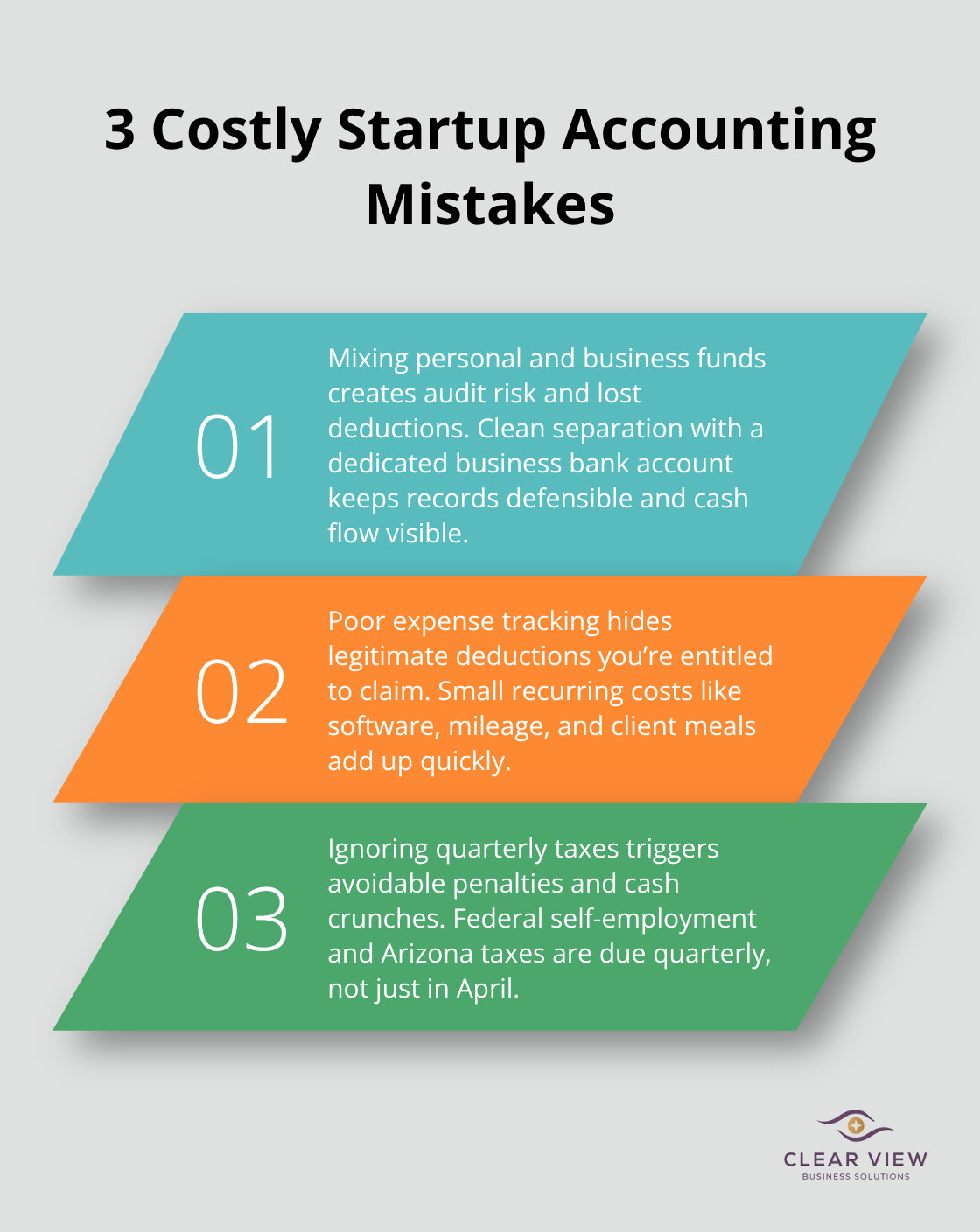
The second mistake is poor expense tracking, which leads startups to miss thousands in legitimate deductions. Most founders track big purchases but ignore smaller recurring costs: software subscriptions, meals with clients, mileage, home office supplies. These add up quickly.
A startup spending $500 monthly on uncategorized expenses leaves $6,000 annually on the table. Without a system like QuickBooks or Xero connected to your bank account, expenses disappear into credit card statements and receipts in a shoebox. When tax season arrives, you either pay taxes on income you didn’t actually earn or scramble to reconstruct receipts that no longer exist.
The third mistake is treating quarterly taxes as optional. Federal self-employment taxes and Arizona state taxes don’t wait until April. The IRS expects estimated quarterly payments from business owners, and Arizona requires separate state tax filings. Missing these deadlines triggers penalties that start at 5% of the underpayment and grow each quarter.
A startup earning $50,000 in the first year faces roughly $7,500 in self-employment taxes alone, split into four quarterly payments. Founders who don’t plan for this often find themselves short in January, scrambling to borrow money or delay payroll. Try setting aside 25% to 30% of quarterly profits into a separate savings account-this prevents the crisis entirely and keeps your business compliant with federal and state requirements.
These three mistakes form the foundation of financial chaos. The good news is that each one has a straightforward fix, and the systems you put in place now determine whether your accounting scales smoothly or becomes a constant headache. The next section shows you exactly which accounting systems and tools actually work for Tucson startups.
Cloud-based accounting software has become non-negotiable for Tucson startups, and QuickBooks Online leads the pack because it connects directly to your bank account and automates transaction categorization. When you link your business bank account to QuickBooks, transactions appear automatically, which cuts your manual data entry time from hours to minutes each week. Set up your chart of accounts during initial setup to match your specific business structure: separate accounts for revenue streams, cost of goods sold, payroll, marketing, and operating expenses. The IRS expects GAAP-aligned categorization, and correct setup from day one prevents expensive account restructuring later.
Most Tucson startups using QuickBooks report spending only 3 to 4 hours monthly on bookkeeping tasks, compared to 15 to 20 hours for those using spreadsheets or manual systems. Configure your chart of accounts with consistent coding conventions so that reports pull accurate numbers without cleanup work, and enable audit trails so that every transaction shows who entered it and when. Xero functions similarly to QuickBooks Online and costs about 20% less for early-stage businesses, so compare pricing based on your transaction volume and whether you need payroll integration.
Organizing financial records demands a system you actually use, not a perfect system you avoid. Create a folder structure in Google Drive or Dropbox with separate directories for invoices, receipts, bank statements, tax documents, and vendor contracts, then upload receipts the same week you incur expenses using your phone camera or a scanning app like Expensify. Most startups fail at expense documentation because they wait until tax season to organize chaos, so establish the habit now: take a photo of receipts immediately, categorize them in QuickBooks within 48 hours, and reconcile your bank account monthly to catch discrepancies before they compound.
Arizona startups must keep records for at least 3 years from the date you filed your original return or 2 years from the date you paid the tax, whichever is later, per IRS requirements, and digital storage with automatic backups protects against loss far better than paper files. The choice between DIY accounting and professional help depends on your business complexity and available time.
If you have a single revenue stream, fewer than five employees, and under $250,000 in annual revenue, DIY accounting with QuickBooks training is realistic if you commit 4 to 6 hours monthly. However, if you have multiple revenue streams, contractor payments, inventory management, or plans to raise funding within 18 months, professional bookkeeping pays for itself by ensuring clean books that investors trust and by identifying tax-saving opportunities you’d miss alone.
Many Tucson startups hybrid their approach by handling day-to-day transaction entry themselves while hiring an accountant for quarterly reviews, tax planning, and annual financial statements, which typically costs $150 to $300 monthly and protects against costly mistakes. This hybrid model works especially well for founders who want to stay involved in their finances without drowning in administrative work.
The systems you choose now determine whether your accounting scales smoothly or becomes a constant headache. With your accounting foundation in place, the next critical step involves understanding how to plan for taxes before they arrive.
Federal self-employment tax catches most founders off guard, and Arizona state tax adds another layer of complexity that unprepared startups cannot absorb. The IRS requires estimated quarterly tax payments from business owners, which means you cannot wait until April to address what you owe. A Tucson startup earning $60,000 in its first year faces roughly $8,500 in federal self-employment taxes alone, and Arizona state income tax on top of that. Most founders treat these as a single April problem instead of four separate quarterly obligations that demand cash flow planning.
Set up a separate high-yield savings account right now and deposit 30% of every dollar your business earns before you spend it on operations or payroll. This single discipline prevents the cash crisis that forces founders to borrow money or delay paying employees. The IRS calculates penalties starting at 5% of underpayment per quarter, and Arizona adds its own penalties on top, so missing even one quarterly deadline costs real money you cannot recover.
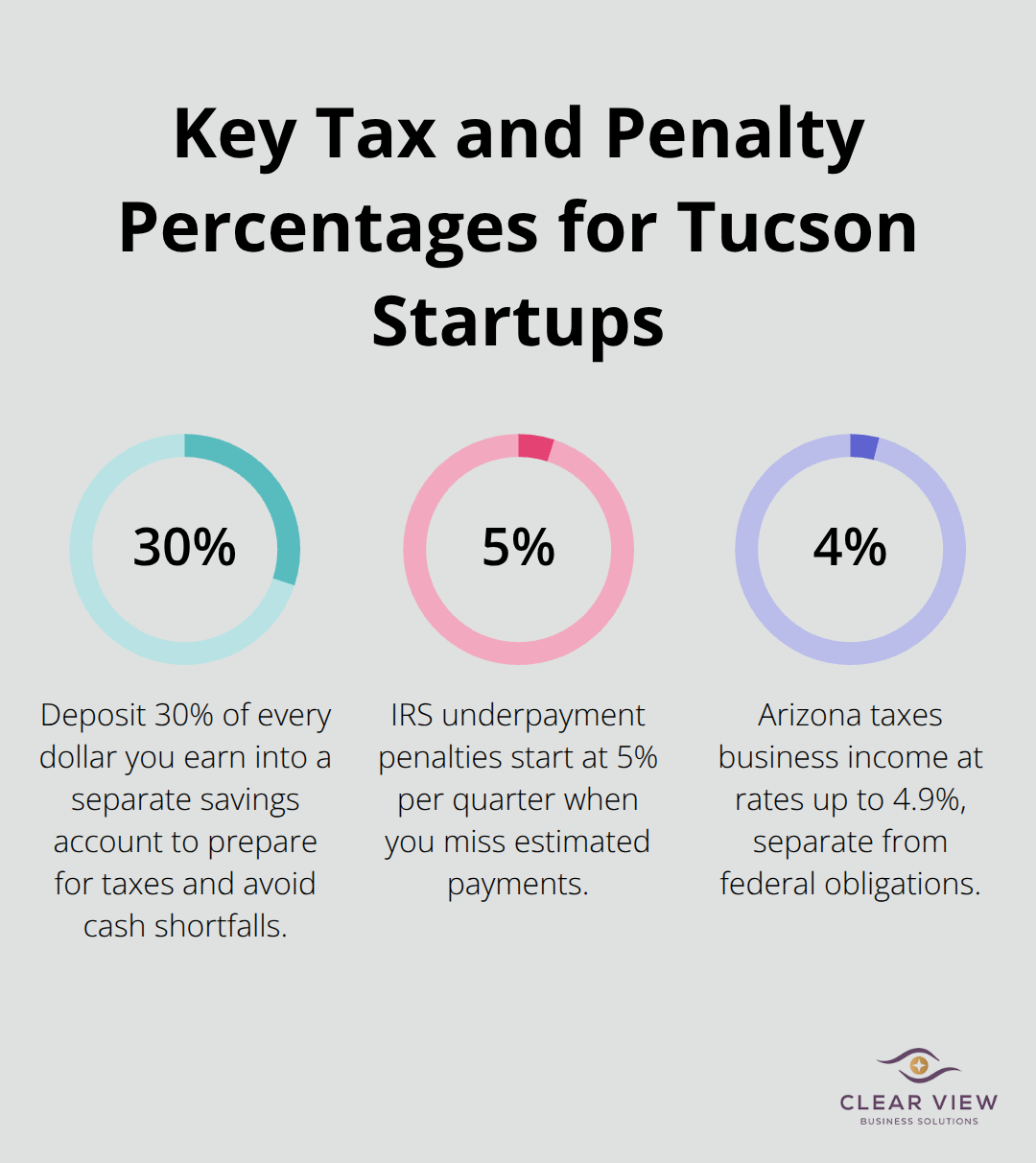
File Form 1040-ES with the IRS by April 15, June 15, September 15, and January 15 to stay compliant, and Arizona requires separate estimated tax payments using Form 140ES. Most Tucson startups overlook that Arizona taxes your business income at rates up to 4.9%, which means a $50,000 profit generates roughly $2,450 in state tax liability that must be planned for separately from federal obligations.
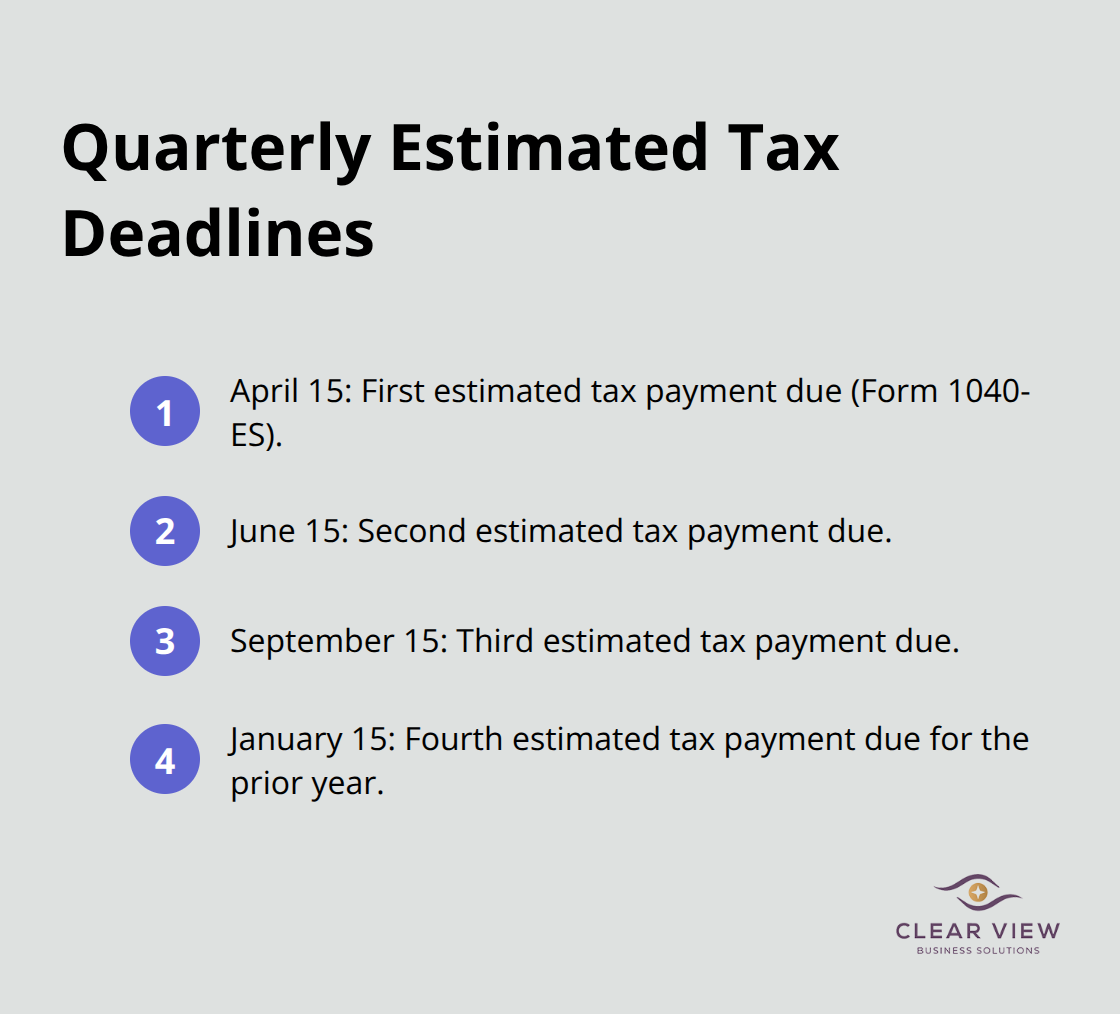
Treat each quarterly deadline as a non-negotiable business expense, not an optional task you handle when cash flow permits.
Home office deductions work only if you maintain a dedicated space used exclusively for business, and the IRS scrutinizes these claims heavily, so photograph your setup and record measurements if you claim this deduction. Mileage deductions for business travel stand at 67 cents per mile for 2024 according to IRS guidance, but personal commuting mileage never counts, so track your odometer readings and maintain a log showing business purpose for each trip.
Software subscriptions, professional memberships, and tools directly related to your business are fully deductible, and most founders miss hundreds monthly by not categorizing these correctly in QuickBooks. Arizona offers R&D tax credits for startups developing new products or processes, which can reduce your state tax liability through income tax credits claimed over a three year period, but you must document the research activities carefully and file the proper forms with the Arizona Department of Revenue to claim them.
Contractor payments to independent contractors require 1099 reporting if you pay any individual over $600 annually, so track these separately and issue forms by January 31 to avoid IRS penalties. The mistake founders make is claiming deductions they cannot defend with receipts and documentation, so photograph every receipt immediately, store them digitally with timestamps, and categorize them in QuickBooks within 48 hours.
Quarterly tax planning with an accountant costs $200 to $400 per quarter but typically identifies deductions and credits that pay for themselves multiple times over. This proactive approach maximizes what you keep and minimizes what you owe to federal and state authorities.
Weak accounting foundations undermine every decision you make as a founder and create financial crises that derail otherwise solid businesses. The systems you build now-a dedicated business bank account, cloud-based software connected to your bank, and quarterly tax planning-transform accounting from a burden into a tool that informs your growth decisions. When you know your real profitability and cash flow each month, you stop guessing and start planning with confidence.
Professional startup accounting guidance in Tucson matters because it catches problems before they become expensive disasters and identifies tax deductions you’d miss alone. We at Clear View Business Solutions work specifically with Tucson startups to handle full-cycle bookkeeping, tax planning tailored to your business structure, and QuickBooks training so you understand your own numbers. Visit our website to schedule a consultation and review your current financial setup with our team.
Your financial foundation determines whether your startup thrives or struggles, and the time to build it right is now.




At Clear View Business Solutions, we know you want your business to prosper without having to worry about whether you are paying more in taxes than you should or whether your business is set up correctly. The problem is it's hard to find a trusted advisor who can translate financial jargon to layman's terms and who can actually help you plan for better results.
We believe it doesn't have to be this way! No business owner should settle for working with a CPA firm that falls short of understanding what you want to achieve and how to help you get there.
Northwest Location:
7530 N. La Cholla Blvd., Tucson, AZ 85741
Central Location:
2933 N Campbell Avenue, Tucson, AZ 85719
© 2026 Clear View Business Solutions. All Rights Reserved.
At Clear View Business Solutions, we know you want your business to prosper without having to worry about whether you are paying more in taxes than you should or whether your business is set up correctly. The problem is it's hard to find a trusted advisor who can translate financial jargon to layman's terms and who can actually help you plan for better results.
We believe it doesn't have to be this way! No business owner should settle for working with a CPA firm that falls short of understanding what you want to achieve and how to help you get there. With over 20 years of experience serving hundreds of business owners like you, our team of experts combines financial expertise and proactive communication with our drive to help each client achieve results and have fun along the way.
Here's how we do it:
Discover: We start with a consultation to understand your specific goals, what's holding you back, and what success looks like for you.
Strategize & Optimize: Together, we design a customized strategy that empowers you to progress toward your goals, and we optimize our communication as partners.
Thrive: You enjoy a clear view of your business and your financial prosperity.
Schedule a consultation today, and take the first step toward being able to focus on your core business again without wondering if your numbers are right- or what they mean to your business.
In the meantime, download, "The Business Owner's Essential Guide to Tax Deductions" and make sure you aren't leaving money on the table.