

Startup accounting growth in Tucson depends on getting the fundamentals right from day one. Most founders focus on product and sales while their finances fall apart behind the scenes.
At Clear View Business Solutions, we’ve seen firsthand how accounting mistakes derail growth. The good news is that fixing these problems early makes scaling predictable and stress-free.
Most Tucson startups operate with tangled finances from month one, and the damage compounds fast. We at Clear View Business Solutions watch founders make three critical errors that transform manageable problems into catastrophic ones by year two.
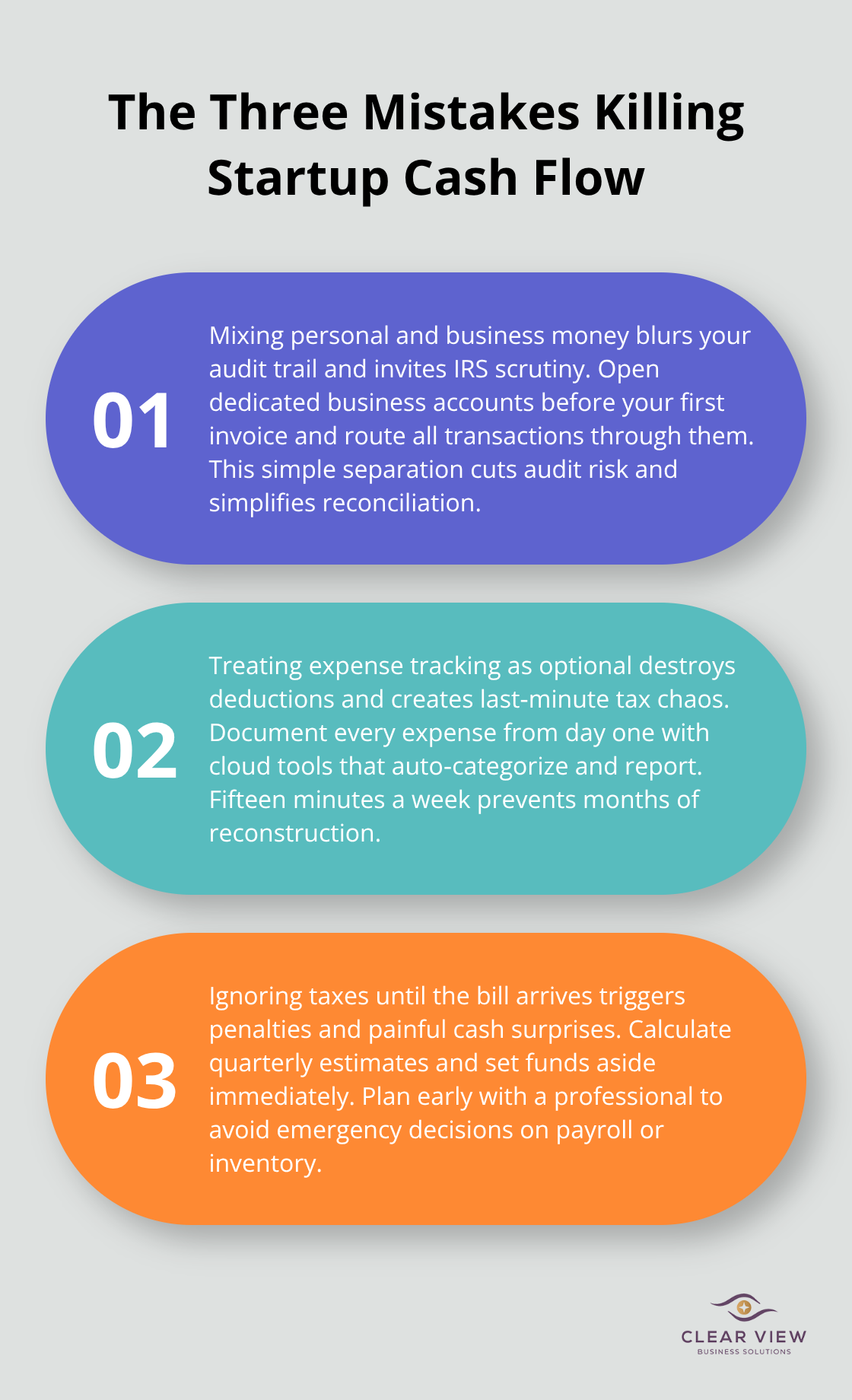
The first mistake is mixing personal and business money. When your business account receives customer payments alongside your personal transfers, tax audits become inevitable. The IRS scrutinizes commingled accounts heavily, and you lose the paper trail that protects you during disputes. Separate accounts cost nothing to open at any Tucson bank, yet founders delay this step as if it requires complex paperwork. It does not. Open a dedicated business checking account before your first invoice goes out, then route all business revenue and expenses through it. This single action cuts audit risk dramatically and makes year-end reconciliation hours instead of days.
The second mistake is treating expense tracking as optional. Most startups track sales obsessively but ignore spending, then scramble in November when tax time approaches. You cannot claim deductions you did not document. The IRS demands receipts and proof for every business expense, whether it is software subscriptions, mileage, or client dinners. Start documenting expenses on day one using cloud-based tools like QuickBooks or Wave, which automatically categorize transactions and generate reports. Do not wait until quarterly reviews to organize receipts into folders. Real-time tracking takes fifteen minutes weekly and prevents the panic of reconstructing nine months of spending in December.
The third mistake is ignoring taxes until the bill arrives. Startups often assume they owe nothing until they are profitable, then face crushing estimated tax payments they never planned for. Self-employed income in Arizona is subject to federal, state, and self-employment taxes regardless of profit. Calculate your estimated tax liability quarterly and set that money aside immediately. Your payments must total either 90% of the tax due for the current calendar year, or 100% of the tax. Working with a tax professional early in your startup journey ensures you claim every available deduction while avoiding penalties. Many founders discover mid-year that they owe twenty thousand dollars they never budgeted for, forcing desperate decisions about payroll or inventory. Planning ahead eliminates that shock entirely.
These three errors share a common thread: they all stem from reactive rather than proactive financial management. Founders who address these mistakes in their first ninety days build accounting systems that scale without constant firefighting. The startups that fail to act on these issues spend their second and third years fixing problems that cost far more to solve than they would have cost to prevent. Your next step is to build systems that work for you automatically, starting with the right bookkeeping foundation.
The gap between a startup that survives year three and one that collapses at year two comes down to one thing: infrastructure. You cannot scale chaos. The moment you move beyond solo founder finances, manual spreadsheets fail catastrophically. Founders lose thousands in missed deductions, duplicate payments, and reconciliation errors because they built their accounting on unstable ground. The solution is not complex or expensive. It requires three deliberate moves executed in your first month of operation.
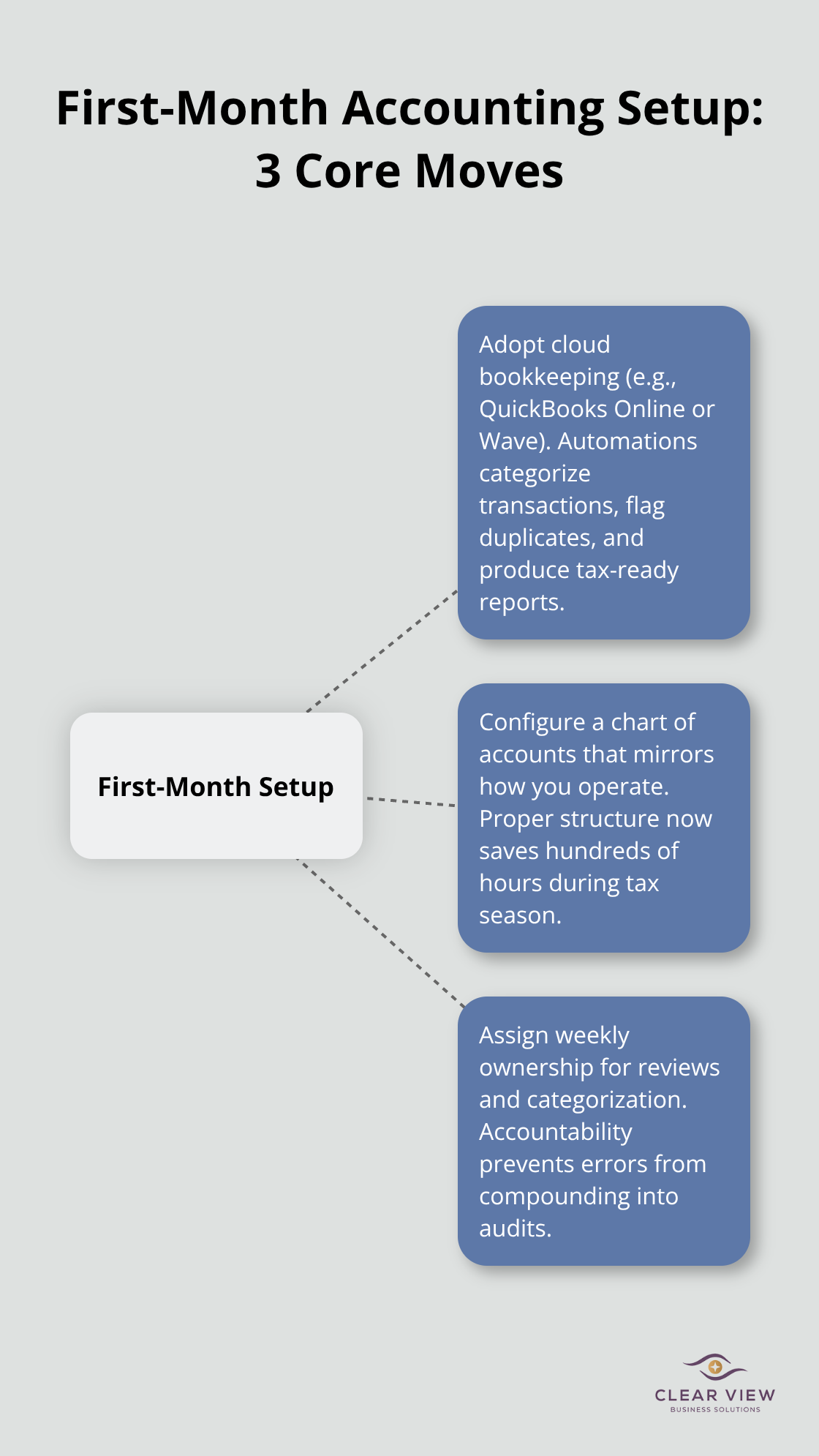
Start with cloud-based bookkeeping software immediately. QuickBooks Online or Wave cost between zero and fifteen dollars monthly and handle the heavy lifting that manual tracking cannot. These platforms automatically categorize transactions from your business bank account, flag duplicate charges before they process, and generate tax-ready reports without manual entry. According to research from the National Small Business Association, automated bookkeeping reduces accounting errors compared to manual systems. More importantly, these tools integrate with your bank, your payment processor, and your invoicing platform, meaning data flows in one direction without re-entry.
Set up your chart of accounts in the first week to match how your business actually operates, not how a template suggests. If you sell services and products differently, create separate income accounts. If you operate from multiple locations, tag transactions by location. This structure takes two hours to establish and saves hundreds of hours later. Once configured, your team spends fifteen minutes weekly reviewing and categorizing new transactions instead of reconstructing months of receipts during tax season.
Assign one person ownership of this task and hold them accountable weekly, not quarterly. The person reviewing transactions should be someone who understands your business operations, not just the bookkeeper, so categorization errors surface immediately rather than in an audit.
Next, establish financial processes that require zero judgment calls. Document where money goes and where it comes from before your first transaction. Create a simple one-page guide that shows your team exactly how to handle customer refunds, employee reimbursements, and vendor payments. Your guide should specify which account receives which transaction type, who approves payments above certain thresholds, and when reports get reviewed. This removes the guesswork that causes cash flow surprises.
The IRS can include returns filed within the last three years in an audit, and the cost of professional reconstruction during an audit exceeds two thousand dollars. Preventing that scenario costs nothing upfront.
Open a dedicated business checking account and a business credit card at your Tucson bank before you invoice your first customer. Route all business revenue through the checking account and all discretionary spending through the credit card. This separation makes reconciliation mechanical rather than investigative. Your business card should have clear spending limits based on employee role, and statements should feed directly into your accounting software.
Request that your bank provide monthly statements in a format your bookkeeping software accepts, eliminating manual data entry. Many founders resist this discipline because it feels bureaucratic, but the alternative is spending your third year reconstructing two years of commingled transactions for tax purposes. With these three systems in place, your financial foundation supports growth without constant manual intervention. The next step involves monitoring what these systems produce-the metrics and projections that tell you whether your startup is actually on track.
Cash flow projections separate startups that survive funding gaps from those that collapse mid-growth. Most founders skip this step because they assume their accountant will handle it, then panic when their bank account drops below payroll. We work with Tucson startups that have solid revenue but zero visibility into when cash actually arrives and leaves. The difference between a startup that navigates a slow quarter and one that misses payroll comes down to a single document: a rolling cash flow forecasts that you update weekly.
This forecast shows your starting cash balance, every dollar coming in from customers, every dollar going out for expenses, and your ending balance each week. Without it, you operate blind. Start this forecast in your first month by listing all fixed costs that repeat monthly-rent, software subscriptions, insurance, salaries. Then add variable costs that scale with revenue, like payment processing fees or materials.
Project customer revenue conservatively, using actual sales data if you have it, or industry benchmarks if you do not. For early-stage startups without revenue history, the Small Business Administration suggests using comparable company data adjusted for your market size and growth rate. Input these numbers into a spreadsheet or accounting software that calculates your cash position week by week. Update it every Friday with actual results from the previous week and new customer commitments for the coming month. This discipline takes ninety minutes weekly and prevents the shock of insufficient cash for payroll or vendor payments. Many Tucson founders discover in week eight that their cash runs out in week twelve because they never ran the numbers. A forecast catches this problem in week two, giving you time to negotiate extended payment terms with vendors, accelerate customer collections, or adjust spending before crisis hits.
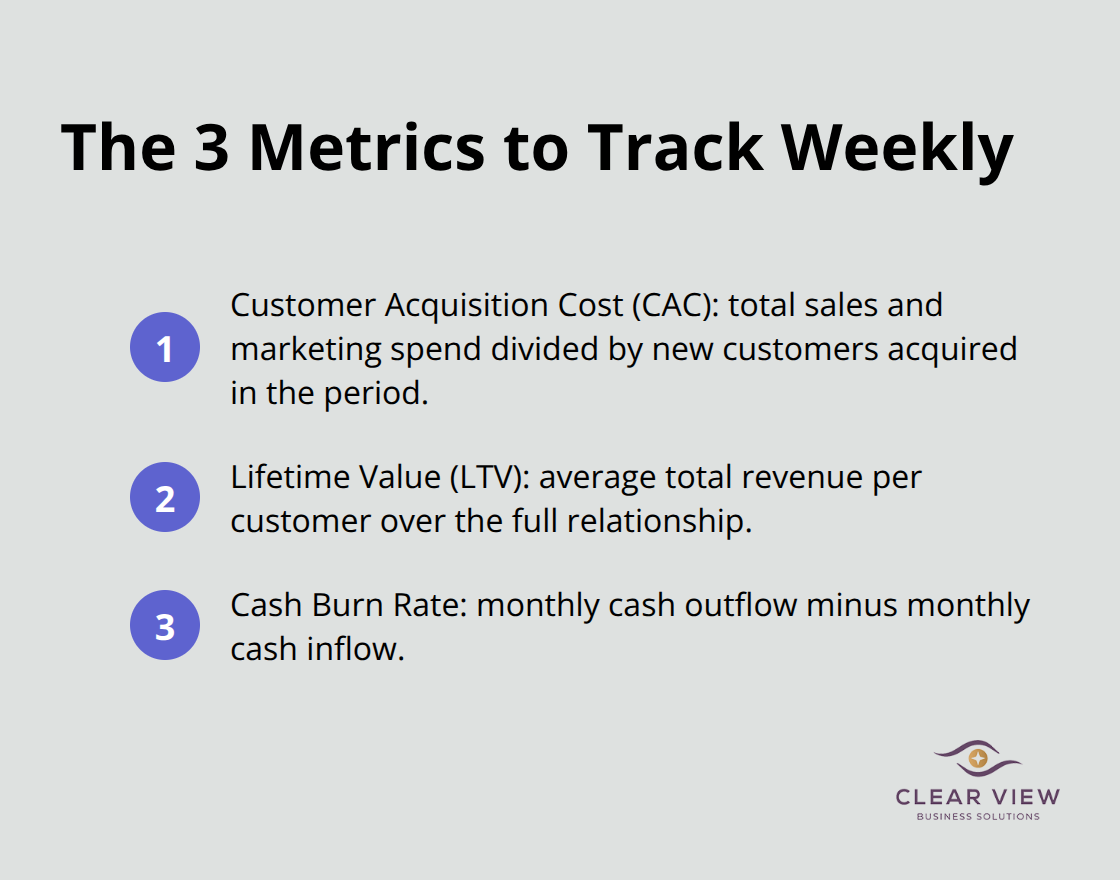
Monitoring the right financial metrics tells you whether your startup is actually growing or just spending faster. Most founders obsess over revenue without understanding the costs hidden behind that number. Three metrics reveal true business health: customer acquisition cost (your total sales and marketing spending divided by new customers acquired that month), lifetime value (your average customer revenue across their full relationship with your company), and cash burn rate (your monthly cash outflow minus any cash inflow).
If your customer acquisition cost exceeds thirty percent of your first-year customer revenue, your growth model is broken and spending more on marketing only accelerates failure. If your lifetime value is less than three times your customer acquisition cost, you cannot afford to scale. If your cash burn rate exceeds your monthly revenue growth, you will run out of money before reaching profitability. Track these three numbers weekly in a dashboard that your entire leadership team reviews together.
This forces hard conversations about pricing, spending, and customer quality before problems become fatal. Many startups fail not because their product is bad but because they grew revenue while burning cash faster than they earned it. The metrics reveal this disconnect immediately.
Work with a tax professional starting in month two of operation, not month eleven when panic sets in. Most Tucson founders wait until they owe taxes to consult a professional, missing deductions worth thousands and facing penalties for underpayment. A tax professional identifies deductions specific to your business structure and customer base, then calculates your quarterly estimated tax liability so you set aside the correct amount each month. This prevents the shock of owing twenty thousand dollars in April that you never budgeted for.
Additionally, a tax professional advises on business entity structure-whether operating as a sole proprietor, LLC, S-corp, or C-corp saves you the most in taxes given your specific income and expenses. For many Tucson startups earning between fifty thousand and five hundred thousand annually, an S-corp election reduces self-employment taxes by fifteen to twenty percent compared to an LLC, saving several thousand dollars annually. Your tax professional also identifies whether you qualify for R&D credits if your startup develops software or processes, research credits that can reduce your tax bill by thousands without additional documentation. They ensure you capitalize assets correctly rather than expense them, and they structure contractor payments to maximize deductions while maintaining IRS compliance.
The cost of quarterly tax consultations, typically two hundred to five hundred dollars per quarter, pays for itself through deductions and structure optimization within the first year. Waiting until April to file taxes costs two to three times more because you pay for emergency reconstruction and penalties rather than proactive planning.
Proper accounting forms the foundation that separates startups scaling predictably from those collapsing under financial chaos. The three mistakes we covered-mixing personal and business money, neglecting expense tracking, and ignoring taxes-destroy more Tucson startups than bad products or weak markets ever will. Yet all three are preventable with systems you can build in your first month, and startup accounting growth in Tucson accelerates when founders treat finances as a competitive advantage rather than a compliance burden.
Cloud-based bookkeeping software, clear financial processes, and separate business accounts cost almost nothing to implement but save thousands in audit fees, penalties, and lost deductions. Cash flow forecasts and metric tracking transform you from a founder operating blind into one making decisions based on actual financial reality. Working with a tax professional from month two rather than month eleven cuts your tax bill while protecting you during audits.
Your next step is simple: open a separate business bank account this week, set up cloud-based bookkeeping software this month, and schedule a consultation with a tax professional before your second month ends. These three actions eliminate the chaos that derails most startups and position your business for sustainable growth.




At Clear View Business Solutions, we know you want your business to prosper without having to worry about whether you are paying more in taxes than you should or whether your business is set up correctly. The problem is it's hard to find a trusted advisor who can translate financial jargon to layman's terms and who can actually help you plan for better results.
We believe it doesn't have to be this way! No business owner should settle for working with a CPA firm that falls short of understanding what you want to achieve and how to help you get there.
Northwest Location:
7530 N. La Cholla Blvd., Tucson, AZ 85741
Central Location:
2933 N Campbell Avenue, Tucson, AZ 85719
© 2026 Clear View Business Solutions. All Rights Reserved.
At Clear View Business Solutions, we know you want your business to prosper without having to worry about whether you are paying more in taxes than you should or whether your business is set up correctly. The problem is it's hard to find a trusted advisor who can translate financial jargon to layman's terms and who can actually help you plan for better results.
We believe it doesn't have to be this way! No business owner should settle for working with a CPA firm that falls short of understanding what you want to achieve and how to help you get there. With over 20 years of experience serving hundreds of business owners like you, our team of experts combines financial expertise and proactive communication with our drive to help each client achieve results and have fun along the way.
Here's how we do it:
Discover: We start with a consultation to understand your specific goals, what's holding you back, and what success looks like for you.
Strategize & Optimize: Together, we design a customized strategy that empowers you to progress toward your goals, and we optimize our communication as partners.
Thrive: You enjoy a clear view of your business and your financial prosperity.
Schedule a consultation today, and take the first step toward being able to focus on your core business again without wondering if your numbers are right- or what they mean to your business.
In the meantime, download, "The Business Owner's Essential Guide to Tax Deductions" and make sure you aren't leaving money on the table.