


Most people leave thousands of dollars on the table each year by not using tax deferral strategies. The difference between a mediocre retirement and a comfortable one often comes down to how strategically you handle taxes during your working years.
At Clear View Business Solutions, we’ve seen firsthand how the right approach can compound into significant wealth over time. This guide walks you through practical strategies you can implement today, regardless of where you are in your career.
Tax deferral postpones taxes on income or investment gains, allowing your money to compound without the immediate tax hit. Here’s the concrete difference it makes: a $100,000 investment growing at 7% annually becomes $386,968 after 20 years inside a tax-deferred account, compared to $289,571 in a fully taxable account before taxes are paid. That’s roughly $97,000 more in your account because taxes waited.
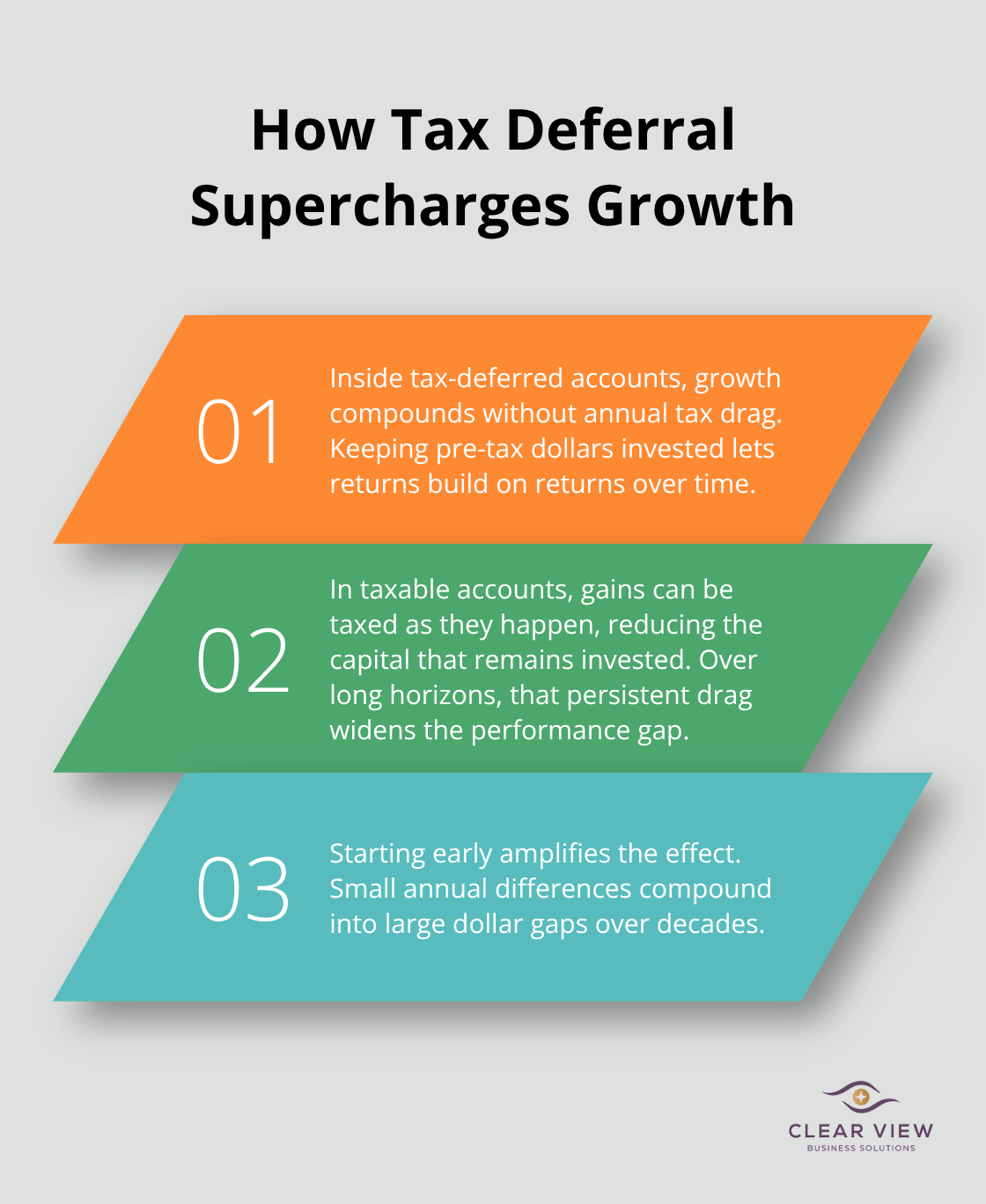
The math works because every dollar that would have gone to the IRS instead stays invested, generating returns on top of returns. This compounding effect accelerates over time, which is why starting early matters far more than most people realize.
The 2025 contribution limits reflect how seriously the IRS takes this strategy: you can contribute up to $23,500 to a traditional 401(k), with an additional $7,500 catch-up contribution if you’re over 50. For those aged 60 to 63, catch-up contributions jump to $11,250, acknowledging that people in their final working years need to make up ground quickly. Traditional IRAs offer deductibility thresholds around $89,000 for single filers in 2025, though this varies based on whether you have access to an employer plan. The key insight most people miss is that tax deferral isn’t about avoiding taxes forever-it’s about controlling when you pay them and potentially paying less overall if your tax bracket drops in retirement.
Tax deferral shines brightest with tax-inefficient investments like high-yield bonds, where you’d otherwise pay ordinary income tax on every dollar earned annually. J.P. Morgan research shows that on a $1 million investment over 30 years, the difference between a tax-deferred and taxable account for high-yield bonds can reach approximately $1.7 million, making deferral genuinely powerful for this asset class. Conversely, tax-deferred accounts waste their advantage on long-term capital gains and qualified dividends, which already benefit from favorable rates capped at 23.8% in taxable accounts. This matters because choosing the wrong account for the wrong asset can actually double your tax burden over time.
Inside tax-deferred accounts, you trade without triggering capital gains taxes, enabling strategic rebalancing that would be costly in taxable accounts. Real estate investors have their own powerful tool: Section 1031 like-kind exchanges allow you to defer capital gains taxes when you reinvest proceeds into similar property of equal or greater value (provided you identify replacement property within 45 days and close within 180 days). Business owners often overlook Solo 401(k)s, which permit combined employee and employer contributions totaling up to $66,000 annually as of 2023, with earnings growing tax-deferred. Defined Benefit Plans can offer even larger deferred contributions for older or higher-income owners. Accelerated depreciation, including bonus depreciation at 40% in 2025 (scheduled to phase out by 2027), lets you deduct asset costs faster-purchasing $200,000 in qualifying equipment could yield a $200,000 immediate deduction in the year it’s placed in service, lowering current tax liability and increasing cash flow directly.
The biggest mistake high-income earners make is automatically funneling everything into tax-deferred accounts without considering future tax rates. Many people will face top federal income tax rates even in retirement due to investment income and required minimum distributions, making the deferral advantage weaker than they assumed. If you expect to be in a lower tax bracket in retirement, deferral wins. If you’re moving to a no-income-tax state or expect rates to remain high, taxable accounts with tax-loss harvesting become preferable. Taxable accounts offer tax-loss harvesting to offset gains and reduce annual taxes-a lever unavailable in tax-deferred accounts.
Heirs benefit from a cost-basis step-up in taxable accounts at death, which substantially reduces inherited tax liability; tax-deferred assets don’t provide this same step-up. This matters enormously for wealth transfer. Roth conversions from traditional IRAs can avoid future taxes on growth entirely, and after-tax contributions can be converted with little or no tax. Qualified Roth distributions are tax-free if you’re 59½ or older and the account has been open for at least five years. The breakeven analysis is complex: depending on time horizon and investment type, the required after-tax return for a tax-deferred asset to match a taxable one ranges from about 5.5% to 39.5% annually over 10 to 30 years according to J.P. Morgan. This isn’t a one-size-fits-all decision, which is why the next section walks you through assessing your specific situation before you commit to any strategy.
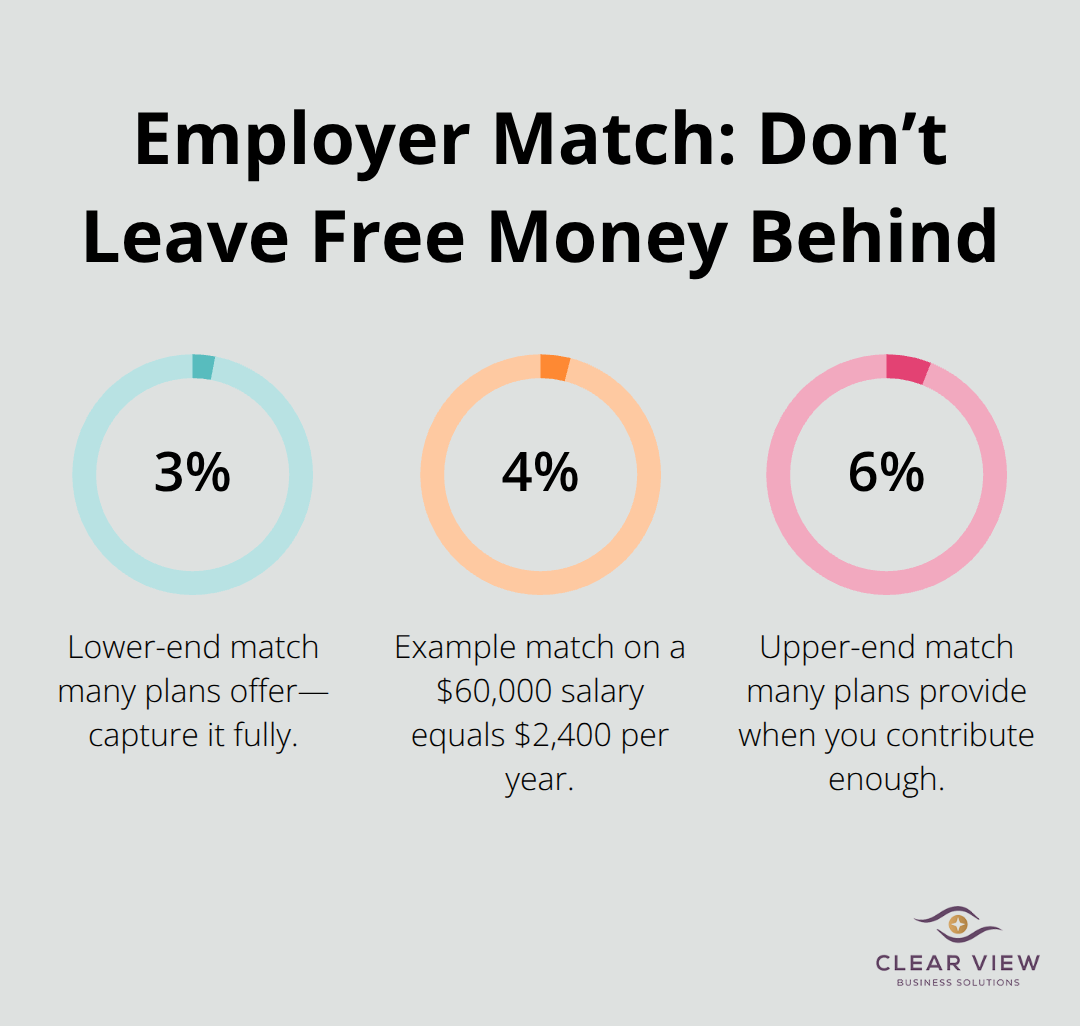
Your career arc fundamentally changes which tax deferral strategies make sense. Early in your career, you have decades of compounding ahead, making aggressive contributions to tax-deferred accounts mathematically superior. At 25 years old with 40 years until retirement, maxing out a 401(k) at $23,500 annually compounds dramatically. If your employer matches contributions, that’s free money sitting on the table-most plans offer 3 to 6 percent matches, and refusing it costs you directly. A 4 percent match on a $60,000 salary equals $2,400 annually that you forfeit if you don’t contribute enough to capture it. Beyond the 401(k), open a traditional IRA immediately to add another $7,000 in annual tax-deferred space (or $8,000 if you’re already over 50, though that’s unlikely at this stage).
The deductibility phase-out around $89,000 for single filers in 2025 means most early-career earners qualify for full deductions. Start here, not with taxable brokerage accounts, because the tax deferral advantage compounds most powerfully over 30+ year horizons.
Mid-career professionals-typically those earning $100,000 to $300,000 annually-face the opposite problem: they’ve outgrown standard 401(k)s and IRAs but haven’t yet optimized business-owner strategies. If you’re self-employed or own a side business, a Solo 401(k) permits combined employee and employer contributions reaching $66,000 annually as of 2023 data, dwarfing what W-2 employees can defer. This matters because mid-career earners often have the highest tax rates of their entire lives, making deferral genuinely valuable. Health Savings Accounts represent an underutilized lever that we see repeatedly neglected. An HSA with a high-deductible health plan ($1,650 individual deductible minimum in 2025) allows tax-deductible contributions of $4,300 annually for self-only coverage, grows tax-free, and permits tax-free withdrawals for qualified medical expenses. Critically, after age 65, you withdraw from an HSA for any reason without penalty-only ordinary income tax applies to non-medical withdrawals, making it function like a second retirement account. The triple tax advantage (deductible contributions, tax-free growth, tax-free qualified withdrawals) makes HSAs the most efficient tax-deferred vehicle available, yet many mid-career earners skip them because they’re unfamiliar.
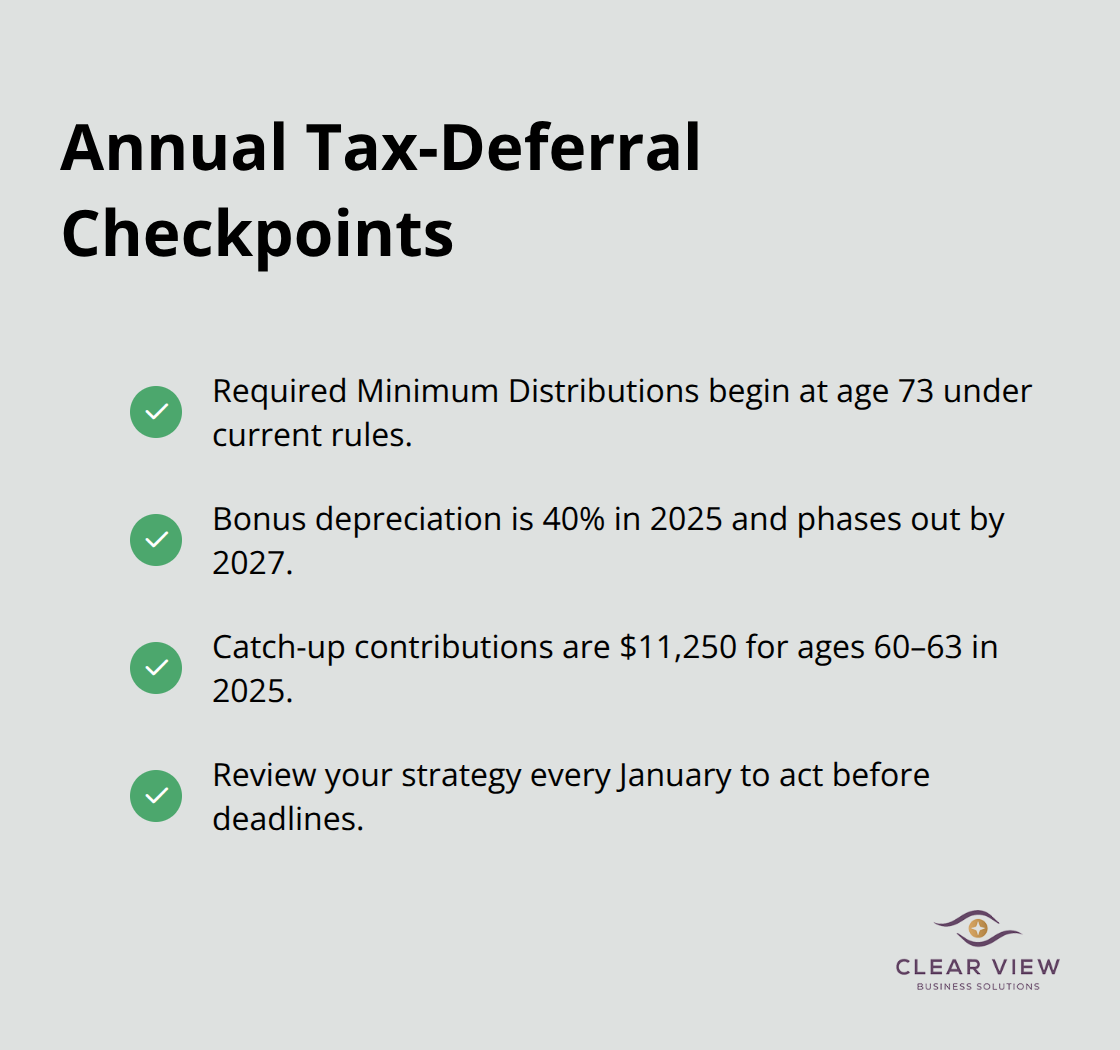
Pre-retirement savers within five to ten years of stopping work face a different calculus entirely. Required Minimum Distributions from traditional accounts begin at age 73 under current rules, potentially pushing you into higher tax brackets than you anticipated. This is where Roth conversions become tactically powerful: convert portions of traditional IRA balances to Roth accounts during lower-income years (perhaps between retirement and Social Security eligibility) to lock in current tax rates on growth that would otherwise face taxation at higher rates later. The 2025 catch-up contribution allowance of $11,250 for ages 60 to 63 acknowledges this reality-your final working years should be hyper-aggressive on deferrals since you have minimal time to recover from market downturns and maximum need to reduce RMDs later. Model out specific conversion windows and Social Security timing to minimize lifetime tax burden rather than just current-year taxes, as this strategic approach transforms your final working years into a powerful wealth-building phase.
Start with your most recent tax return and identify your marginal tax bracket, which determines whether deferral actually saves you money. Your marginal rate is what you pay on the next dollar earned, not your effective rate. If you’re a single filer earning $95,000 in 2025, you’re in the 24 percent federal bracket, meaning every $1,000 deferred saves you $240 in federal taxes alone. This calculation shifts dramatically for higher earners: at $250,000, you’re in the 35 percent bracket, so deferral saves $350 per $1,000 contributed. The IRS publishes these brackets annually, and they change with inflation. Know your exact bracket before choosing accounts, because some strategies only make sense above or below specific income thresholds.
For instance, traditional IRA deductibility phases out starting at $89,000 for single filers in 2025, meaning someone earning $92,000 gets partial deductibility while someone at $95,000 gets none. This threshold-based planning requires precision. Once you know your bracket, calculate what portion of your income you can realistically defer without creating cash flow problems. Most people underestimate how much they can defer because they forget about employer matches and fail to adjust spending. If you earn $100,000 and contribute $23,500 to a 401(k) plus $7,000 to an IRA, you’ve reduced taxable income by $30,500 while your take-home pay drops by roughly $23,000 after tax savings-a manageable reduction for most households.
Account selection demands brutal honesty about your future tax situation rather than assumptions. If you expect to earn more in five years, aggressive traditional deferrals today make sense because your current 24 percent rate beats your future 35 percent rate. If you’re already maxed out on 401(k) and IRA contributions, a Solo 401(k) offers $66,000 in annual space if you’re self-employed, while HSAs deliver triple tax advantages that most people ignore entirely. Taxable accounts become superior specifically when you hold tax-efficient investments like index funds generating mostly long-term capital gains taxed at 15 or 20 percent.
The critical step most people skip is modeling both scenarios: calculate what your accounts will look like in retirement under current tax rates versus higher rates, then choose accordingly. This comparison reveals whether tax deferral actually benefits your specific situation or whether taxable accounts with tax-loss harvesting capabilities serve you better. Your income level, investment type, and retirement timeline all influence which path wins.
Annual reviews matter more than most realize because tax law changes, your income changes, and your goals evolve. In 2025, bonus depreciation sits at 40 percent and phases out by 2027, meaning a business owner should accelerate equipment purchases before the deduction shrinks. Similarly, catch-up contribution limits for ages 60 to 63 jump to $11,250, a signal that your final working years demand aggressive action. Review your strategy every January, not when tax time arrives in April, so you can capitalize on opportunities before they disappear.
Tax deferral strategies work because they align your current tax burden with your future financial reality. The math is straightforward: controlling when you pay taxes rather than paying them immediately compounds into substantial wealth over decades. Early-career professionals gain the most from aggressive 401(k) and IRA contributions, while mid-career earners unlock Solo 401(k)s and HSAs that most people overlook, and pre-retirement savers benefit from strategic Roth conversions and catch-up contributions.
Your tax situation is too complex for generic advice, since Required Minimum Distributions, Social Security timing, state tax changes, and investment type all influence whether tax deferral actually benefits you or whether taxable accounts with tax-loss harvesting serve you better. The difference between a $240,000 and $340,000 retirement account often comes down to decisions you make in your 40s and 50s, not your 20s. Professional guidance becomes essential, not optional, when you want to navigate these decisions with personalized tax planning that accounts for your complete financial picture.
Start by reviewing your current accounts and tax bracket this month, not next April, and identify one opportunity to implement immediately-whether that’s capturing an employer match you’re leaving on the table, opening an HSA, or scheduling a conversation with a tax professional. The cost of inaction compounds far faster than the cost of getting professional guidance. Contact Clear View Business Solutions to discuss your tax deferral strategy and take control of your financial future.




At Clear View Business Solutions, we know you want your business to prosper without having to worry about whether you are paying more in taxes than you should or whether your business is set up correctly. The problem is it's hard to find a trusted advisor who can translate financial jargon to layman's terms and who can actually help you plan for better results.
We believe it doesn't have to be this way! No business owner should settle for working with a CPA firm that falls short of understanding what you want to achieve and how to help you get there.
Northwest Location:
7530 N. La Cholla Blvd., Tucson, AZ 85741
Central Location:
2933 N Campbell Avenue, Tucson, AZ 85719
© 2026 Clear View Business Solutions. All Rights Reserved.
At Clear View Business Solutions, we know you want your business to prosper without having to worry about whether you are paying more in taxes than you should or whether your business is set up correctly. The problem is it's hard to find a trusted advisor who can translate financial jargon to layman's terms and who can actually help you plan for better results.
We believe it doesn't have to be this way! No business owner should settle for working with a CPA firm that falls short of understanding what you want to achieve and how to help you get there. With over 20 years of experience serving hundreds of business owners like you, our team of experts combines financial expertise and proactive communication with our drive to help each client achieve results and have fun along the way.
Here's how we do it:
Discover: We start with a consultation to understand your specific goals, what's holding you back, and what success looks like for you.
Strategize & Optimize: Together, we design a customized strategy that empowers you to progress toward your goals, and we optimize our communication as partners.
Thrive: You enjoy a clear view of your business and your financial prosperity.
Schedule a consultation today, and take the first step toward being able to focus on your core business again without wondering if your numbers are right- or what they mean to your business.
In the meantime, download, "The Business Owner's Essential Guide to Tax Deductions" and make sure you aren't leaving money on the table.