


Nonprofit financial reporting is often treated as a compliance checkbox rather than a communication tool. Yet the way you present your finances directly shapes how donors, board members, and grantmakers view your organization.
We at Clear View Business Solutions have seen firsthand how nonprofits struggle with fund classification, documentation gaps, and unclear reporting. The good news is that these problems are fixable with the right approach.
Nonprofit financial reporting isn’t optional-it’s the foundation of stakeholder trust. The Financial Accounting Standards Board established ASC 958 specifically for not-for-profit organizations, and this framework separates legitimate nonprofits from those operating without proper structure. ASC 958 requires you to classify net assets into three categories: unrestricted, temporarily restricted, and permanently restricted. This distinction matters because donors, grantmakers, and board members need to see exactly how their contributions flow through your organization. Many nonprofits misclassify restricted funds, treating donor-designated money as unrestricted. Auditors catch this violation immediately, and it damages credibility with funders.
The IRS Form 990, which you must file annually if your nonprofit has gross receipts over $50,000, demands detailed breakdowns of revenue sources, expense allocation by function, and compensation for officers and key employees. The deadline is typically May 15 following the fiscal year-end, though you can request an extension. Most nonprofits struggle with incomplete documentation of in-kind donations and failure to maintain supporting records for grant compliance. These gaps create audit findings and raise red flags with grantmakers who review your filing.
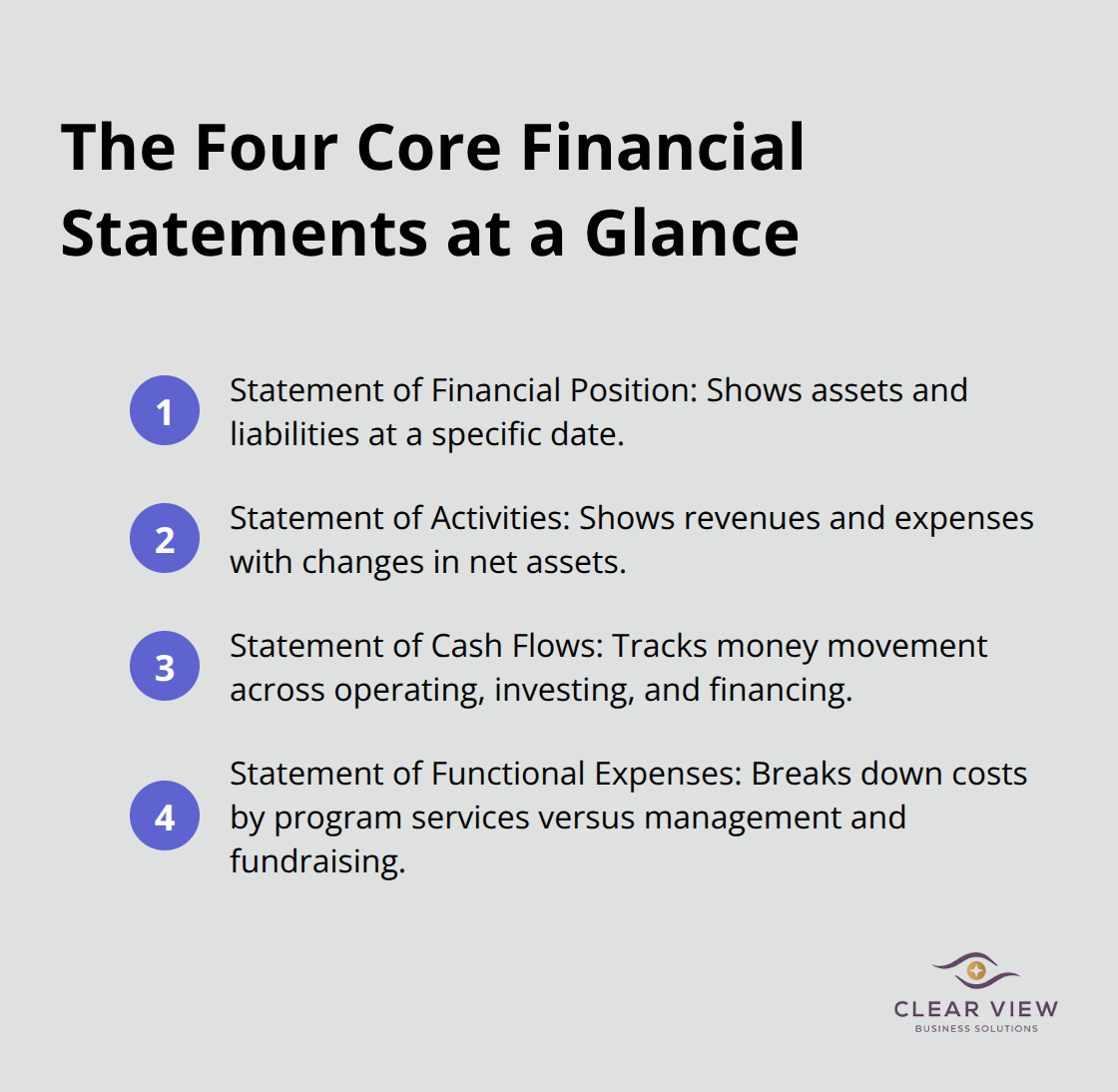
Your financial statements must include four core components: the Statement of Financial Position shows assets and liabilities at a specific date; the Statement of Activities shows revenues and expenses with changes in net assets; the Statement of Cash Flows tracks money movement; and the Statement of Functional Expenses breaks down costs by program services versus management and fundraising. The notes to these statements are where transparency happens-they explain accounting policies, revenue sources, investment strategies, and any significant changes from prior periods. Grantmakers specifically review these notes to verify funds were spent as promised.
Independent audits strengthen credibility; the National Council of Nonprofits confirms that boards have fiduciary duty to verify that financial practices support the mission. Regular account reconciliation prevents errors from accumulating-monthly reconciliation catches discrepancies before they become audit findings. Form 990 public disclosure on your website demonstrates accountability and builds donor confidence faster than any marketing message. The sections covering compensation, related-party transactions, and program accomplishments tell stakeholders your organization operates with integrity.
These foundational elements set the stage for how you communicate financial health to different audiences. The next chapter explores how to present these statements clearly so board members, donors, and grantmakers actually understand what your numbers reveal about organizational performance.
Restricted fund misclassification happens more often than auditors want to admit, and it stems from confusion rather than intentional fraud. A donor gives $10,000 for youth programs, your staff deposits it into the general account, and suddenly that money looks unrestricted on your books. When the audit firm flags this violation, you scramble to reclassify transactions and explain the error to your board. The National Council of Nonprofits emphasizes that boards have fiduciary duty to verify financial practices support the mission, which means your board should spot these errors before an auditor does.
ASC 958 requires three categories of net assets, and treating a restricted gift as unrestricted directly contradicts that framework. The fix is straightforward: implement a donor tracking system that tags every contribution at the point of entry. QuickBooks Online has fields for restricted versus unrestricted funds, and many nonprofits already own the software but fail to use these features. Your accounting system should reject unrestricted coding for donations with explicit donor restrictions.
In-kind donations create a documentation nightmare that grantmakers scrutinize heavily. A nonprofit receives donated office equipment but never records it because no cash changed hands. When a grant funder reviews your Form 990, they see no record of that donation, which raises questions about whether you accurately report your revenue and asset base. The IRS requires you to document in-kind contributions with fair market value assessments and a clear description of what was received.
Most nonprofits fail here because they lack a standard process for capturing these gifts. You need a simple form that staff complete whenever anyone donates goods or services. This form should include the donor’s name, item description, fair market value, and the date received. Store these forms in a central location so your accounting team can record them properly before year-end close.
Monthly reconciliation catches missing transactions before they become audit findings, and it stands as the single most effective control you can implement. Reconcile your bank statements to your general ledger every month without exception. If a donation arrived but your books show a discrepancy, that difference surfaces immediately instead of months later during year-end close.
Account reconciliation also identifies duplicate entries, unauthorized transactions, and timing differences that accumulate into significant errors. Staff should know that monthly reconciliation is non-negotiable, not optional, and that skipping it creates liability for the entire organization. Assign this task to someone with no authority to approve transactions (segregation of duties prevents fraud and catches errors faster). When you reconcile monthly, you build the foundation for accurate financial statements that donors and grantmakers trust.
The next chapter explores how to present these corrected statements clearly so board members, donors, and grantmakers actually understand what your numbers reveal about organizational performance.
Financial statements packed with numbers mean nothing if your board members, donors, and grantmakers cannot extract meaning from them. Most nonprofits present raw financial data without context or translation. A donor sees a Statement of Activities with revenue and expenses listed in accounting categories, but they have no idea whether their $5,000 gift funded 50 youth counseling sessions or paid for administrative overhead. This disconnect costs nonprofits repeat donations and grant funding.
The solution is to pair every financial number with a narrative explanation that connects the data to mission outcomes. Start your financial reports with a one-page executive summary that highlights three to five key takeaways in plain language. Instead of writing “Net Assets Increased by $47,300,” write “We received $120,000 in new grant funding for after-school programming while reducing administrative costs by 8 percent.” This sentence tells stakeholders what happened and why it matters.
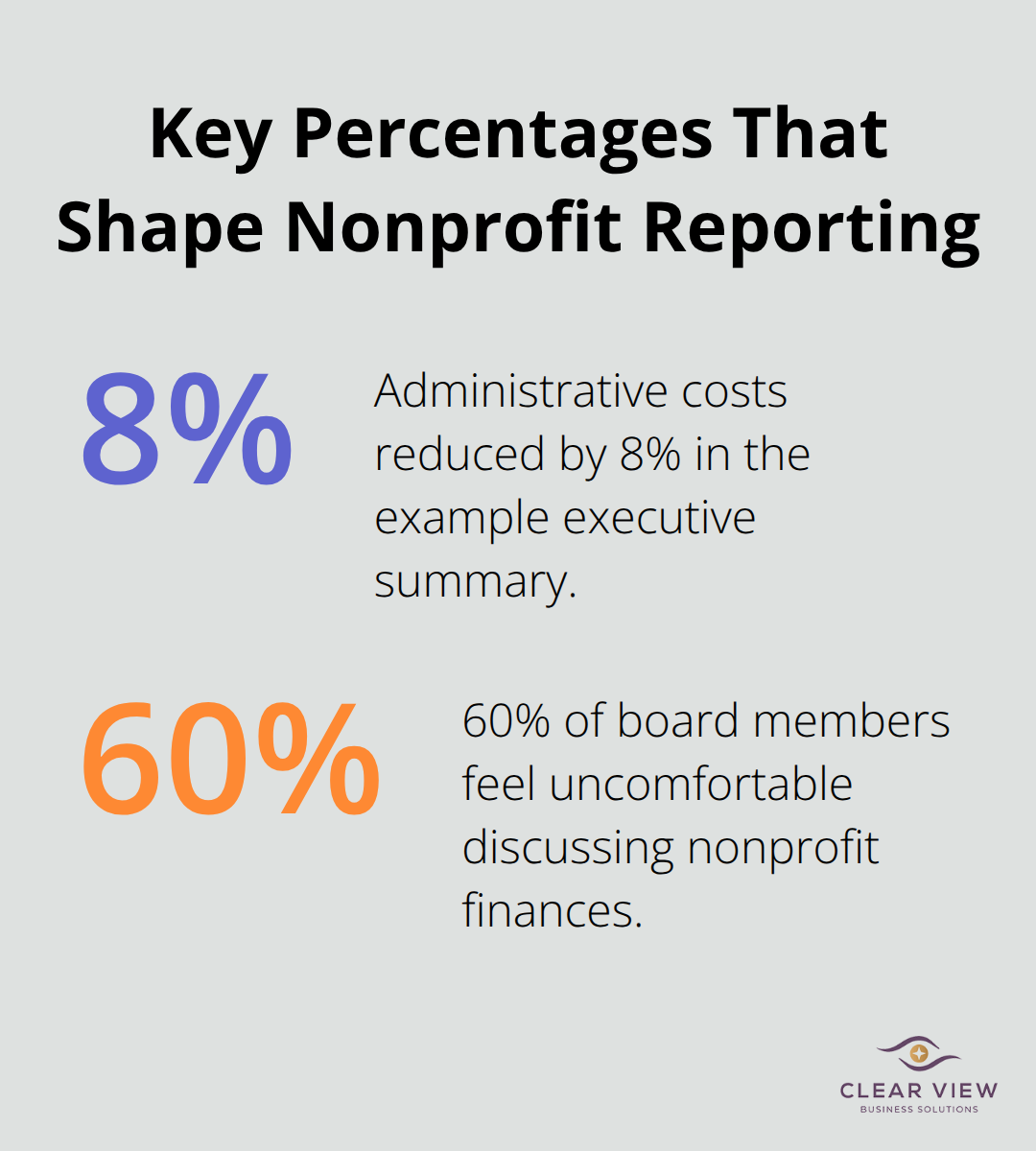
Add a brief explanation of any significant changes from the prior year, such as a drop in individual donations or an increase in program spending. Board members specifically need this context because they vote on budgets and strategic decisions without reviewing detailed accounting notes. Research from BoardSource shows that 60 percent of board members feel uncomfortable discussing nonprofit finances. Your executive summary closes that gap by translating complexity into clarity.
Visual tools eliminate the biggest barrier to stakeholder understanding: dense numbers on a page. Create a simple pie chart showing how your organization spends every dollar, breaking program services, management, and fundraising into distinct segments. Stakeholders want to see revenue fund programs rather than overhead. A single chart proves this instantly without requiring anyone to calculate percentages from your Statement of Functional Expenses.
Add a line graph tracking revenue trends over the past three years so donors can see whether your funding is stable or declining. Include a dashboard on your website or annual report that displays your current ratio (current assets divided by current liabilities) and days cash on hand-two metrics that reveal financial health faster than any narrative. A current ratio above 1.5 signals strong liquidity, while fewer than 90 days of cash reserves indicates vulnerability.
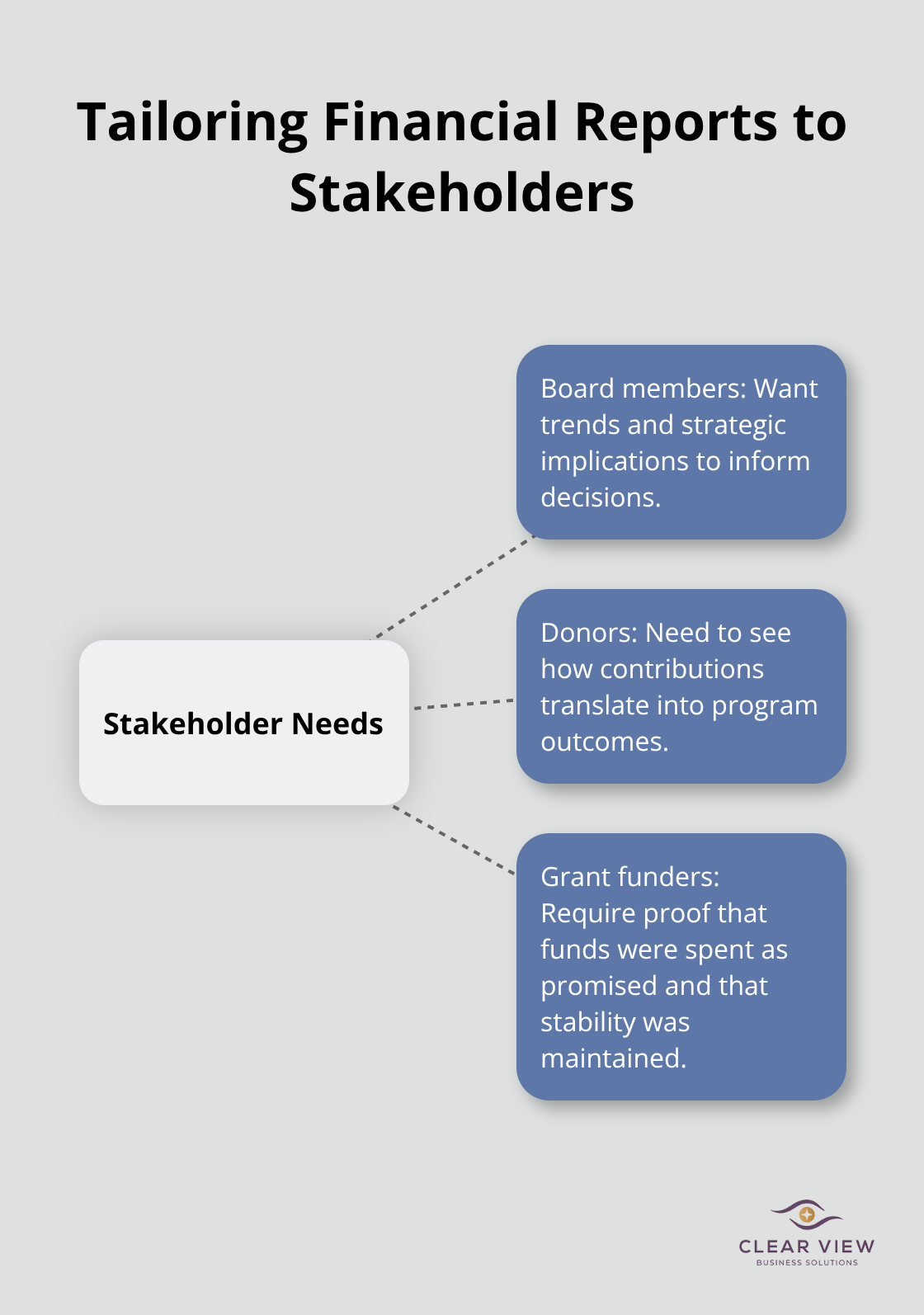
Grantmakers review these metrics before awarding funding because they want confidence that you can sustain operations if grants are delayed. Different stakeholders need different information, so customize your presentation accordingly. Board members want to see trends and strategic implications. Donors want to understand how their contributions translate into program outcomes. Grant funders want proof that you spent their money as promised and maintained financial stability throughout the grant period.
When you present financial data visually alongside numbers, you reduce the cognitive load on readers and help them spot trends and concerns without getting lost in columns. This approach works across all stakeholder audiences and transforms financial reporting from a compliance burden into a genuine communication tool that builds trust and supports your mission.
Nonprofit financial reporting transforms from a compliance burden into a strategic asset the moment your board and donors understand what your numbers reveal. When stakeholders see clear financial data paired with mission outcomes, they trust your organization with larger gifts and renewed grants, and transparency builds credibility faster than any marketing campaign. Start this month by auditing your current financial practices, reviewing how you classify restricted versus unrestricted funds, and implementing a donor tracking system that tags contributions at entry.
Establish monthly bank reconciliation as a non-negotiable practice and assign it to someone without transaction approval authority so discrepancies surface before they become audit findings. Create an in-kind donation form that your staff completes whenever goods or services arrive, then store these forms centrally so your accounting team records them before year-end close. Redesign how you present financial statements to different audiences by writing a one-page executive summary that translates numbers into mission impact and adding visual tools like pie charts and line graphs that reveal financial health.
If your nonprofit lacks the internal capacity to implement these changes, professional support accelerates results significantly. We at Clear View Business Solutions help nonprofits strengthen their financial operations through comprehensive bookkeeping and accounting services tailored to mission-driven organizations, and our team understands nonprofit-specific reporting requirements and works with you to build systems that support both compliance and stakeholder communication. Contact us to discuss how we can help your organization achieve financial clarity and build lasting donor confidence.




At Clear View Business Solutions, we know you want your business to prosper without having to worry about whether you are paying more in taxes than you should or whether your business is set up correctly. The problem is it's hard to find a trusted advisor who can translate financial jargon to layman's terms and who can actually help you plan for better results.
We believe it doesn't have to be this way! No business owner should settle for working with a CPA firm that falls short of understanding what you want to achieve and how to help you get there.
Northwest Location:
7530 N. La Cholla Blvd., Tucson, AZ 85741
Central Location:
2933 N Campbell Avenue, Tucson, AZ 85719
© 2026 Clear View Business Solutions. All Rights Reserved.
At Clear View Business Solutions, we know you want your business to prosper without having to worry about whether you are paying more in taxes than you should or whether your business is set up correctly. The problem is it's hard to find a trusted advisor who can translate financial jargon to layman's terms and who can actually help you plan for better results.
We believe it doesn't have to be this way! No business owner should settle for working with a CPA firm that falls short of understanding what you want to achieve and how to help you get there. With over 20 years of experience serving hundreds of business owners like you, our team of experts combines financial expertise and proactive communication with our drive to help each client achieve results and have fun along the way.
Here's how we do it:
Discover: We start with a consultation to understand your specific goals, what's holding you back, and what success looks like for you.
Strategize & Optimize: Together, we design a customized strategy that empowers you to progress toward your goals, and we optimize our communication as partners.
Thrive: You enjoy a clear view of your business and your financial prosperity.
Schedule a consultation today, and take the first step toward being able to focus on your core business again without wondering if your numbers are right- or what they mean to your business.
In the meantime, download, "The Business Owner's Essential Guide to Tax Deductions" and make sure you aren't leaving money on the table.