


Business tax planning can save companies thousands of dollars annually when implemented correctly. The IRS reports that businesses miss over $1 billion in deductions each year due to poor planning.
We at Clear View Business Solutions see this pattern repeatedly. Smart tax strategies require year-round attention, not last-minute scrambling before deadlines.
Tax planning and tax preparation represent two fundamentally different approaches to business tax management. Tax preparation happens after the year ends when you collect receipts and file returns. Tax planning occurs throughout the year with strategic decisions that reduce your tax burden before it accumulates.
Businesses with proactive tax planning strategies can achieve significant savings compared to those who only focus on tax preparation. This difference translates to thousands of dollars in annual savings for most small businesses.

Business owners often overlook significant deductions that can reduce taxable income substantially. The home office deduction allows businesses to deduct expenses for workspace used exclusively for business purposes (potentially worth thousands annually). Equipment purchases under Section 179 let businesses deduct up to $2,500,000 in 2025 for equipment, with a phase-out threshold beginning when equipment costs exceed this amount.
The Research and Development tax credit provides dollar-for-dollar tax reduction for innovation activities. This makes it more valuable than standard deductions since credits reduce your actual tax bill rather than just taxable income. Professional services, business meals at 50% deduction rate, and employee benefit costs offer additional opportunities to lower tax liability.
Smart businesses control when they recognize income and accelerate expenses to shift tax burdens to more favorable periods. Companies that anticipate higher income next year should accelerate deductible expenses into the current year while they defer income recognition when possible. The opposite strategy works when you expect lower future income.
Bonus depreciation at 40% for 2025 allows businesses to deduct nearly half of equipment costs immediately rather than depreciate over several years. Quarterly estimated tax payments prevent penalties and help manage cash flow (the IRS requires payments when businesses expect to owe $1,000 or more in taxes).
These fundamental strategies form the foundation for more advanced tax optimization techniques that can transform your business structure and maximize long-term savings.
S corporations deliver the most compelling tax advantage for profitable small businesses through self-employment tax savings. Business owners who elect S corp status pay self-employment taxes only on their salary, not on distributions. A business owner who earns $100,000 annually could save tens of thousands in self-employment taxes compared to operation as a sole proprietorship. The IRS requires S corp owners to pay themselves a reasonable salary, but distributions above salary avoid the 15.3% self-employment tax rate.
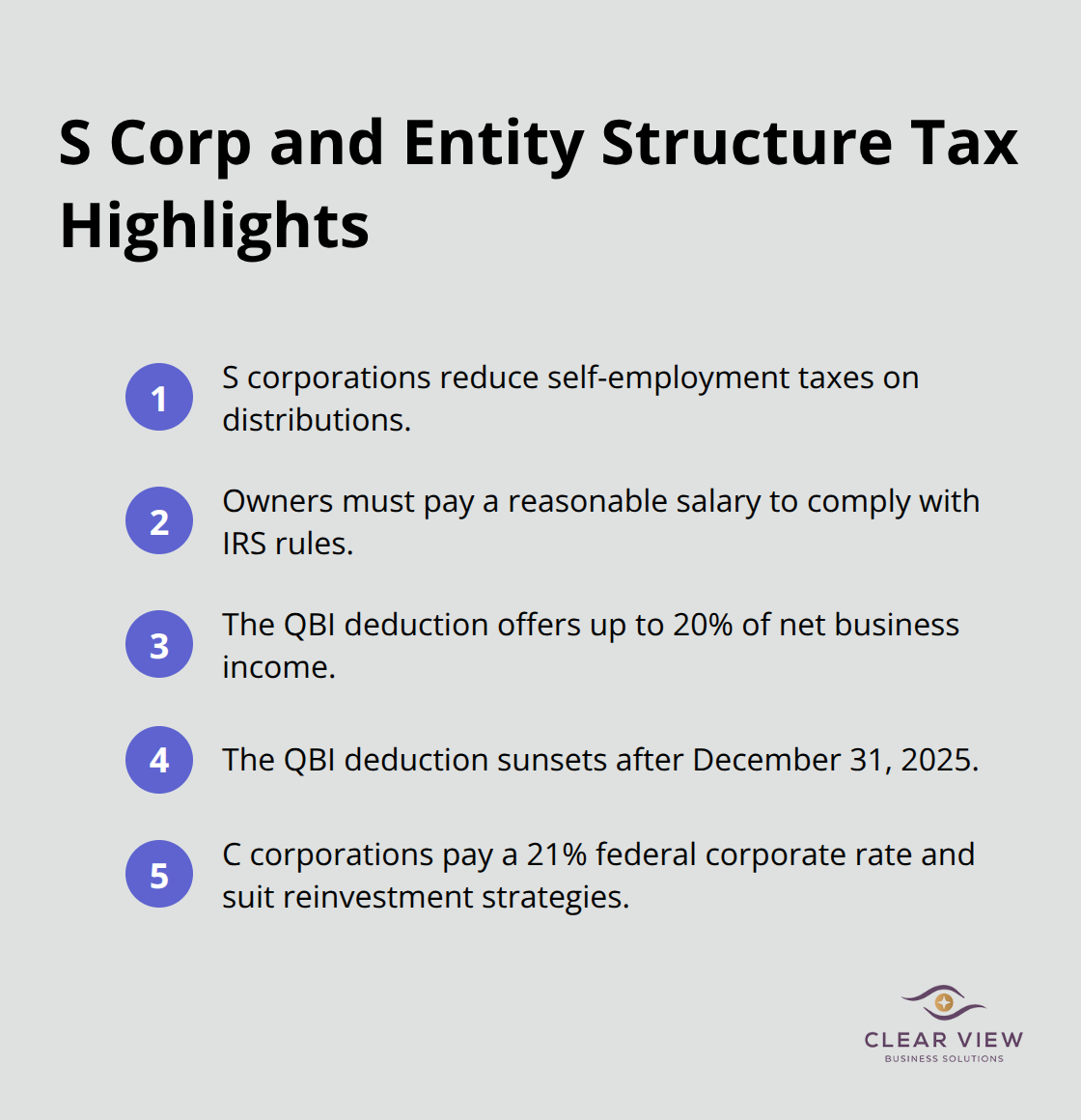
Pass-through entities (including LLCs, partnerships, and S corporations) can claim the Qualified Business Income deduction worth up to 20% of net business income. This deduction expires December 31, 2025, which makes immediate action necessary for businesses that haven’t optimized their structure. C corporations face double taxation with a 21% federal corporate rate plus individual taxes on dividends, which makes them suitable primarily for businesses that plan to reinvest profits rather than distribute them.
Solo 401k plans allow self-employed business owners to contribute up to $69,000 for 2025, which provides immediate tax deductions while they build retirement wealth. Traditional employer 401k plans enable businesses to deduct contributions while they attract quality employees. SEP IRAs offer simpler administration with contribution limits of 25% of compensation up to $70,000 for 2025.
Small businesses with fewer than 25 full-time equivalent employees who earn average wages below $64,000 can claim the Small Business Health Care Tax Credit worth up to 50% of premium costs. Employee benefit deductions include health insurance premiums, dental coverage, and wellness programs that reduce taxable income dollar-for-dollar.
The One Big Beautiful Bill Act enacted July 4, 2025, restored 100% bonus depreciation for equipment placed in service after January 19, 2025. This represents a massive improvement from the previous 60% rate, which allows businesses to deduct the full cost of equipment immediately rather than depreciate over multiple years. Section 179 expensing permits deductions with a minimum of $1,000 of qualified business income required for eligibility.
Manufacturing businesses gain additional advantages through full deductions for facility construction costs when construction begins between January 20, 2025, and December 31, 2028. Research and development expenses incurred from January 2025 forward qualify for immediate deduction, with small businesses able to retroactively expense R&D costs back to 2022.
These strategic choices form the foundation for tax optimization, but even the best strategies fail when businesses make common implementation mistakes that can trigger penalties and missed opportunities.
Poor documentation represents the single biggest threat to business tax savings, with nearly 40% of small business audits starting with simple record keeping errors. Businesses must maintain detailed expense records for at least three years, including receipts, invoices, and bank statements that clearly demonstrate business purpose. The home office deduction faces rejection most frequently because business owners fail to document exclusive business use of their workspace.
Equipment purchases under Section 179 require specific documentation that shows the date placed in service and business use percentage. Without proper records, even legitimate business expenses become worthless during IRS audits. The IRS demands proof of business purpose for every deduction claimed.
Quarterly estimated tax payments become mandatory when businesses expect to owe $1,000 or more in taxes, yet countless small businesses skip these payments and face penalties. The IRS charges a 5% monthly penalty on late payments in many states, which can quickly exceed the original tax owed. Businesses that miss quarterly payments also struggle with cash flow when large tax bills arrive unexpectedly.
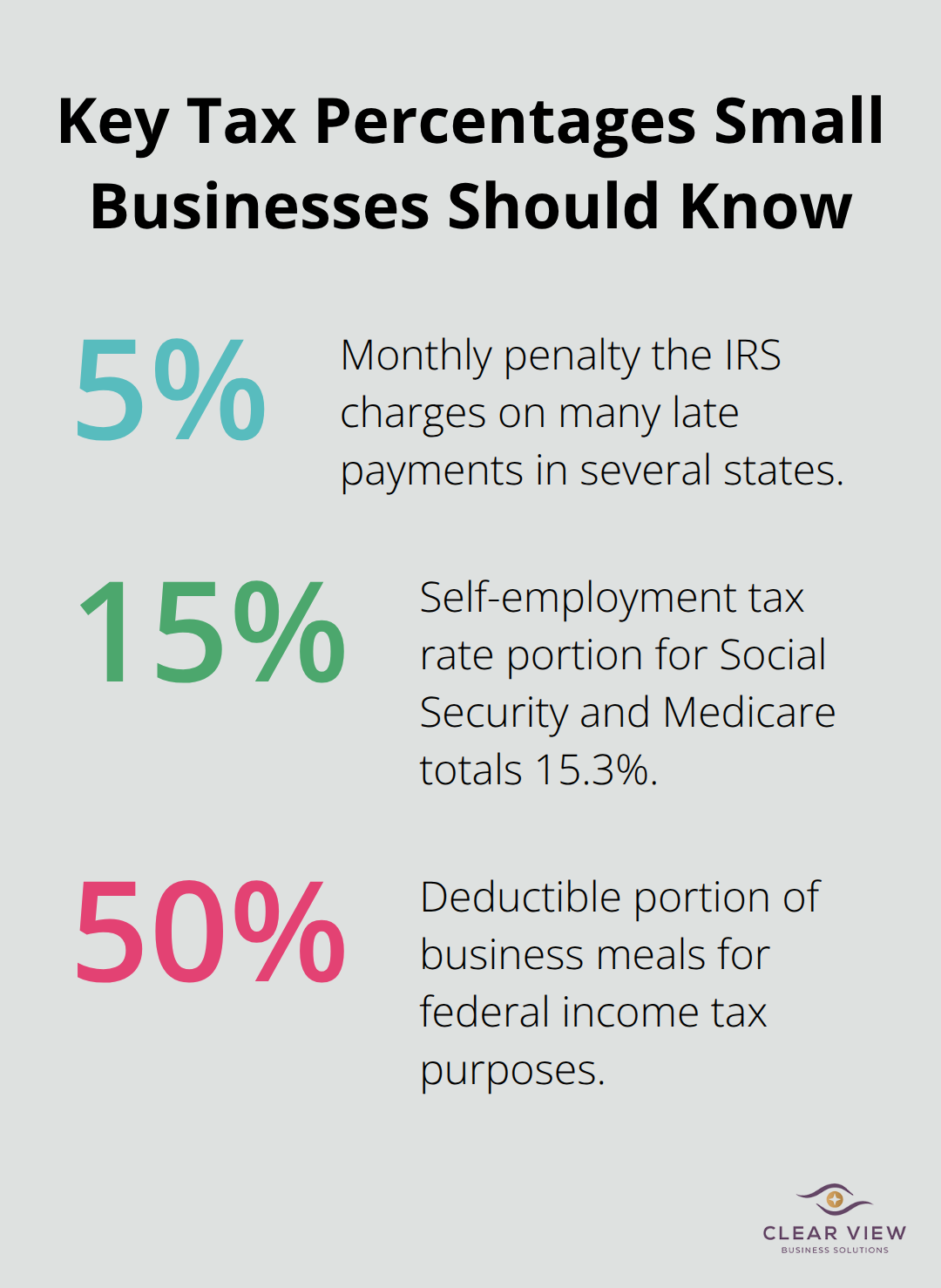
Self-employed individuals and S corporation owners often underestimate their tax liability because they forget about self-employment taxes on top of income taxes (which can reach 15.3% for Social Security and Medicare taxes). Smart businesses calculate estimated payments based on 110% of prior year taxes to avoid penalties while they manage cash reserves effectively.
Business owners who mix business and personal expenses destroy the legal protection that business entities provide and trigger IRS scrutiny. Companies that use business credit cards for personal purchases or pay personal bills from business accounts create documentation nightmares that can invalidate their entity structure. The IRS views mixed expenses as a sign of poor business practices and may reclassify the entire business as a hobby (eliminating all business deductions).
Separate bank accounts, credit cards, and accounting systems cost minimal money but prevent catastrophic tax consequences. Business meals, travel expenses, and equipment purchases must show clear business purpose through proper documentation and separation from personal activities. The cost of separate systems pales compared to the penalties for improper expense classification.
Business tax planning transforms financial outcomes when companies implement strategies consistently throughout the year rather than rush during tax season. Companies that adopt proactive approaches typically save 15-30% more on taxes compared to reactive methods, with savings often reaching tens of thousands annually for profitable small businesses. Professional tax advisory services provide expertise that software solutions cannot match, as tax professionals identify overlooked deductions and navigate complex regulations like the One Big Beautiful Bill Act provisions.
The cost of professional guidance typically pays for itself through discovered savings and avoided penalties. Tax experts adapt strategies to changing laws and help businesses maintain compliance while maximizing benefits. Smart business owners recognize that professional tax advice represents an investment rather than an expense (with returns that often exceed the initial cost by substantial margins).
We at Clear View Business Solutions help Tucson businesses maximize their tax benefits through comprehensive accounting services that simplify complex tax situations. Start implementing these strategies immediately by reviewing your current entity structure, establishing separate business accounts, and scheduling quarterly tax reviews. Document all business expenses meticulously and consider equipment purchases before year-end to maximize Section 179 deductions.
At Clear View Business Solutions, we know you want your business to prosper without having to worry about whether you are paying more in taxes than you should or whether your business is set up correctly. The problem is it's hard to find a trusted advisor who can translate financial jargon to layman's terms and who can actually help you plan for better results.
We believe it doesn't have to be this way! No business owner should settle for working with a CPA firm that falls short of understanding what you want to achieve and how to help you get there.
Northwest Location:
7530 N. La Cholla Blvd., Tucson, AZ 85741
Central Location:
2933 N Campbell Avenue, Tucson, AZ 85719
© 2026 Clear View Business Solutions. All Rights Reserved.
At Clear View Business Solutions, we know you want your business to prosper without having to worry about whether you are paying more in taxes than you should or whether your business is set up correctly. The problem is it's hard to find a trusted advisor who can translate financial jargon to layman's terms and who can actually help you plan for better results.
We believe it doesn't have to be this way! No business owner should settle for working with a CPA firm that falls short of understanding what you want to achieve and how to help you get there. With over 20 years of experience serving hundreds of business owners like you, our team of experts combines financial expertise and proactive communication with our drive to help each client achieve results and have fun along the way.
Here's how we do it:
Discover: We start with a consultation to understand your specific goals, what's holding you back, and what success looks like for you.
Strategize & Optimize: Together, we design a customized strategy that empowers you to progress toward your goals, and we optimize our communication as partners.
Thrive: You enjoy a clear view of your business and your financial prosperity.
Schedule a consultation today, and take the first step toward being able to focus on your core business again without wondering if your numbers are right- or what they mean to your business.
In the meantime, download, "The Business Owner's Essential Guide to Tax Deductions" and make sure you aren't leaving money on the table.