


Tax planning business strategies can save companies thousands of dollars annually. The IRS reports that businesses miss $1.3 billion in deductions each year due to poor planning.
We at Clear View Business Solutions see this pattern repeatedly. Smart tax planning requires understanding deductions, timing strategies, and avoiding common mistakes that cost businesses money.
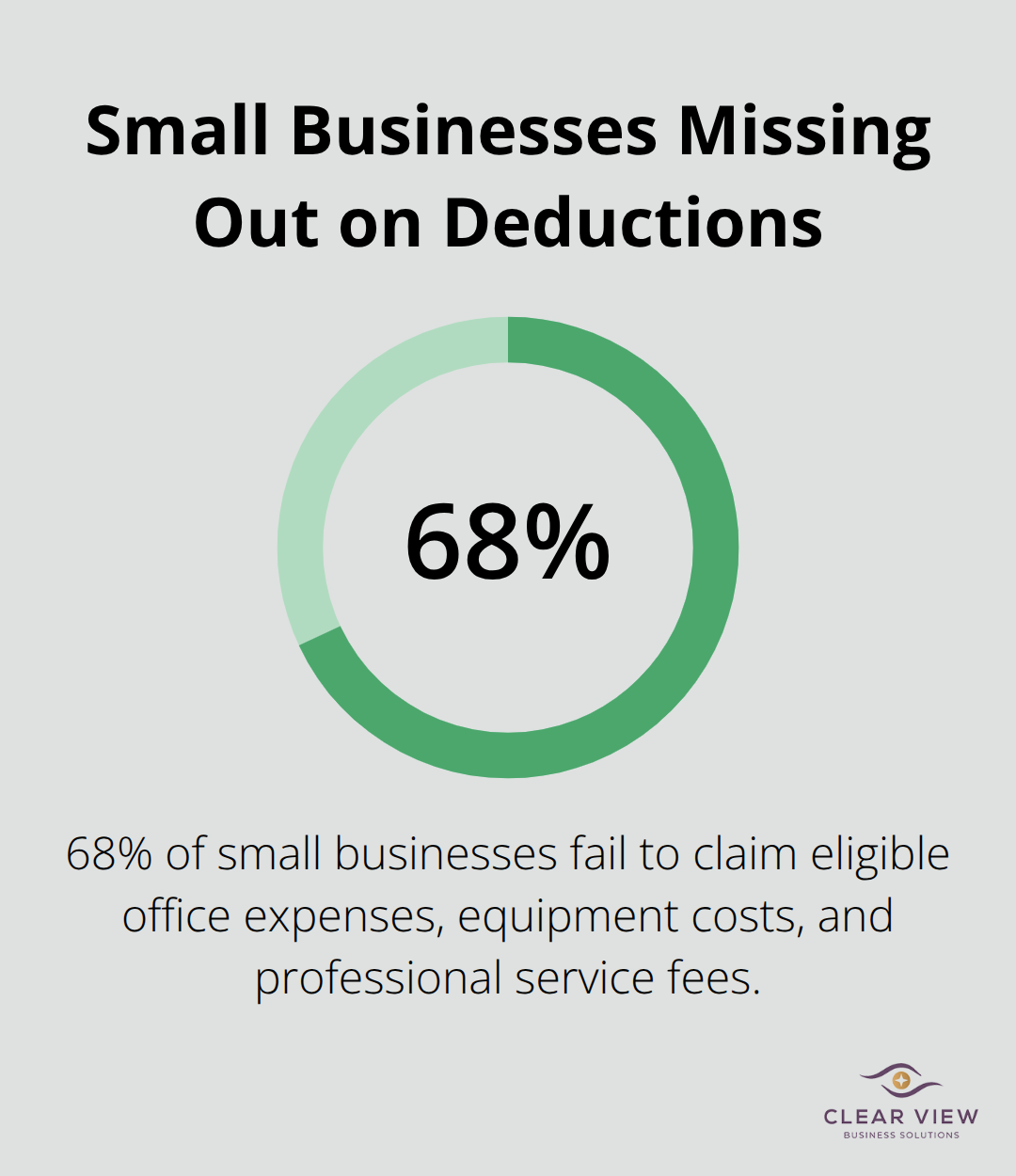
Business tax planning starts with ordinary deductions that most companies overlook. The National Federation of Independent Business found that 68% of small businesses fail to claim eligible office expenses, equipment costs, and professional service fees.
Vehicle deductions alone save $4,200 annually for businesses that use the standard mileage rate of 70 cents per mile. Professional fees, marketing expenses, and software subscriptions qualify as immediate deductions when you document them properly.
Cash-basis businesses control their tax liability through smart timing decisions. You can accelerate expenses into the current year while you defer income until January to reduce immediate tax obligations significantly.
The Section 179 deduction is available to businesses that spend less than $6.5 million per year for equipment. Bonus depreciation adds another layer of savings at 40% for 2025 (though this rate drops to 20% in 2026).
Accrual-basis companies have less flexibility but can still optimize through strategic vendor payments and invoice timing.
S Corporations offer the strongest tax advantages for profitable businesses through salary optimization strategies. Owners pay employment taxes only on reasonable salaries while they take additional profits as distributions.
LLCs provide maximum flexibility and allow owners to elect corporate taxation when beneficial. C Corporations face double taxation but offer better retirement plan options and can retain earnings at lower corporate rates.
The qualified business income deduction allows eligible taxpayers to deduct up to 20 percent of their qualified business income, plus 20 percent of qualified real estate investment trust dividends. This foundation sets the stage for more advanced optimization techniques that can multiply your tax savings.
SEP-IRAs deliver the strongest tax benefits for small business owners. These plans allow contributions up to 25% of compensation with a maximum of $70,000 for 2025. The Small Business Administration reports that businesses with SEP-IRAs reduce their tax liability by an average of $12,800 annually.
Solo 401k plans offer even better flexibility for self-employed individuals. These plans permit both employee and employer contributions that total $70,000 plus $7,500 catch-up contributions for those over 50. The Work Opportunity Tax Credit provides additional savings up to $9,600 when you hire employees from targeted groups and establish retirement plans for them.

Section 179 deductions allow immediate write-offs up to $2,500,000 for equipment that businesses place in service before December 31, 2025. The phase-out threshold sits at $2,890,000, which makes this deduction accessible for most small businesses.
Bonus depreciation adds another 40% deduction in 2025 (though this drops to 20% in 2026). IRS data shows businesses save $23,000 on average through strategic equipment purchase dates. Clean energy equipment qualifies for additional federal tax credits under the Inflation Reduction Act, which creates compound savings opportunities.
Manufacturing equipment, software, and vehicles all qualify when you document the business use percentage properly.
The Small Business Health Care Tax Credit covers up to 50% of employee health insurance premiums for businesses with fewer than 25 employees who earn average wages below $56,000. The Research and Development Tax Credit provides dollar-for-dollar reductions against tax liability, with new 2025 reporting requirements that demand detailed project documentation.
State-specific Qualified Pass-Through Entity taxes help bypass the $10,000 SALT deduction cap in states that participate. These strategies work best when you coordinate the process with your CPA before year-end to maximize their impact on your tax position.
Poor execution of these advanced strategies can create costly mistakes that wipe out potential savings entirely.
The IRS audits businesses with incomplete records at rates 300% higher than those with proper documentation systems. Poor management of data, along with insufficient IT security systems, further intensifies the risk of losing vital business records.
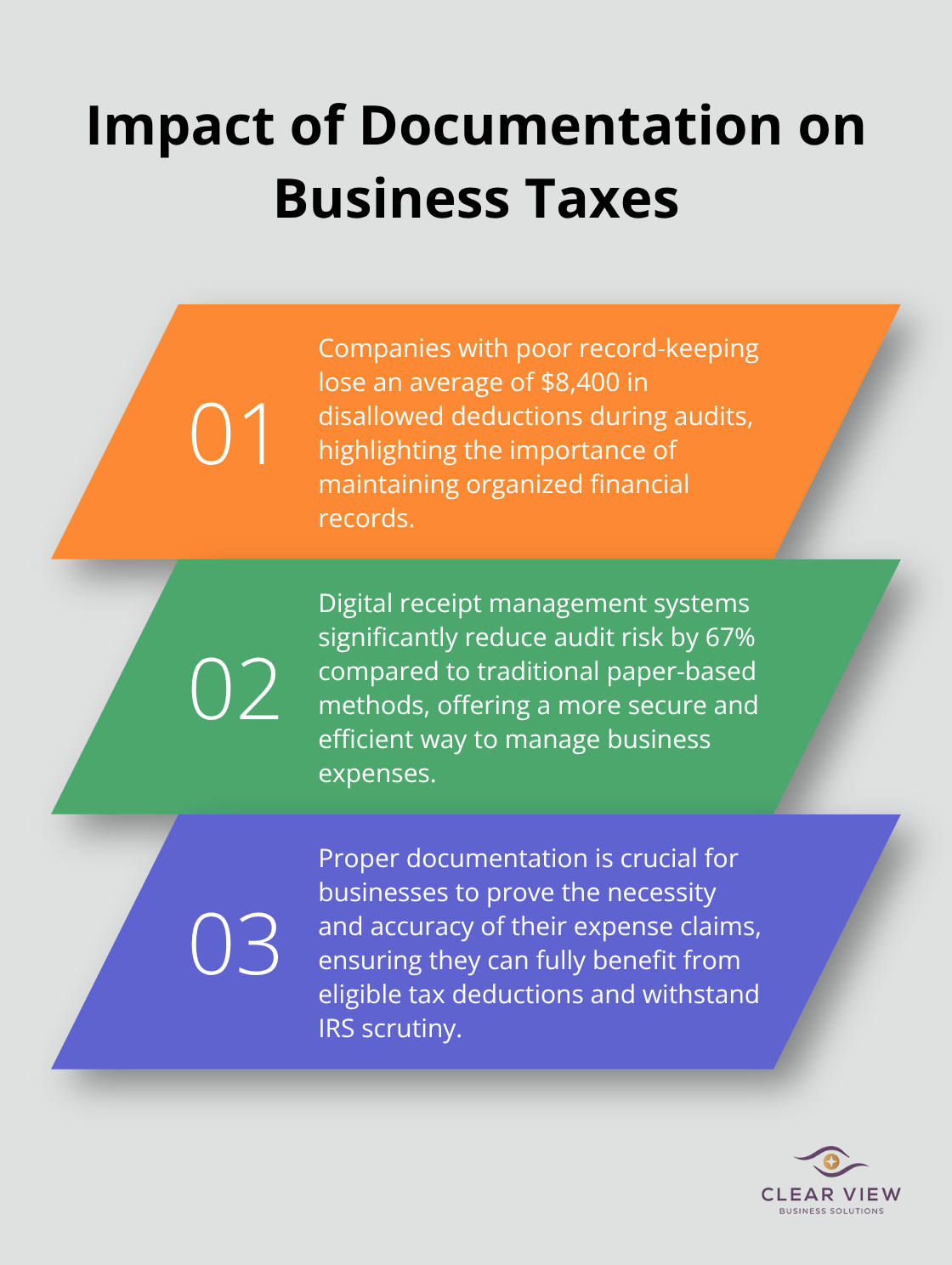
Companies that fail to maintain organized records lose an average of $8,400 in disallowed deductions during audits. Digital receipt management systems reduce audit risk by 67% compared to paper-based methods.
Businesses must track mileage logs, maintain vendor invoices, and document business purpose for every expense claim to survive IRS scrutiny. The agency requires contemporaneous records that prove business necessity and accurate amounts.
The IRS charges failure-to-pay penalties of 0.5% per month on unpaid quarterly taxes, which compounds to devastating amounts over time. Businesses that miss quarterly deadlines face average penalties of $2,800 annually according to Treasury Department statistics.
Safe harbor rules require payments of 100% of prior year taxes or 90% of current year obligations to avoid penalties. Companies with previous year adjusted gross income above $150,000 must pay 110% of prior year taxes quarterly.
State quarterly requirements vary significantly, with California imposing some of the strictest penalty structures that can exceed federal amounts. Electronic payment systems reduce missed deadline risks by 89% through automated scheduling features.
Multi-state businesses face complex requirements that create hidden tax obligations in states where they conduct business activities. State compliance studies indicate that 74.5 percent of businesses comply with use tax requirements, leading to back-tax assessments that average $15,600.
Remote employee locations trigger nexus requirements in 23 states, which creates unexpected obligations for employers. State-specific pass-through entity taxes offer deduction opportunities, but 58% of eligible businesses fail to elect these beneficial tax treatments.
Professional tax guidance becomes essential when state obligations multiply your compliance burden beyond manageable levels. Each state maintains different thresholds for economic nexus (ranging from $100,000 to $500,000 in sales).
Effective tax planning business strategies deliver measurable financial benefits that compound year after year. Companies that implement proper deduction tracking, strategic timing decisions, and entity optimization reduce their tax liability by an average of $15,000 annually. These businesses also avoid costly compliance mistakes that drain resources and create unnecessary stress.
The complexity of modern tax regulations makes professional guidance essential for sustained success. State nexus requirements, quarterly payment schedules, and federal tax credits create compliance challenges that overwhelm most business owners. Documentation failures alone cost companies $8,400 in disallowed deductions during audits (according to IRS audit statistics).
We at Clear View Business Solutions help businesses navigate complex tax strategies and maintain full compliance with federal and state requirements. Our team provides personalized guidance to optimize your financial position through comprehensive tax planning services. Start your tax optimization journey by scheduling a consultation with Clear View Business Solutions to develop a customized strategy that fits your business structure and growth objectives.




At Clear View Business Solutions, we know you want your business to prosper without having to worry about whether you are paying more in taxes than you should or whether your business is set up correctly. The problem is it's hard to find a trusted advisor who can translate financial jargon to layman's terms and who can actually help you plan for better results.
We believe it doesn't have to be this way! No business owner should settle for working with a CPA firm that falls short of understanding what you want to achieve and how to help you get there.
Northwest Location:
7530 N. La Cholla Blvd., Tucson, AZ 85741
Central Location:
2933 N Campbell Avenue, Tucson, AZ 85719
© 2026 Clear View Business Solutions. All Rights Reserved.
At Clear View Business Solutions, we know you want your business to prosper without having to worry about whether you are paying more in taxes than you should or whether your business is set up correctly. The problem is it's hard to find a trusted advisor who can translate financial jargon to layman's terms and who can actually help you plan for better results.
We believe it doesn't have to be this way! No business owner should settle for working with a CPA firm that falls short of understanding what you want to achieve and how to help you get there. With over 20 years of experience serving hundreds of business owners like you, our team of experts combines financial expertise and proactive communication with our drive to help each client achieve results and have fun along the way.
Here's how we do it:
Discover: We start with a consultation to understand your specific goals, what's holding you back, and what success looks like for you.
Strategize & Optimize: Together, we design a customized strategy that empowers you to progress toward your goals, and we optimize our communication as partners.
Thrive: You enjoy a clear view of your business and your financial prosperity.
Schedule a consultation today, and take the first step toward being able to focus on your core business again without wondering if your numbers are right- or what they mean to your business.
In the meantime, download, "The Business Owner's Essential Guide to Tax Deductions" and make sure you aren't leaving money on the table.