


Most small business owners leave money on the table every year. Tax credits for small businesses can reduce what you owe the IRS dollar-for-dollar, yet many owners don’t claim them because they don’t understand how they work.
At Clear View Business Solutions, we’ve helped countless business owners identify credits they qualified for but never used. This guide walks you through the major credits available, exactly how to claim them, and the mistakes that trigger audits.
Tax credits and deductions operate differently, and mixing them up costs small business owners substantial money. A tax deduction reduces your taxable income before the IRS calculates what you owe. If you earn $100,000 and claim a $10,000 deduction, you only pay taxes on $90,000. A tax credit reduces the actual tax you owe dollar-for-dollar after all calculations finish. A $10,000 credit means you pay $10,000 less in taxes, period.
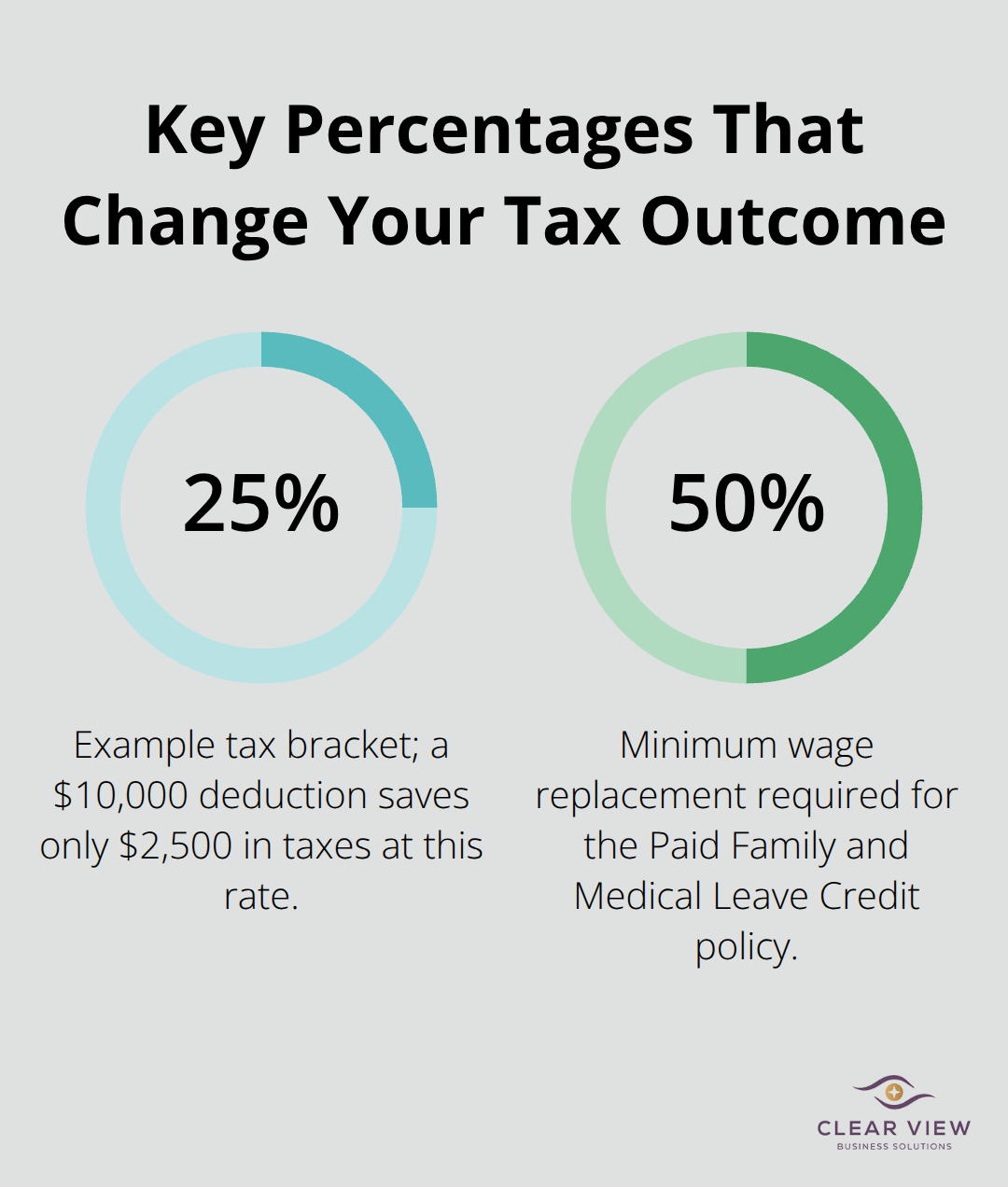
The difference is substantial. If your business operates in a 25% tax bracket, that $10,000 deduction saves you $2,500 in taxes. That same $10,000 credit saves you the full $10,000. According to IRS guidance, credits deliver far more impact than deductions for eligible activities.
Many owners focus on maximizing deductions through business expenses like supplies and mileage, which is smart, but they ignore credits entirely because they don’t understand them.
Credits exist specifically to incentivize certain business behaviors-hiring from disadvantaged groups, investing in research, offering paid family leave. The IRS rewards these actions with direct tax reductions, not just income offsets. The Work Opportunity Tax Credit illustrates this perfectly. If you hire someone from a targeted group and meet the wage requirements, you receive a credit ranging from $2,400 to $9,600 per employee, depending on the target group and hours worked. That credit comes straight off your tax liability.
You could claim this credit and still deduct that employee’s salary as a business expense. You get both benefits simultaneously. The Research and Development Tax Credit works the same way-it reduces your tax bill while you also deduct your R&D costs. Small business owners frequently miss these overlapping opportunities because they view taxes as a single calculation rather than a layered system of deductions plus credits. The IRS treats them separately for a reason.
The catch is that credits have strict eligibility rules. You cannot simply claim every credit available. The Paid Family and Medical Leave Credit requires you to have a written paid leave policy meeting FMLA standards, with at least two weeks of paid leave at 50% wage replacement. You cannot retrofit this retroactively and claim credit for past wages. The credit applies only to wages paid after your policy is in place.
The Employee Retention Credit, which provided up to $7,000 per employee per quarter in 2021 through the American Rescue Plan, required gross receipt declines or government shutdowns-specific conditions, not general hardship. Many owners claimed this credit incorrectly, mixing wages already used for PPP loan forgiveness into their calculations, which triggered audits and penalties.
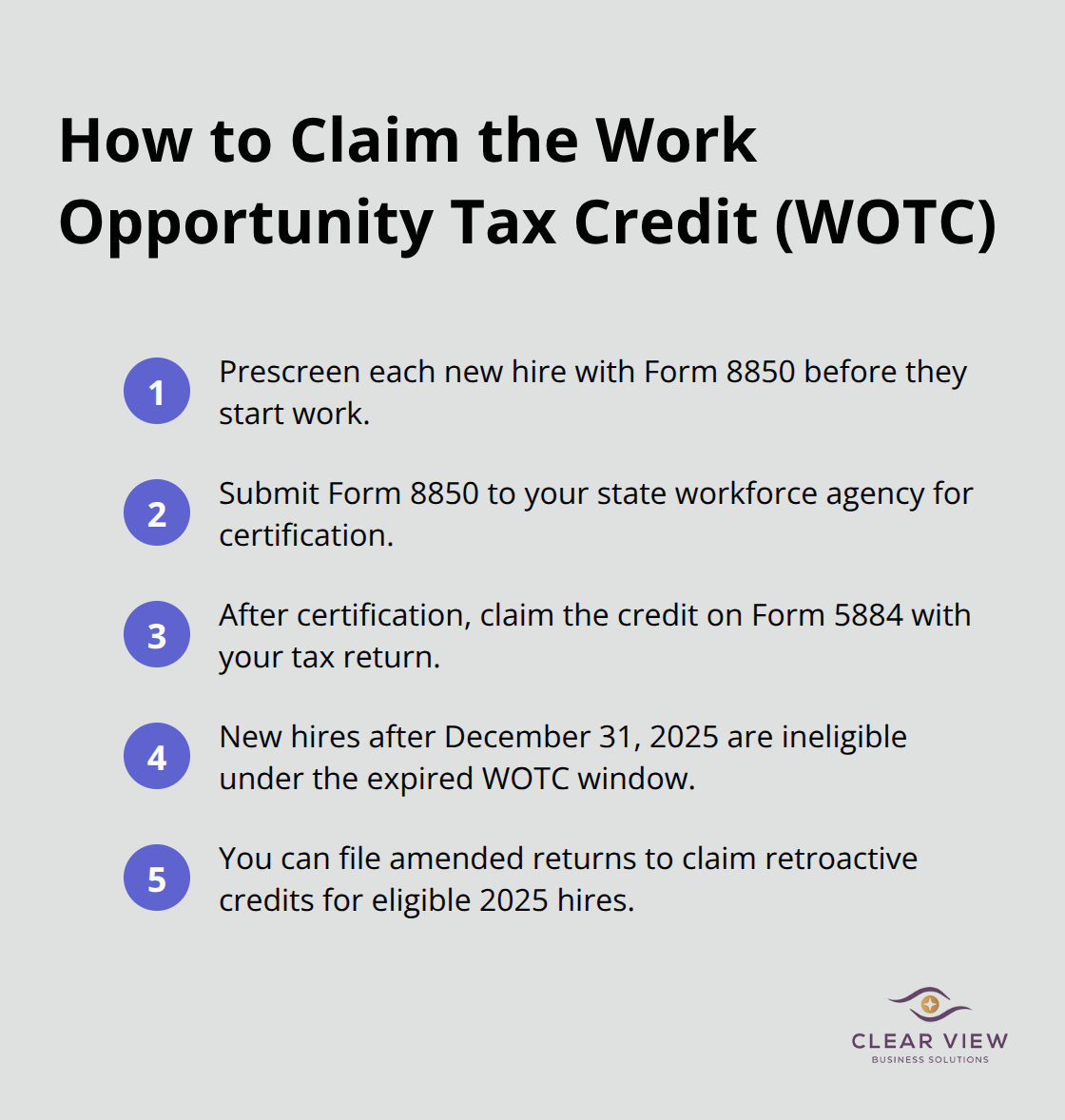
Before claiming any credit, you must confirm your business meets every eligibility threshold: employee count, wage levels, geographic location, qualifying activity documentation, and timing. Skipping this step is how audits start. Documentation requirements vary by credit type, and the IRS expects you to support every claim with records. The Work Opportunity Tax Credit requires Form 8850 (prescreening) and state workforce agency certification before you claim Form 5884. The R&D Tax Credit demands detailed project records showing which expenses qualify. The Paid Family and Medical Leave Credit needs your written policy plus payroll records proving wage amounts and timing.
Getting these details right upfront prevents costly corrections later. With proper documentation in place, you’re ready to move forward with claiming the credits your business actually qualifies for-and understanding exactly how to file them without triggering red flags.
The Research and Development Tax Credit rewards companies that spend money developing new products, improving existing ones, or solving technical problems. If your business develops software, manufactures equipment, or tests new processes, you likely qualify. The credit reduces your federal tax liability for qualifying R&D expenses, and the IRS allows you to claim it on Form 6765 alongside your regular business deductions for those same costs. You receive both benefits simultaneously.
Small businesses with gross receipts under $5 million can use the R&D credit to offset payroll tax liability up to $500,000 annually, which means the credit can generate actual refunds rather than just reducing taxes owed. The investment in documentation pays off immediately through direct tax reduction. Most small manufacturers and software companies leave this credit unclaimed simply because they don’t understand the rules.
You need detailed project records showing which expenses qualify as R&D, but this documentation requirement protects you during audits. Many business owners assume R&D credits apply only to pharmaceutical or aerospace companies. That assumption costs them thousands. If you spent money this year testing product improvements, developing custom software, or engineering solutions to technical problems, you have a legitimate claim.
The Work Opportunity Tax Credit is available to employers for hiring individuals from certain targeted groups who have faced barriers to employment. Eligible groups include individuals receiving SNAP benefits, ex-felons, long-term unemployment recipients, and several others.
The mechanics are straightforward: you prescreen new hires using Form 8850 before they start work, submit it to your state workforce agency for certification, then claim the credit on your tax return. The credit expired December 31, 2025, so this window has closed for new hires. However, if you hired qualifying individuals in 2025, you can still file amended returns to claim retroactive credits. This opportunity remains available for businesses that acted quickly.
The Employee Retention Credit provided up to $7,000 per employee per quarter throughout 2021 under the American Rescue Plan, creating a maximum of $28,000 per employee for the year. However, many businesses claimed it incorrectly by including wages already forgiven under PPP loans, triggering IRS audits and penalties.
If you took PPP funds and claimed ERC on overlapping wages, the IRS will demand repayment plus interest. The credit applied only to wages not used for PPP forgiveness. If your payroll costs exceeded your PPP loan amount, the remaining wages qualified for ERC, but you needed to allocate precisely which wages fell into which category. This credit is largely exhausted now, but if you claimed it and mixed in PPP-forgiven wages, you should consult a tax professional immediately to assess your exposure and file corrected returns before the IRS initiates contact.
Understanding which credits your business qualifies for represents only half the battle. The other half involves proper documentation and filing procedures that prevent costly mistakes during IRS review.
Documentation determines whether the IRS accepts your credit claims or initiates an audit. The IRS rejects credits not because it opposes them, but because businesses file incomplete paperwork or claim wages that fail to qualify. For the Research and Development Tax Credit, you need detailed project records that show which expenses directly support qualifying activities. This means documenting the technical problem you solved, which employees worked on it, how many hours they spent, and the exact costs incurred. Software companies typically track this through project management systems or time sheets; manufacturers through engineering logs and material purchase orders. Form 6765 asks for summary information, but auditors request underlying documentation that proves every expense claimed. Without these records prepared during the year, you’ll scramble to reconstruct them months later when the IRS contacts you. Start building this documentation as work happens, not during tax season.
The Work Opportunity Tax Credit demands a specific documentation sequence that most employers miss. You must file Form 8850 before the new hire starts work-not after, not during their first week. The form prescreens the employee against targeted group criteria, and your state workforce agency certifies whether they qualify. Only after receiving certification can you claim the credit on Form 5884. Many employers skip the prescreen step entirely, assuming they can claim the credit retroactively. That assumption triggers immediate audit flags because the IRS knows most claims without prior certification lack support. If you hired someone in 2025 from a targeted group but never filed Form 8850, you cannot claim the credit now. The window closed when that employee started. This is why eligibility verification must happen before hiring decisions are finalized, not afterward.
The Paid Family and Medical Leave Credit requires your written policy to exist and reach employees before you pay qualifying wages. If you created the policy in June but claim credit for wages paid in January through May, the IRS will disallow those earlier wages because no policy existed then. Form 8994 requires you to certify the policy’s effective date, and auditors cross-reference it against your payroll records.
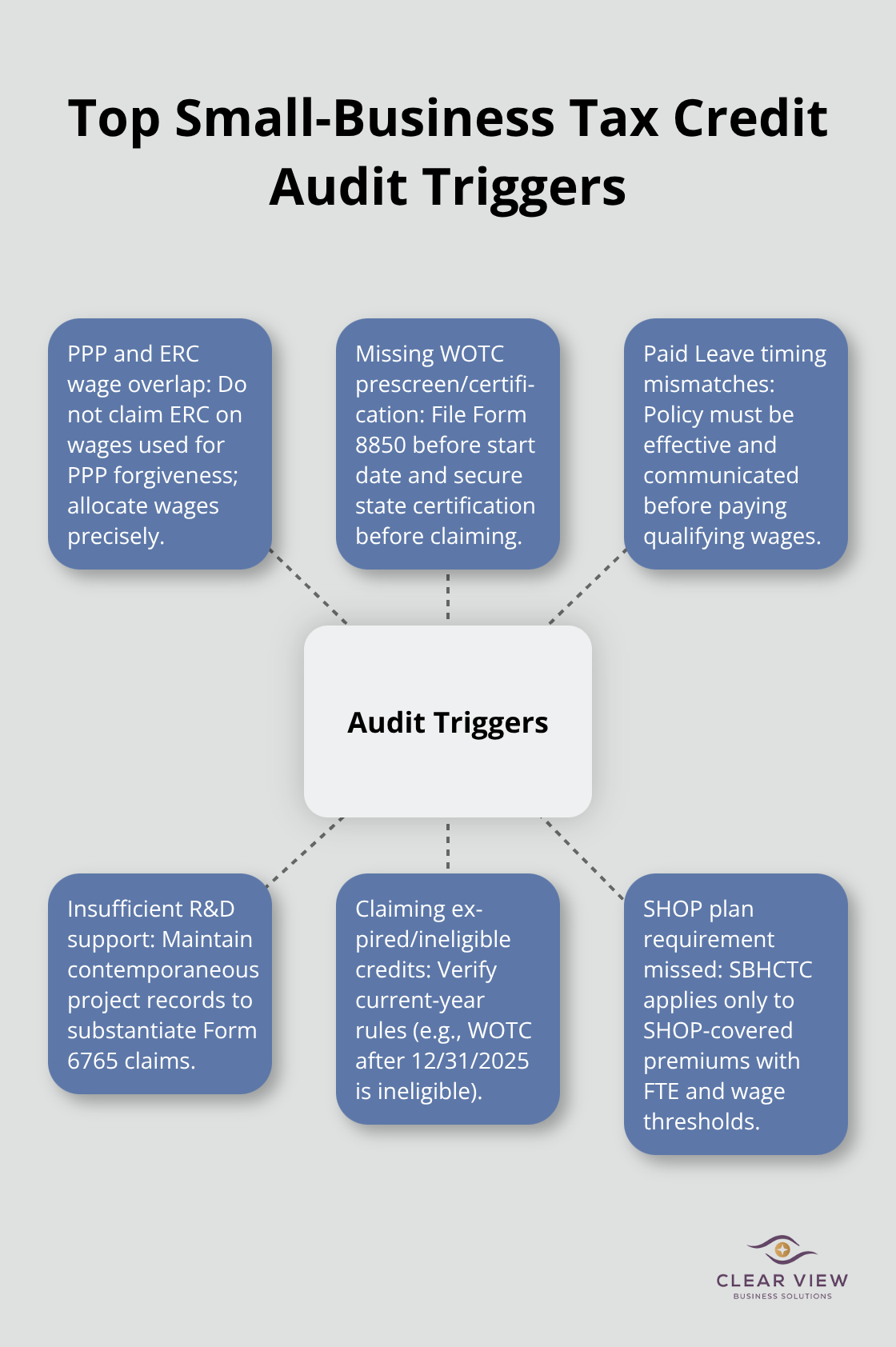
Timing mismatches represent the leading audit trigger for this credit. Your policy must precede the wages you claim, not follow them.
The most dangerous mistake involves mixing PPP-forgiven wages with Employee Retention Credit claims. If you received a PPP loan of $50,000 and used $45,000 for payroll, then claimed ERC on $40,000 of those same wages, the IRS will demand full repayment of the ERC plus interest and penalties. The allocation must be precise: you can claim ERC only on wages not covered by PPP forgiveness. If your payroll costs exceeded your PPP loan amount, the remaining wages qualified for ERC, but you needed to allocate exactly which wages fell into which category. This credit is largely exhausted now, but if you claimed it and mixed in PPP-forgiven wages, you should consult a tax professional immediately to assess your exposure and file corrected returns before the IRS initiates contact.
Another frequent error involves claiming credits without verifying current eligibility rules. The Work Opportunity Tax Credit expired December 31, 2025, yet some businesses will file 2025 returns in 2026 claiming it for hires made in January 2026. That credit no longer applies to new hires, and the IRS will flag this immediately. Before claiming any credit, verify whether it remains active and whether your specific activity qualifies under current-year rules. The Small Business Health Care Tax Credit applies only if you pay health insurance premiums through a SHOP plan and have fewer than 25 full-time equivalents earning below specific wage thresholds. Many owners claim it after offering health insurance through any provider, not realizing the SHOP requirement disqualifies them. Form 8941 and Form 3800 require detailed information about plan structure, and incomplete answers signal audit risk. The solution is straightforward: verify eligibility before filing, gather supporting documentation during the year, and cross-check your credit claims against current IRS guidance. If uncertainty exists about any eligibility rule or documentation requirement, consulting a tax professional before filing prevents costly corrections later.
Tax credits for small businesses represent the fastest way to reduce what you owe the IRS, yet most owners never claim them. The Research and Development Tax Credit, Work Opportunity Tax Credit, and Employee Retention Credit alone can save thousands annually if you qualify and file correctly. The difference between claiming these credits and ignoring them often exceeds the cost of professional tax guidance.
Audit your 2025 hiring, R&D spending, and employee benefits against the eligibility rules outlined in this guide. If you hired from targeted groups, invested in product development, or offered paid family leave, you likely qualify for at least one credit. Document everything now rather than scrambling during tax season, and gather project records, payroll documentation, and policy dates before filing your return.
The cost of mistakes exceeds the cost of getting it right (mixing PPP-forgiven wages with ERC claims triggers audits and penalties, filing without proper documentation invites IRS scrutiny, and claiming expired credits wastes effort). We at Clear View Business Solutions help small business owners identify tax credits for small business that they qualify for and file them correctly. If uncertainty exists about your eligibility or filing requirements, contact Clear View Business Solutions before submitting your return to prevent costly corrections.
At Clear View Business Solutions, we know you want your business to prosper without having to worry about whether you are paying more in taxes than you should or whether your business is set up correctly. The problem is it's hard to find a trusted advisor who can translate financial jargon to layman's terms and who can actually help you plan for better results.
We believe it doesn't have to be this way! No business owner should settle for working with a CPA firm that falls short of understanding what you want to achieve and how to help you get there.
Northwest Location:
7530 N. La Cholla Blvd., Tucson, AZ 85741
Central Location:
2929 N Campbell Avenue, Tucson, AZ 85719
© 2025 Clear View Business Solutions. All Rights Reserved.
At Clear View Business Solutions, we know you want your business to prosper without having to worry about whether you are paying more in taxes than you should or whether your business is set up correctly. The problem is it's hard to find a trusted advisor who can translate financial jargon to layman's terms and who can actually help you plan for better results.
We believe it doesn't have to be this way! No business owner should settle for working with a CPA firm that falls short of understanding what you want to achieve and how to help you get there. With over 20 years of experience serving hundreds of business owners like you, our team of experts combines financial expertise and proactive communication with our drive to help each client achieve results and have fun along the way.
Here's how we do it:
Discover: We start with a consultation to understand your specific goals, what's holding you back, and what success looks like for you.
Strategize & Optimize: Together, we design a customized strategy that empowers you to progress toward your goals, and we optimize our communication as partners.
Thrive: You enjoy a clear view of your business and your financial prosperity.
Schedule a consultation today, and take the first step toward being able to focus on your core business again without wondering if your numbers are right- or what they mean to your business.
In the meantime, download, "The Business Owner's Essential Guide to Tax Deductions" and make sure you aren't leaving money on the table.