


Freelancers and gig workers often leave thousands of dollars on the table each year by missing legitimate tax deductions. The difference between knowing what you can write off and guessing can mean hundreds or thousands in your pocket.
At Clear View Business Solutions, we’ve seen firsthand how proper deduction tracking transforms tax season from stressful to straightforward. This guide walks you through the deductions that matter most for your bottom line.
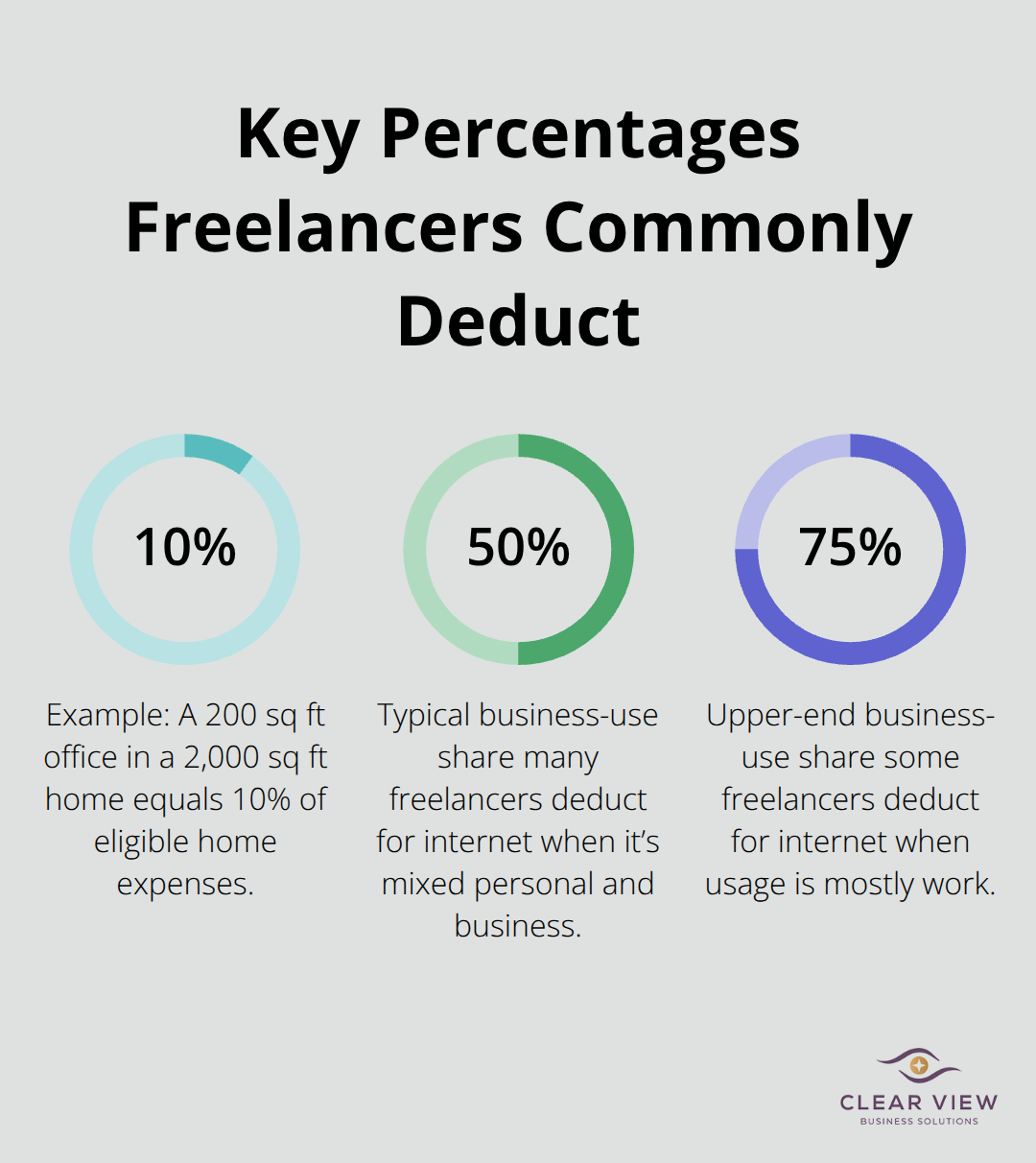
The simplified method sounds convenient, but it often costs you money. Under the IRS simplified approach, you can deduct up to 300 square feet at $5 per square foot, which maxes out at $1,500 annually. The actual expense method, by contrast, lets you deduct a percentage of your real home costs based on your office’s square footage ratio. If you have a 200 square foot home office in a 2,000 square foot house, that’s 10 percent of your mortgage interest, property taxes, utilities, internet, insurance, and maintenance. For most freelancers, the actual expense method delivers significantly larger deductions, especially if you own your home or pay substantial rent. Calculate both methods before filing, then use whichever produces the bigger write-off. The IRS allows this comparison, and you should exploit it.
Grab a tape measure and get exact dimensions of your dedicated workspace. Take photographs showing your office setup, desk, equipment, and how it’s separated from the rest of your home. This documentation becomes your defense if the IRS questions your deduction. The space must be used exclusively for business, not occasionally, so a bedroom that doubles as an office doesn’t qualify. Once you have square footage, calculate the percentage of your home used for business by dividing office square feet by total home square feet. Store these measurements and photos with your tax records. The IRS publication on home offices emphasizes that exclusive business use is non-negotiable, so be honest about your space. If you work at a coffee shop three days a week and a home office two days a week, you cannot claim the full home office deduction.
Your home produces multiple expenses, and only a portion counts as a business deduction. Mortgage interest or rent, property taxes, utilities, internet, home insurance, repairs, and depreciation all factor into the calculation. Multiply each annual expense by your office percentage to find the deductible amount. If your annual electric bill is $1,200 and your office is 10 percent of your home, you deduct $120 in electricity. Internet costs require careful attention. If you use internet solely for business, the entire bill is deductible. If you use it for personal browsing too, allocate a reasonable business percentage (most freelancers deduct 50 to 75 percent of internet costs). Equipment like your desk, chair, and filing cabinets follows depreciation rules under Section 179 expensing, which allows you to deduct up to $2,500,000 in 2025 when property costs are under $4,000,000. Bonus depreciation currently permits 100 percent deduction for qualified property in 2025, meaning office furniture and computers qualify for full write-off in the year you purchase them rather than depreciation over several years. Keep receipts for all home office expenses and track your calculations in a spreadsheet or accounting software. This paper trail protects you during an audit and makes tax season faster.
Separate your home expenses into categories to simplify the calculation process. Utilities (electricity, gas, water) vary monthly, so collect twelve months of bills and calculate the annual average. Internet and phone bills stay relatively consistent, making them easier to track. Home insurance and property taxes appear on annual statements or monthly mortgage statements. Equipment purchases require individual receipts and dates. Create a simple spreadsheet with columns for expense type, date, amount, and business percentage. Update it monthly as bills arrive. This approach prevents you from forgetting expenses and ensures you capture everything deductible. When vehicle and transportation expenses come into play for your business, the same meticulous tracking approach applies, though the methods differ significantly from home office calculations.
The IRS standard mileage rate for 2025 is 70 cents per mile for business driving, and this number matters because it often proves simpler than tracking actual expenses. However, simplicity doesn’t always equal savings. If you drive a fuel-efficient vehicle with low maintenance costs, the standard rate wins. If you own an older truck or SUV with high fuel and repair expenses, actual expense tracking produces bigger deductions. The decision hinges on your specific vehicle and annual mileage. Calculate both approaches: multiply your business miles by 70 cents, then add up actual fuel, maintenance, insurance, and depreciation for the same period. Use whichever total is larger.
The IRS requires meticulous mileage logs regardless of which method you choose. Record the date, starting odometer reading, ending reading, destination, and business purpose for every trip. A single trip without documentation is worthless at audit time. Many freelancers fail here, maintaining vague notes like “client meeting” instead of specifics.
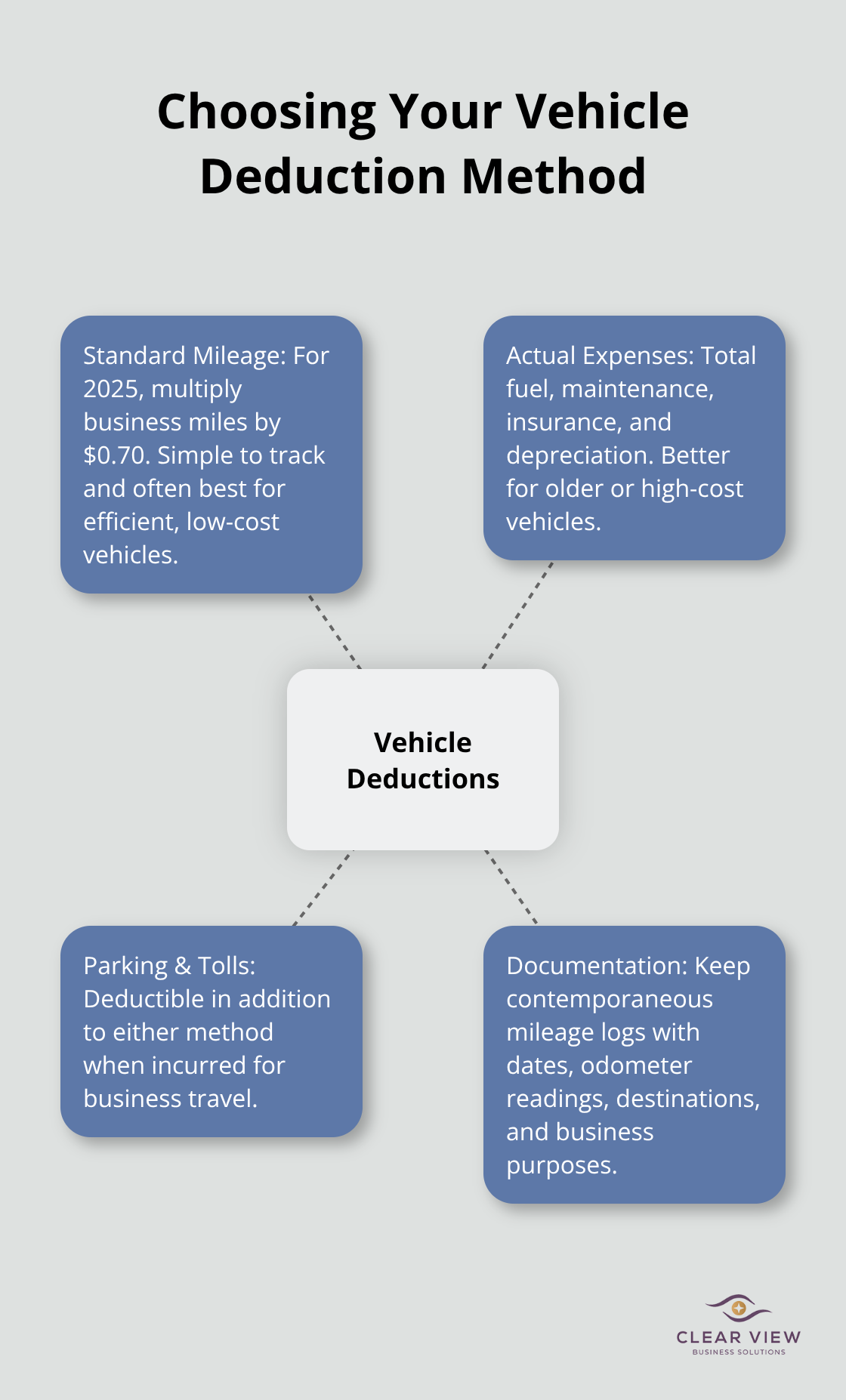
The IRS publication on vehicle expenses emphasizes that contemporaneous records-logged at the time of travel, not reconstructed weeks later-carry the most weight. Digital mileage apps like MileIQ or Stride Health automatically track distance using your phone’s GPS, eliminating manual entry errors and creating timestamped records that survive scrutiny. If you use multiple vehicles for business, allocate mileage between them carefully, as the standard rate applies differently depending on which vehicle you drove. Personal use miles never count, so a trip to the grocery store doesn’t get logged, but a drive to meet a client does.
Fuel, maintenance, repairs, insurance, and depreciation become deductible only when you choose actual expense tracking over the standard rate. Fuel receipts should be collected monthly and categorized by date and amount. Maintenance records from your mechanic provide documentation for oil changes, tire rotations, and repairs. Insurance premiums for business vehicle coverage are fully deductible, though personal vehicle insurance isn’t. Depreciation requires Form 4562 and follows Section 179 expensing rules, allowing accelerated deductions in the purchase year. Create a dedicated folder or spreadsheet for transportation receipts, organized by month. Upload photos of receipts to cloud storage immediately to prevent loss.
Parking fees and tolls incurred during business travel stack on top of your mileage or actual expense deduction, so save every receipt from parking lots and toll roads. These small expenses compound into significant deductions when tracked consistently. At tax time, sum the categories and reconcile against your mileage log to catch discrepancies. If your mileage log shows 12,000 business miles but fuel receipts suggest only 8,000 miles worth of driving, the IRS will question the difference. Consistency between your logs and receipts is your strongest defense. Beyond vehicles, your office itself generates another category of deductions that many freelancers overlook entirely-the supplies and equipment you purchase to run your business.
Office supplies and software subscriptions rank among the easiest deductions to claim because nearly every purchase qualifies immediately. Pens, paper, notebooks, printer ink, folders, and desk organizers are fully deductible in the year you purchase them on Schedule C. The same applies to software subscriptions that directly support your work. Adobe Creative Cloud, project management tools like Asana, accounting software, and industry-specific applications all qualify as ordinary and necessary business expenses. These consumables and recurring subscriptions reduce your taxable income dollar-for-dollar when purchased.
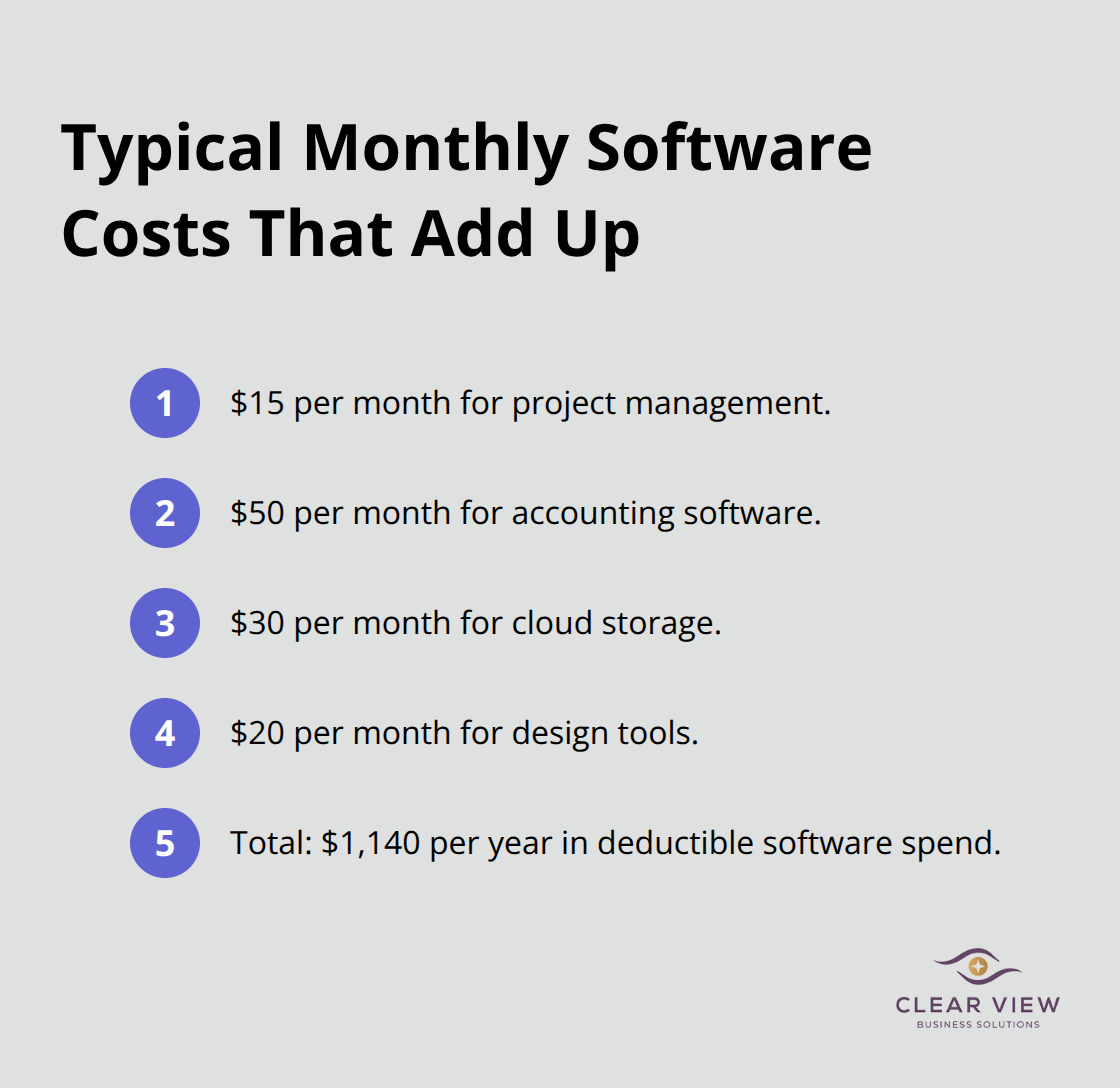
Many freelancers underestimate this category because individual purchases feel small, but software subscriptions compound quickly. A freelancer paying $15 monthly for project management, $50 for accounting software, $30 for cloud storage, and $20 for design tools spends $1,140 annually. Tracked properly, that $1,140 directly lowers taxable income. Create a monthly expense log in a spreadsheet or accounting software, categorizing each purchase as office supplies or software.
Save all receipts digitally through a receipt scanner or cloud backup service. This documentation protects you during audits and makes year-end tax preparation straightforward.
Items under $2,500 that you consume quickly, like printer paper or art supplies, expense immediately. Equipment with longer useful lives, including computers, furniture, machinery, or specialized tools, falls under depreciation rules governed by Section 179 expensing rules for equipment depreciation. The 2025 tax code allows 100 percent bonus depreciation for qualified property, meaning a $3,000 laptop or $1,500 ergonomic desk qualifies for full deduction in the purchase year rather than depreciation spread across multiple years. This accelerated deduction substantially reduces your current-year tax bill.
Courses that maintain or improve your existing trade skills qualify for immediate deduction on Schedule C. A copywriter taking a course on SEO writing or a graphic designer studying new design software can deduct tuition and course materials. However, courses that qualify you for an entirely new profession fail the test. The distinction matters. A photographer learning advanced lighting techniques qualifies; a photographer enrolling in law school does not. Document the business purpose of each course by saving the course description and your notes explaining how it relates to your current freelance work. When claiming education expenses, avoid claiming the same expense twice by choosing between the education deduction and education credits like the American Opportunity Credit, as the IRS prohibits both.
Track all three categories-supplies, equipment, and education-in separate line items within your tax records so nothing gets overlooked during filing. This organization system prevents duplicate claims and ensures you capture every eligible expense.
Tax deductions for freelancers represent real money that stays in your business instead of flowing to the IRS. Home office deductions, vehicle expenses, and business supplies collectively reduce taxable income by thousands annually when you track them properly. Your documentation system determines whether you capture every deduction or leave money on the table.
A spreadsheet tracking home office expenses by category, a mileage log updated weekly, and a folder for software receipts create the foundation for confident tax filing. Digital tools like receipt scanners and cloud storage eliminate the risk of lost documentation. Without this paper trail, even legitimate deductions become indefensible during an audit.
We at Clear View Business Solutions help freelancers and small business owners navigate these deductions and maximize their tax benefits through personalized tax planning and full-cycle bookkeeping. Our team specializes in ensuring compliance while identifying every deduction you qualify for, so you keep more of what you earn. Visit Clear View Business Solutions to learn how we support freelancers in Tucson with tax planning, bookkeeping, and IRS representation tailored to your business needs.




At Clear View Business Solutions, we know you want your business to prosper without having to worry about whether you are paying more in taxes than you should or whether your business is set up correctly. The problem is it's hard to find a trusted advisor who can translate financial jargon to layman's terms and who can actually help you plan for better results.
We believe it doesn't have to be this way! No business owner should settle for working with a CPA firm that falls short of understanding what you want to achieve and how to help you get there.
Northwest Location:
7530 N. La Cholla Blvd., Tucson, AZ 85741
Central Location:
2933 N Campbell Avenue, Tucson, AZ 85719
© 2026 Clear View Business Solutions. All Rights Reserved.
At Clear View Business Solutions, we know you want your business to prosper without having to worry about whether you are paying more in taxes than you should or whether your business is set up correctly. The problem is it's hard to find a trusted advisor who can translate financial jargon to layman's terms and who can actually help you plan for better results.
We believe it doesn't have to be this way! No business owner should settle for working with a CPA firm that falls short of understanding what you want to achieve and how to help you get there. With over 20 years of experience serving hundreds of business owners like you, our team of experts combines financial expertise and proactive communication with our drive to help each client achieve results and have fun along the way.
Here's how we do it:
Discover: We start with a consultation to understand your specific goals, what's holding you back, and what success looks like for you.
Strategize & Optimize: Together, we design a customized strategy that empowers you to progress toward your goals, and we optimize our communication as partners.
Thrive: You enjoy a clear view of your business and your financial prosperity.
Schedule a consultation today, and take the first step toward being able to focus on your core business again without wondering if your numbers are right- or what they mean to your business.
In the meantime, download, "The Business Owner's Essential Guide to Tax Deductions" and make sure you aren't leaving money on the table.