


Trust accounting isn’t optional-it’s a legal requirement that protects your clients and your business. At Clear View Business Solutions, we’ve seen firsthand how poor trust accounting practices expose firms to regulatory penalties, client disputes, and reputational damage.
This guide walks you through the systems, controls, and procedures that separate compliant firms from those facing audits and sanctions.
Trust accounting is fundamentally about tracking every dollar that moves in and out of accounts you control on behalf of someone else. It’s not bookkeeping with a different name-it’s a legal framework that documents your fiduciary responsibility. At its core, trust accounting separates what belongs to the beneficiary from what you’ve earned or spent. You track receipts (income from investments, rent, or other sources), disbursements (distributions to beneficiaries, taxes, administrative fees), and asset changes (purchases or sales of property, stocks, or bonds).
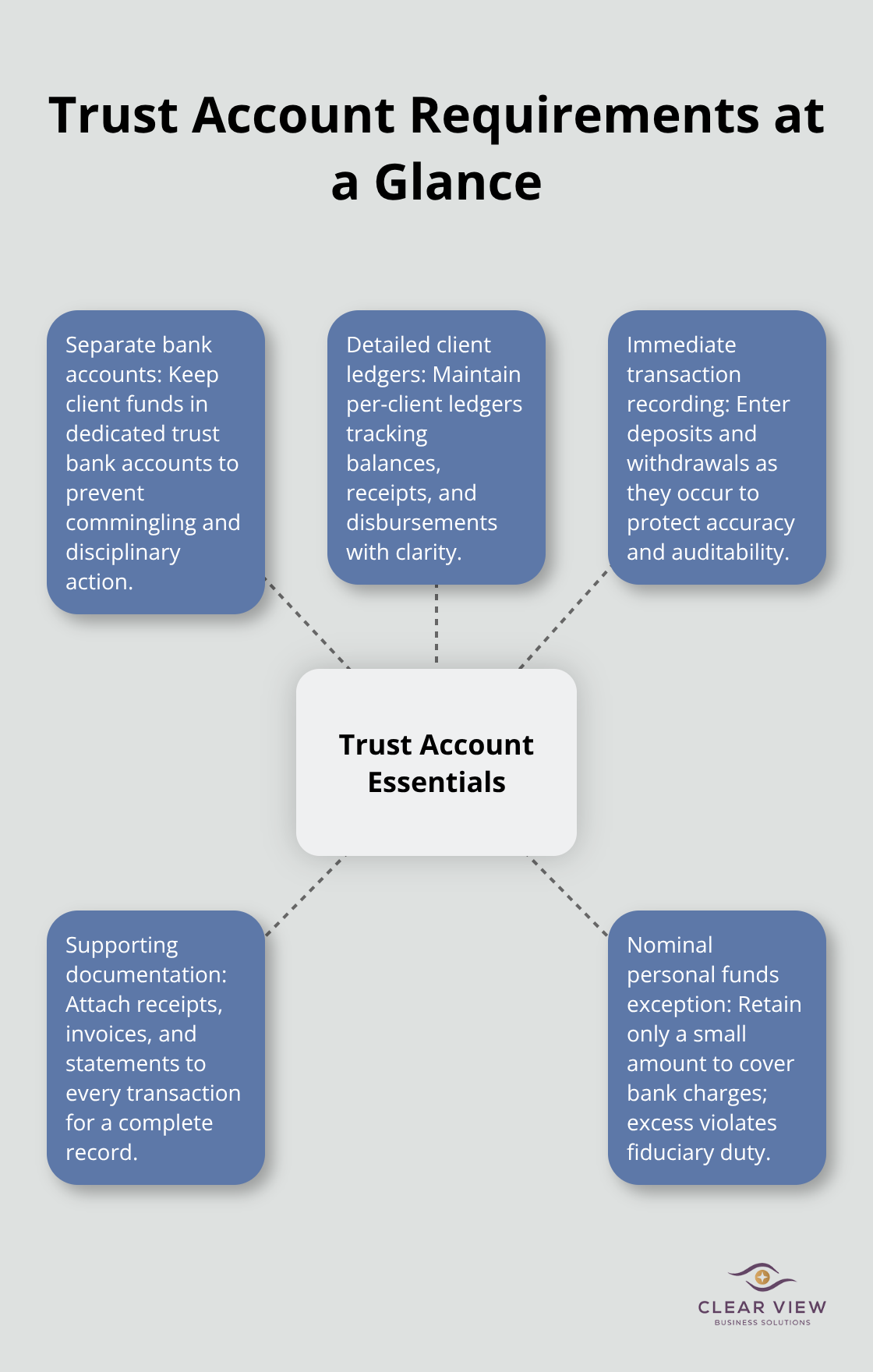
The American Bar Association’s trust accounting guidelines make clear that commingling client funds with personal or firm money violates fiduciary duty, and even small violations trigger state bar discipline. According to LawPay’s compliance data, attorneys holding client funds are considered fiduciaries, and mismanagement leads directly to state bar action. This means trust accounts require separate bank accounts, detailed ledgers for each beneficiary or client, and immediate recording of every transaction with supporting documentation like receipts and invoices. You cannot keep personal funds mixed with trust funds-only a nominal amount to cover bank charges qualifies as an exception.
Your legal obligation as a fiduciary spans three core duties: loyalty, care, and disclosure. Loyalty means the beneficiary’s interests come before your own-no self-dealing or hidden conflicts. Care requires you to make informed decisions and document your reasoning. Disclosure demands transparency through regular reporting to beneficiaries about assets, income, expenses, and distributions. State laws across the country, including California’s trust law, reinforce these duties by requiring that you act with integrity and demonstrate compliance through accurate accounting.
Failure to account ranks among the most serious breaches of fiduciary duty in Massachusetts and other jurisdictions, with courts treating it as grounds for removal and personal liability. The consequences of poor practices are concrete: regulatory penalties, audits, removal as trustee or attorney, litigation costs, and repayment of misused funds. LawPay reports that firms relying on manual processes or generic accounting software face significantly higher error rates and compliance gaps. Daily data backups, three-way monthly reconciliations (comparing bank statements, trust liability, and per-client balances), and IOLTA-compliant software aren’t suggestions-they’re the baseline for avoiding liability.
These foundational requirements set the stage for the systems and controls that actually prevent problems before they start.
Separating trust funds from operating money sounds straightforward until you face the reality of daily operations. Firms lose thousands to commingling errors because they use generic bank accounts or fail to establish dedicated infrastructure from day one. The foundation of compliant trust accounting is physical separation: one bank account for trust funds, another for operating expenses, and a third for any nominal personal funds needed to cover bank charges. This three-account structure prevents the accidental transfer that triggers bar discipline.
Within that trust account, you maintain a general ledger showing total trust liability and individual client or beneficiary ledgers tracking their specific balance. The ledger entries must happen immediately when money moves-not weekly, not daily, but within hours. Every deposit requires documentation showing the source, client name, date, and amount. Every withdrawal requires the same detail plus the purpose and recipient. Your bank statements become the truth source; reconcile them monthly against your ledgers to catch errors before they compound into larger problems.
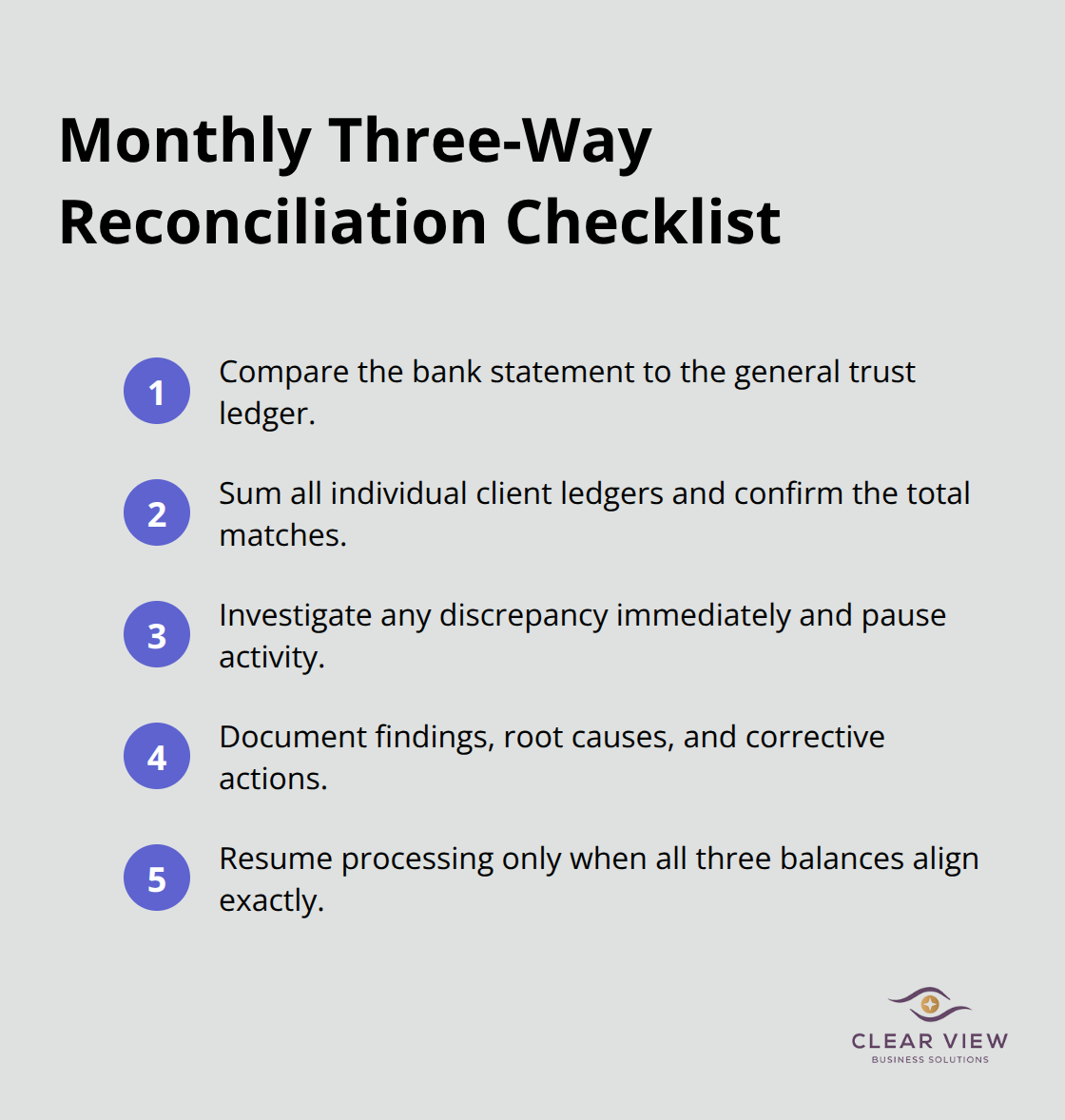
Regular reconciliation separates firms that catch problems from those that face audits. Three-way reconciliation means comparing your trust account bank statement, your general trust ledger, and the sum of all individual client ledgers monthly. These three numbers must match exactly. If they don’t, you stop and investigate immediately.
Firms conducting monthly three-way reconciliations catch errors quickly, while those reconciling quarterly miss problems that grow into disputes.
Beyond monthly reconciliation, you need quarterly audits where you verify account balances against supporting documentation and annually compare trust account records against tax filings. Specialized trust accounting software (IOLTA-compliant platforms) automates much of this work and creates audit trails that show who accessed what and when. Generic accounting software fails because it doesn’t track the principal-versus-income distinction required for trust reporting or generate the beneficiary statements regulators expect. Daily data backups protect your records against loss; monthly backups leave you vulnerable to weeks of lost transactions. Your documentation should include receipts for every expense, invoices for income, bank statements, canceled checks, and investment statements. This documentation doesn’t sit in a file drawer-it lives in a system where you can retrieve any transaction from any beneficiary within minutes when a question arises.
These systems form the backbone of trust accounting, but they only work when your team understands why each control matters and how to execute it consistently.
The infrastructure you’ve built means nothing without controls that force compliance every single day. Most firms fail at trust accounting not because they lack systems but because staff bypass them. You need controls that make the wrong action harder than the right one.
Start with separation of duties: the person who records deposits cannot be the same person who reconciles the account, and the person who approves withdrawals cannot process them. This separation creates friction that catches errors before they become liability. That leader reviews every transaction daily, compares it against supporting documentation, and flags anything that doesn’t match the trust document or the beneficiary’s authorized needs. They’re not doing the work themselves; they’re verifying that others did it correctly.
Establish written withdrawal protocols that require a beneficiary request, verification against the trust document, and approval before any money leaves the account. No exceptions for small amounts or repeat beneficiaries. Document the request in writing, even if it arrives by email. This creates an audit trail that protects you if a beneficiary later claims they never received distributions or received the wrong amount.
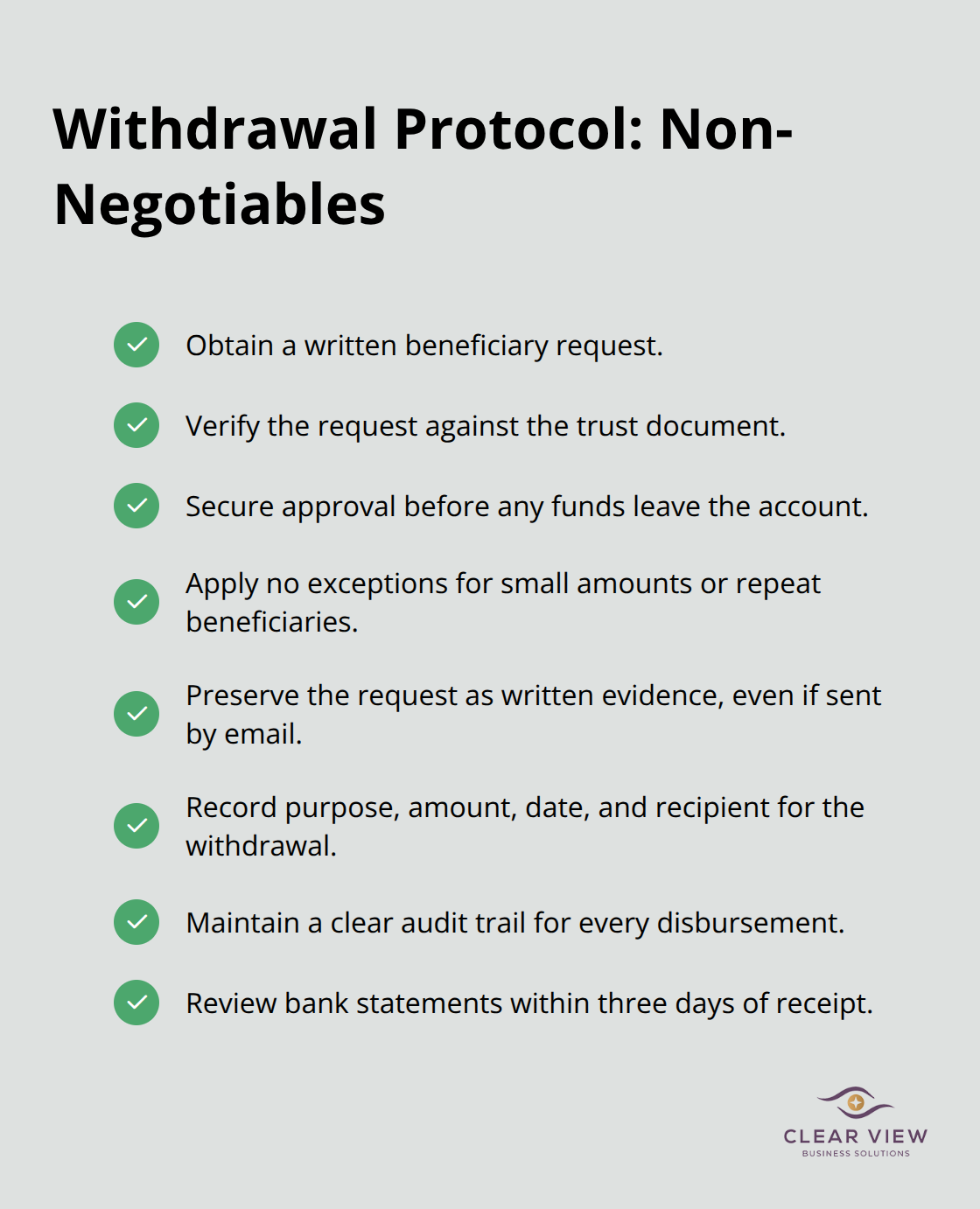
Set a policy that nominal personal funds in the trust account cannot exceed what your bank charges monthly for account maintenance. Anything beyond that violates fiduciary duty. Review your bank statements line by line within three days of receipt; don’t wait for end-of-month reconciliation to discover unauthorized activity.
Your team won’t follow controls they don’t understand. Train staff on why fiduciary duty matters, not just how to execute procedures. Show them examples of real consequences: attorneys removed from practice, personal liability judgments, and state bar discipline. Make clear that trust accounting violations aren’t administrative mistakes; they’re breaches of duty that harm beneficiaries and destroy careers. Conduct training when staff begins and annually thereafter, documenting attendance and comprehension.
Use IOLTA-compliant software that automates the controls you’ve designed and makes it harder to violate them. The software should restrict who can access trust accounts, require approval workflows before withdrawals process, and generate daily transaction logs that your oversight leader reviews. It should produce per-client ledgers automatically, flag reconciliation discrepancies instantly, and create beneficiary statements with a single click. Avoid generic accounting software; it lacks the principal-versus-income distinction required for trust reporting and doesn’t generate the compliance documentation regulators expect. Test your software’s backup and recovery process quarterly by actually restoring data from backup to verify it works. Firms that discover their backups are corrupted during an audit face far worse consequences than those that catch the problem during routine testing.
Schedule monthly three-way reconciliations on a calendar and treat them as unmissable commitments. If reconciliation reveals a discrepancy, stop and investigate before moving forward. Document what you found, why it happened, and how you corrected it. That documentation becomes your defense if a beneficiary questions your handling later.
Trust accounting compliance demands ongoing commitment that protects your beneficiaries and your reputation. The systems, controls, and procedures we’ve outlined work together to prevent the errors that trigger audits, disputes, and regulatory action. Your separate accounts, detailed ledgers, monthly reconciliations, and staff training form a complete framework that demonstrates fiduciary responsibility in practice, not just on paper.
Start by auditing your current processes against the standards we’ve covered. Do you have separate trust and operating accounts? Are your reconciliations happening monthly with documented results? Is your software IOLTA-compliant and generating the reports beneficiaries need? Identify gaps and prioritize the highest-risk areas first-if you’re using generic accounting software, switch to a specialized platform designed for trust accounting immediately. If reconciliation happens sporadically, schedule it monthly and assign a leader to oversee the process. If your team lacks training on fiduciary duties, conduct a session this quarter and document attendance.
Strengthen your procedures by writing down every control we’ve discussed and assigning ownership. Who approves withdrawals? Who reconciles accounts? Who reviews transactions daily? Who backs up data? Written procedures eliminate confusion and create accountability. At Clear View Business Solutions, we help individuals and small businesses in Tucson navigate complex financial and tax matters with personalized guidance-whether you need support with bookkeeping, tax planning, or IRS representation, our team simplifies the process so you can focus on what matters.




At Clear View Business Solutions, we know you want your business to prosper without having to worry about whether you are paying more in taxes than you should or whether your business is set up correctly. The problem is it's hard to find a trusted advisor who can translate financial jargon to layman's terms and who can actually help you plan for better results.
We believe it doesn't have to be this way! No business owner should settle for working with a CPA firm that falls short of understanding what you want to achieve and how to help you get there.
Northwest Location:
7530 N. La Cholla Blvd., Tucson, AZ 85741
Central Location:
2933 N Campbell Avenue, Tucson, AZ 85719
© 2026 Clear View Business Solutions. All Rights Reserved.
At Clear View Business Solutions, we know you want your business to prosper without having to worry about whether you are paying more in taxes than you should or whether your business is set up correctly. The problem is it's hard to find a trusted advisor who can translate financial jargon to layman's terms and who can actually help you plan for better results.
We believe it doesn't have to be this way! No business owner should settle for working with a CPA firm that falls short of understanding what you want to achieve and how to help you get there. With over 20 years of experience serving hundreds of business owners like you, our team of experts combines financial expertise and proactive communication with our drive to help each client achieve results and have fun along the way.
Here's how we do it:
Discover: We start with a consultation to understand your specific goals, what's holding you back, and what success looks like for you.
Strategize & Optimize: Together, we design a customized strategy that empowers you to progress toward your goals, and we optimize our communication as partners.
Thrive: You enjoy a clear view of your business and your financial prosperity.
Schedule a consultation today, and take the first step toward being able to focus on your core business again without wondering if your numbers are right- or what they mean to your business.
In the meantime, download, "The Business Owner's Essential Guide to Tax Deductions" and make sure you aren't leaving money on the table.