


Small business owners wear too many hats. Between managing operations, serving customers, and handling finances, something always gets neglected-and bookkeeping usually loses.
That’s where professional bookkeeping services come in. At Clear View Business Solutions, we’ve seen firsthand how outsourcing this work transforms a business’s financial health. Accurate records, better decisions, and real cash flow visibility become possible when you stop doing it yourself.
Disorganized bookkeeping costs small businesses real money. When financial records scatter across spreadsheets, bank statements pile up unreconciled, and transaction classifications get muddled, errors compound quickly. Misclassified transactions distort your actual profitability and asset values. Revenue timing mistakes hide how much cash you really have available. Commingled personal and business finances make it nearly impossible to substantiate transactions during an audit or tax filing. Poor documentation and incomplete records trigger penalties and interest charges that small business owners could have avoided entirely. Most small businesses don’t realize they’re vulnerable until tax season arrives and they scramble to piece together a year’s worth of financial chaos. Accurate records aren’t just about compliance-they’re about knowing whether your business is actually profitable.
Small business owners lose significant time on bookkeeping tasks that pull them away from revenue-generating work. Data entry, bank reconciliations, expense categorization, and tax document preparation consume hours every week that could go toward sales, customer service, or product development. When you handle bookkeeping yourself, you also operate without real financial visibility. You can’t make informed decisions about pricing, hiring, or expansion without clean, current financial data.
Professional bookkeeping eliminates this gap immediately. You receive timely profit and loss statements, accurate cash flow reports, and balance sheets that reflect your actual financial position. This matters because businesses that track cash flow weekly or monthly are significantly better positioned to spot problems before they become crises. With organized records from the start, tax preparation becomes straightforward rather than stressful, and you’re far less likely to miss deductions or tax credits that could reduce your liability.
When you hand off bookkeeping to professionals, you reclaim hours each week for activities that actually drive revenue. Your financial records stay current and accurate without consuming your attention. You gain access to someone who understands tax regulations, proper transaction classification, and compliance requirements-expertise that prevents costly mistakes. The transition from scattered records to organized financial systems happens smoothly when you work with experienced bookkeepers who know how to structure your accounts and train you on the tools you’ll use going forward.
Hiring a full-time bookkeeper or accountant in-house runs between $45,000 and $65,000 annually for salary alone, according to the Bureau of Labor Statistics. Add payroll taxes, benefits, software licenses, office space, and equipment, and that number climbs to $60,000 or $75,000 per year for a single employee. Outsourced bookkeeping services cost a fraction of that amount. Most small businesses pay between $1,000 and $3,000 monthly for comprehensive bookkeeping, depending on transaction volume and complexity. That’s roughly $12,000 to $36,000 annually, which means you save $24,000 to $63,000 per year compared to in-house staffing.

Outsourced bookkeeping also scales with your business. During slow months, you pay less. When business picks up and transaction volume increases, you adjust your service level without hiring additional staff or managing layoffs. You eliminate training costs, turnover expenses, and the productivity loss that comes with onboarding new employees.
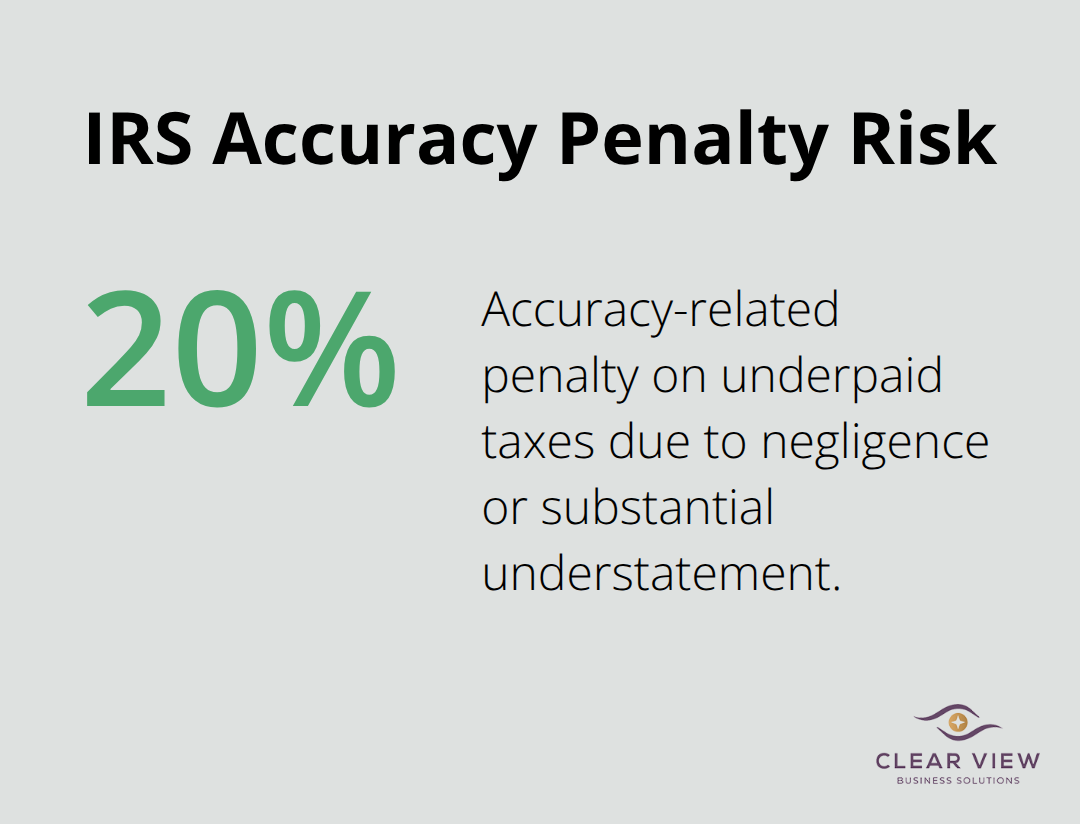
Professional bookkeepers catch errors that cost small business owners thousands in penalties and interest. The IRS charges accuracy-related penalties of 20 percent on underpaid taxes caused by negligent record-keeping or substantial understatements. Misclassified transactions, missed deductions, and improper depreciation tracking compound these problems. A bookkeeper who understands tax regulations and accounting standards spots these issues before they reach your tax return.
They ensure revenue appears in the correct period, capital expenditures receive proper depreciation, and personal expenses never mix with business transactions. Cloud-based accounting software like QuickBooks Online and Xero, when managed by professionals, automatically flags suspicious transactions and reconciliation gaps. This real-time monitoring prevents small errors from turning into audit nightmares. Professional bookkeepers also maintain the documentation and audit trails that substantiate every transaction, which becomes invaluable if the IRS ever questions your filings.
Clean, current financial records let you make decisions based on reality instead of guesswork. When your bookkeeper delivers monthly profit and loss statements and cash flow reports, you know exactly how much money you have available for hiring, equipment purchases, or marketing investments. Small business owners who review their financial statements monthly spot spending patterns, identify which products or services are actually profitable, and adjust pricing accordingly. You can see accounts receivable aging reports that show which customers are slow to pay, allowing you to follow up before cash flow problems develop. Expense categorization becomes consistent and meaningful, so you can compare spending month to month and identify where costs are creeping up. This level of visibility transforms bookkeeping from a compliance burden into a strategic tool for running a better business.
Your bookkeeping needs change as your business expands. A service that adjusts with you (rather than requiring you to hire more staff) keeps overhead predictable and manageable. Transaction volume increases, customer accounts multiply, and tax complexity grows-but your bookkeeping provider handles these changes without disrupting your operations. This flexibility means you focus on growth while someone else manages the financial infrastructure that supports it. When selecting outsourced financial management services, prioritize a partner that grows with you, making the transition from startup to established business seamless.
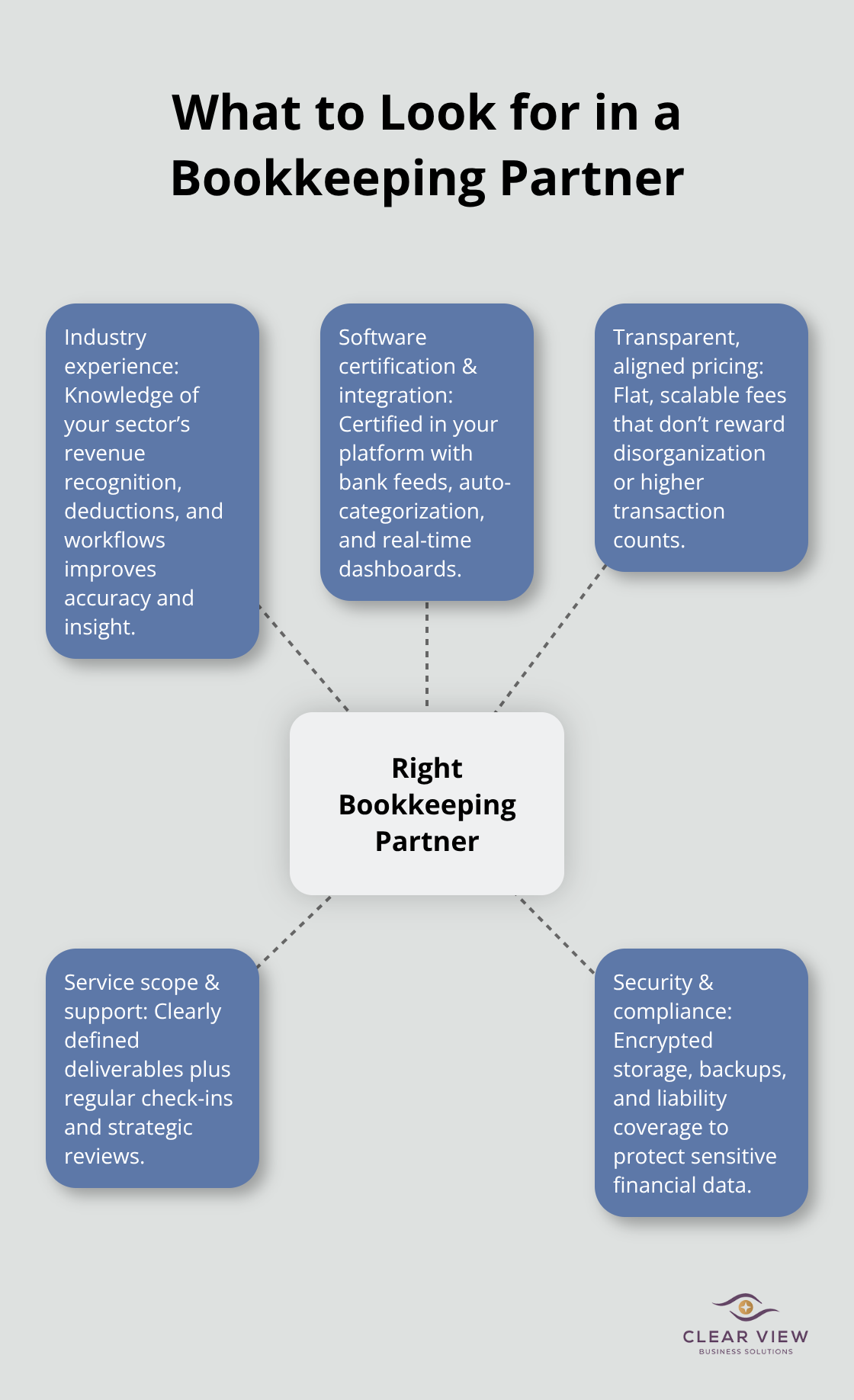
Finding the right bookkeeping service requires looking past generic promises and examining three specific areas where most small businesses make poor choices. First, industry experience matters far more than general bookkeeping competence. A bookkeeper experienced with construction companies understands job costing, contract revenue recognition, and the specific deductions construction businesses claim. A bookkeeper who works primarily with retail operations knows inventory tracking, seasonal cash flow patterns, and margin analysis by product category.
When you interview potential providers, ask directly about their experience with businesses similar to yours, not just their years in business. Request references from clients in your industry and contact them to learn how the bookkeeper handled industry-specific challenges.
Software capabilities come second, and this is where many small businesses waste money on services that don’t integrate with their existing tools. QuickBooks Online dominates small business accounting, but Xero, NetSuite, and other platforms serve different needs. Confirm that your bookkeeping provider holds certification in the specific software you use or plan to use. Certification matters because it means they completed formal training and stay current with platform updates. Ask whether their service includes bank feed integration, automatic transaction categorization, and real-time reporting dashboards. These features save you from manual data entry and give you access to financial reports whenever you need them.
Pricing structures reveal whether a provider prioritizes your success or simply wants to minimize their effort. Monthly flat fees work best for stable, predictable transaction volumes. Per-transaction pricing or hourly rates create perverse incentives where the bookkeeper profits from chaos and complexity rather than efficiency. Some providers charge based on the number of transactions you process each month, which means they profit from disorganization. Avoid this model entirely. Instead, seek providers who offer transparent pricing that scales with your business size, not transaction volume.
When you evaluate specific providers, request a clear service scope document that specifies exactly what’s included: monthly reconciliations, expense categorization, payroll processing, tax document preparation, or financial statement generation. Some bookkeeping services stop at data entry and reconciliation, leaving tax preparation and strategic analysis to you. Others provide comprehensive support including quarterly business reviews where they discuss cash flow trends and highlight opportunities for cost reduction. The comprehensive approach costs more upfront but saves money when your bookkeeper identifies spending patterns or spots a customer who consistently pays late.
Ask potential providers how they handle the transition from your current system. Clean data migration from spreadsheets or outdated software prevents errors that plague you for years. Request a specific onboarding timeline and ask which team member will serve as your primary contact. Personalized service matters because bookkeeping requires ongoing communication about unusual transactions, business changes, and financial goals. Small businesses benefit from providers who schedule regular check-ins rather than treating bookkeeping as a set-it-and-forget-it service.
Finally, verify security practices and compliance certifications. Your financial data contains sensitive information about customer relationships, supplier costs, and profitability. Confirm that the provider uses encrypted cloud storage, maintains regular backups, and carries professional liability insurance. These details matter far more than marketing claims about being a trusted partner. When you choose the right bookkeeping partner, you receive personalized service and full-cycle bookkeeping with QuickBooks training, ensuring your financial infrastructure stays secure and compliant while you focus on running your business.
Professional bookkeeping services transform how small business owners operate by providing accurate financial records that satisfy compliance requirements and prevent costly penalties. You reclaim hours each week previously lost to data entry and reconciliation, redirecting that time toward activities that actually grow revenue. Most importantly, you receive real financial visibility that turns bookkeeping from a compliance burden into a strategic tool for making better decisions about pricing, hiring, and expansion.
Outsourcing costs a fraction of in-house staffing while eliminating training expenses, turnover costs, and the overhead of managing employees. Your bookkeeper catches errors before they reach your tax return, identifies spending patterns you’d otherwise miss, and maintains the documentation that protects you during audits. As your business scales, your bookkeeping service adjusts with you without requiring you to hire additional staff or manage layoffs.
Finding the right partner requires looking beyond marketing claims and prioritizing providers with experience in your specific industry, certification in the software you use, and transparent pricing that scales with your business rather than transaction volume. Verify their security practices and compliance standards, then establish a relationship built on regular communication and personalized service. Contact Clear View Business Solutions to discuss how professional bookkeeping services can strengthen your financial foundation and free you to run your business with confidence.




At Clear View Business Solutions, we know you want your business to prosper without having to worry about whether you are paying more in taxes than you should or whether your business is set up correctly. The problem is it's hard to find a trusted advisor who can translate financial jargon to layman's terms and who can actually help you plan for better results.
We believe it doesn't have to be this way! No business owner should settle for working with a CPA firm that falls short of understanding what you want to achieve and how to help you get there.
Northwest Location:
7530 N. La Cholla Blvd., Tucson, AZ 85741
Central Location:
2933 N Campbell Avenue, Tucson, AZ 85719
© 2026 Clear View Business Solutions. All Rights Reserved.
At Clear View Business Solutions, we know you want your business to prosper without having to worry about whether you are paying more in taxes than you should or whether your business is set up correctly. The problem is it's hard to find a trusted advisor who can translate financial jargon to layman's terms and who can actually help you plan for better results.
We believe it doesn't have to be this way! No business owner should settle for working with a CPA firm that falls short of understanding what you want to achieve and how to help you get there. With over 20 years of experience serving hundreds of business owners like you, our team of experts combines financial expertise and proactive communication with our drive to help each client achieve results and have fun along the way.
Here's how we do it:
Discover: We start with a consultation to understand your specific goals, what's holding you back, and what success looks like for you.
Strategize & Optimize: Together, we design a customized strategy that empowers you to progress toward your goals, and we optimize our communication as partners.
Thrive: You enjoy a clear view of your business and your financial prosperity.
Schedule a consultation today, and take the first step toward being able to focus on your core business again without wondering if your numbers are right- or what they mean to your business.
In the meantime, download, "The Business Owner's Essential Guide to Tax Deductions" and make sure you aren't leaving money on the table.