


December 31st approaches fast, and smart business owners know this means one thing: time to act on year-end tax planning. The IRS collected $4.05 trillion in 2023, but strategic moves before year-end can significantly reduce your tax burden.
We at Clear View Business Solutions see businesses miss thousands in potential savings simply because they wait too long. The right strategies implemented now can mean substantial tax reductions for 2024.
The final weeks of December represent your last chance to implement tax deductions that can save thousands. Businesses that act strategically during this window consistently outperform those that wait until tax season arrives.
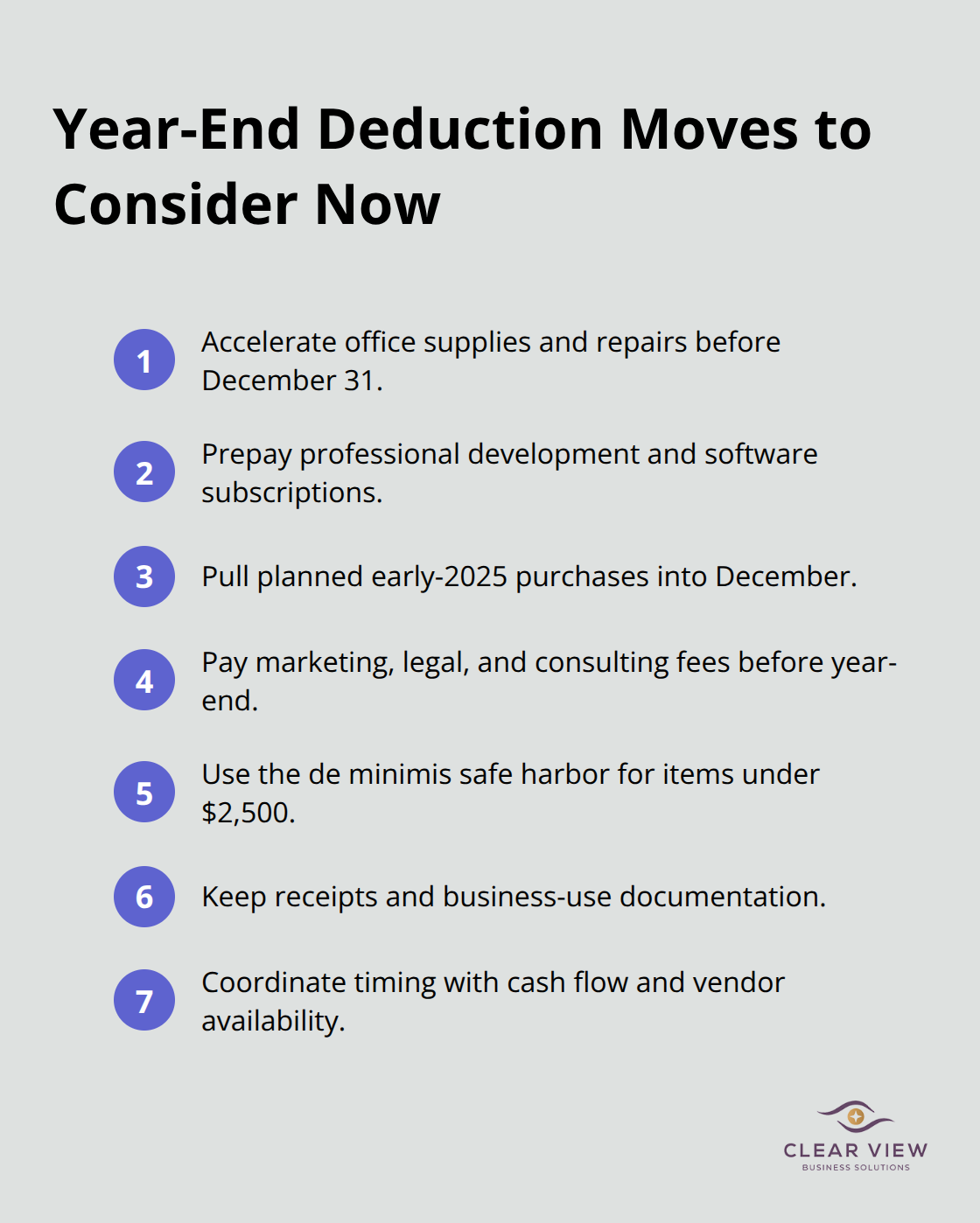
Smart business owners accelerate necessary expenses before year-end to maximize deductions. Office supplies, equipment repairs, professional development courses, and software subscriptions purchased by December 31st reduce your 2024 taxable income dollar-for-dollar.
The key lies in timing purchases you planned for early 2025 and moving them into December. Marketing expenses, legal fees, and consulting services paid before year-end provide immediate tax benefits. Equipment purchases under $2,500 can be fully expensed in 2024 under the de minimis safe harbor rule (making December equipment buys particularly valuable).
Charitable contributions made before December 31st provide substantial tax benefits when structured correctly. Cash donations can be deducted up to 60% of your adjusted gross income, while appreciated stock donations avoid capital gains taxes entirely.
Donor-advised funds allow you to take the full deduction in 2024 while you distribute the funds to charities over multiple years. Bunching charitable contributions into 2024 can push you over the standard deduction threshold of $15,750 for singles or $31,500 for married couples (making itemization worthwhile).
Maximizing retirement contributions represents one of the most powerful year-end tax strategies available. The 2024 contribution limit for 401k plans is $23,000, with an additional $7,500 catch-up contribution for those 50 and older. These contributions reduce your adjusted gross income directly.
SEP-IRA contributions allow business owners to contribute up to 25% of compensation or $69,000, whichever is less. Traditional IRA contributions of up to $7,000 ($8,000 for those over 50) can be made until April 15th, but 401k contributions must be completed by December 31st to count for 2024.
These deduction strategies work best when paired with smart income timing decisions that can shift your tax burden to more favorable periods.
Income timing represents the most powerful tool for controlling your tax liability, yet most business owners fail to use it strategically. The difference between paying taxes at 12% versus 22% can mean thousands in savings when you time income and expenses correctly.
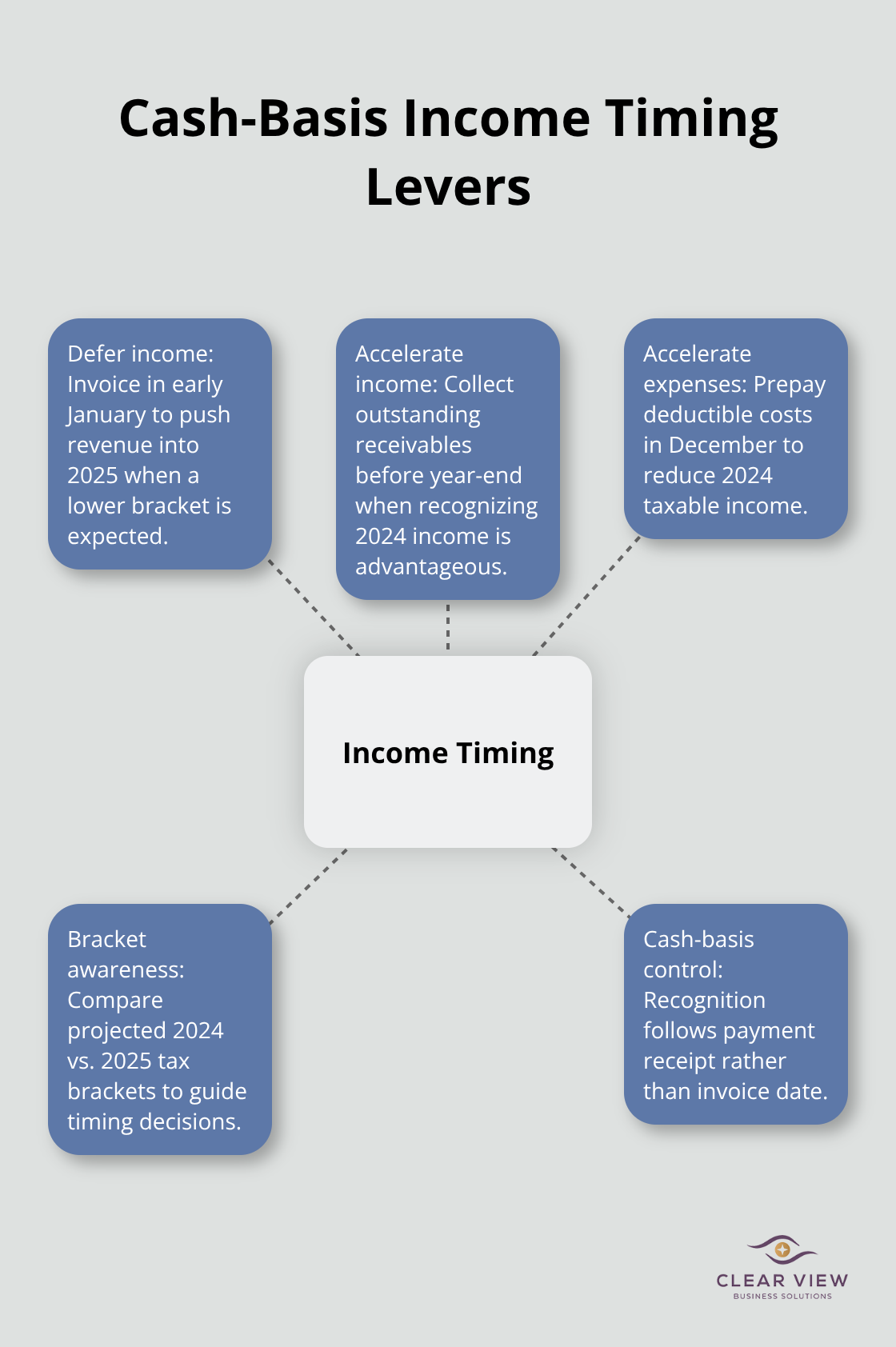
Business owners with fluctuating income should analyze their projected 2024 and 2025 tax brackets before December 31st. If you expect higher income in 2025, accelerate expenses into 2024 and defer income payments until January. Conversely, if 2024 shows unusually high income, defer invoices and accelerate income recognition into 2025.
The IRS allows cash-basis taxpayers to control when they recognize income by timing when they actually receive payments. Invoice clients in early January instead of December to push income into 2025, or collect outstanding receivables before year-end to recognize income in 2024 when beneficial.
Tax loss harvesting can offset capital gains dollar-for-dollar and reduce ordinary income by up to $3,000 annually. The IRS wash sale rule prohibits repurchase of the same security within 30 days, but you can immediately buy similar investments to maintain market exposure.
Investors with significant gains should harvest losses before December 31st to offset taxes owed. Capital losses that exceed gains carry forward indefinitely (making December loss harvesting valuable even without current gains to offset). This strategy works particularly well during volatile market conditions when opportunities to realize losses increase substantially.
Section 179 allows businesses to deduct up to $1,220,000 in equipment purchases for 2024, while bonus depreciation provides 80% first-year write-offs on qualifying assets. Equipment purchased and placed in service by December 31st qualifies for full-year depreciation benefits regardless of the purchase date.
Heavy equipment, vehicles over 6,000 pounds, and technology purchases provide immediate tax relief when timed correctly before year-end. The key lies in actual business use rather than just purchase timing (equipment must serve legitimate business purposes to qualify for these substantial deductions).
These income timing strategies work exceptionally well for small business owners who can take advantage of specialized deductions and business structures.
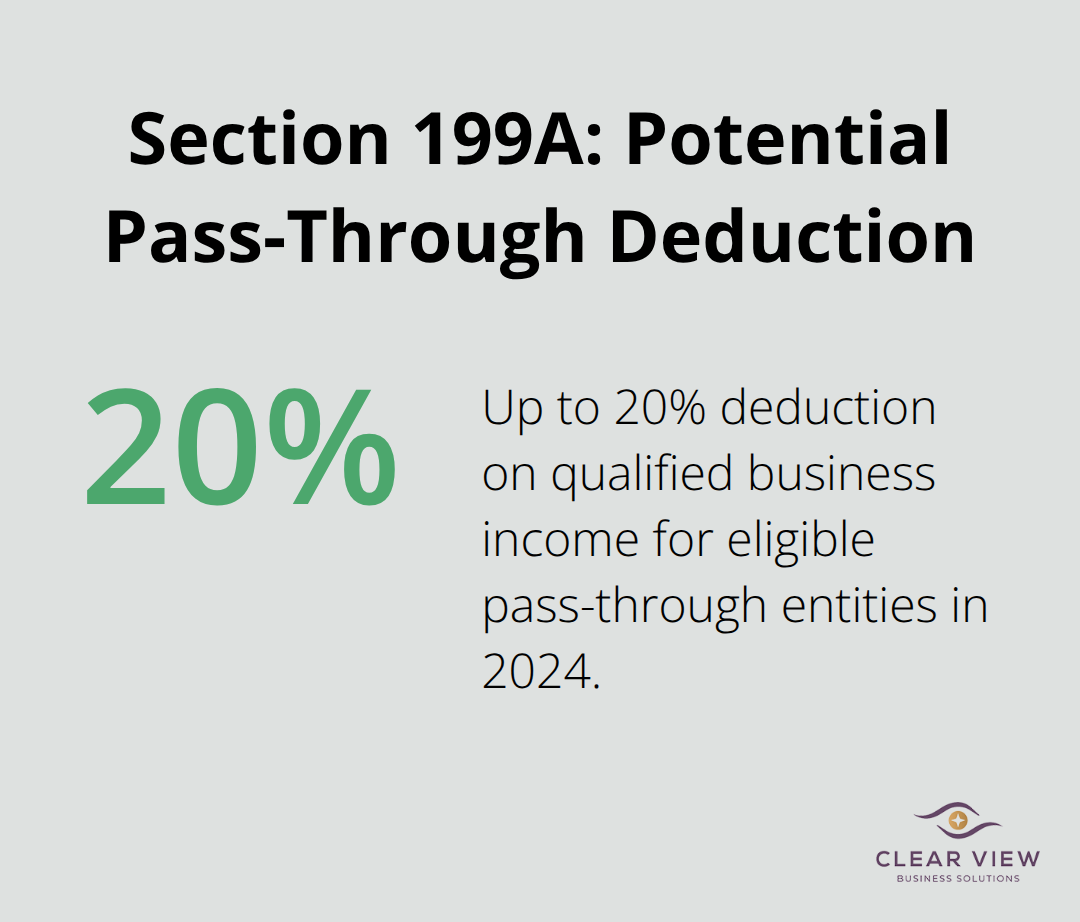
Small business owners who master the Section 199A Qualified Business Income Deduction can reduce their tax liability by up to 20% on business income. This deduction applies to pass-through entities including sole proprietorships, partnerships, S-corporations, and LLCs, provided your taxable income stays below $191,950 for singles or $383,900 for married couples filing jointly in 2024.
The IRS requires that your business qualify as a specified service trade or business to claim this deduction. Year-end tax planning becomes essential to stay within these thresholds and maximize your tax savings.
Business owners can strategically time income and expenses to optimize their Section 199A deduction. If your income approaches the threshold limits, defer invoices until January or accelerate business expenses into December. The deduction phases out completely at $241,950 for singles and $483,900 for married couples (making income management critical for maximum benefits).
Service businesses like consulting, law, and accounting face additional restrictions above the income thresholds. These businesses must meet specific wage and property tests to qualify for the full deduction when income exceeds the limits.
Health Savings Accounts represent the most tax-advantaged savings vehicle available to business owners. The 2024 contribution limits allow $4,300 for individual coverage and $8,550 for family coverage, with an additional $1,000 catch-up contribution for those 55 and older.
HSA funds roll over indefinitely, grow tax-free, and withdraw tax-free for qualified medical expenses. Business owners can deduct HSA contributions as business expenses when offered through their company, while employees receive tax-free contributions as a benefit.
Strategic employee benefit programs can slash your business tax burden while attracting top talent. Group health insurance premiums are 100% deductible as business expenses, while employees receive tax-free coverage worth thousands annually.
Dependent care assistance programs allow businesses to provide up to $5,000 tax-free to employees for childcare expenses. This reduces both employer payroll taxes and employee income taxes. Educational assistance programs permit tax-free reimbursement of up to $5,250 per employee for job-related education, creating immediate business deductions while building employee skills.
December 31st marks your final opportunity to implement year-end tax planning strategies that can save thousands in 2024 taxes. The most impactful actions include retirement contribution maximization, business expense acceleration, investment loss harvesting, and Section 199A deduction optimization for qualifying businesses. Business owners who act now consistently achieve better tax outcomes than those who wait until filing season.
The strategies outlined above work best when you implement them systematically rather than as last-minute decisions. Equipment purchases, charitable contributions, and income timing decisions made in the next few weeks directly impact your 2024 tax liability. Professional tax guidance becomes invaluable when you navigate complex strategies like Section 199A optimization, HSA maximization, and multi-year tax planning (particularly for businesses with fluctuating income patterns).
We at Clear View Business Solutions help businesses and individuals maximize their tax benefits while maintaining full compliance with IRS requirements. Start your preparation for 2025 tax planning now by tracking quarterly income patterns and monitoring tax law changes. The businesses that begin next year’s tax strategy in January consistently outperform those who scramble in December.
At Clear View Business Solutions, we know you want your business to prosper without having to worry about whether you are paying more in taxes than you should or whether your business is set up correctly. The problem is it's hard to find a trusted advisor who can translate financial jargon to layman's terms and who can actually help you plan for better results.
We believe it doesn't have to be this way! No business owner should settle for working with a CPA firm that falls short of understanding what you want to achieve and how to help you get there.
Northwest Location:
7530 N. La Cholla Blvd., Tucson, AZ 85741
Central Location:
2933 N Campbell Avenue, Tucson, AZ 85719
© 2026 Clear View Business Solutions. All Rights Reserved.
At Clear View Business Solutions, we know you want your business to prosper without having to worry about whether you are paying more in taxes than you should or whether your business is set up correctly. The problem is it's hard to find a trusted advisor who can translate financial jargon to layman's terms and who can actually help you plan for better results.
We believe it doesn't have to be this way! No business owner should settle for working with a CPA firm that falls short of understanding what you want to achieve and how to help you get there. With over 20 years of experience serving hundreds of business owners like you, our team of experts combines financial expertise and proactive communication with our drive to help each client achieve results and have fun along the way.
Here's how we do it:
Discover: We start with a consultation to understand your specific goals, what's holding you back, and what success looks like for you.
Strategize & Optimize: Together, we design a customized strategy that empowers you to progress toward your goals, and we optimize our communication as partners.
Thrive: You enjoy a clear view of your business and your financial prosperity.
Schedule a consultation today, and take the first step toward being able to focus on your core business again without wondering if your numbers are right- or what they mean to your business.
In the meantime, download, "The Business Owner's Essential Guide to Tax Deductions" and make sure you aren't leaving money on the table.