


December 31st marks more than just the end of another year-it’s your final opportunity to reduce your tax burden through strategic planning.
We at Clear View Business Solutions see businesses miss thousands in potential savings by waiting until tax season to think about optimization. Smart year-end tax planning strategies can significantly impact your bottom line when implemented before the calendar flips.
The next few weeks offer specific windows for deductions, income timing, and business moves that simply won’t be available come January 1st.
The IRS allows business owners to deduct ordinary and necessary expenses incurred through December 31st, which makes these final weeks your last chance to maximize write-offs. Office supplies, professional development courses, software subscriptions, and equipment repairs completed before year-end qualify for immediate deductions.
The Section 179 deduction permits businesses to write off up to $1.22 million in equipment purchases for 2025, but you must place the equipment in service by December 31st. Small businesses can also accelerate maintenance expenses, prepay rent for early 2026, and purchase necessary inventory to reduce taxable income.
Charitable contributions offer powerful tax advantages when you time them correctly before year-end. Cash donations to qualified organizations can be deducted up to 60% of your adjusted gross income according to IRS rules. You avoid capital gains taxes while you claim the full fair market value as a deduction when you donate appreciated stocks or other assets.
The IRS reports that donor-advised funds allow immediate tax deductions while they give you time to decide on future distributions. Qualified charitable distributions from IRAs let individuals aged 70½ or older donate up to $108,000 directly to charity without they add to taxable income (which can satisfy required minimum distribution requirements).
You can maximize retirement account contributions as one of the most effective year-end tax strategies available. The 2025 contribution limit for 401k plans reaches $23,500, with workers aged 50 or older who qualify for an additional $7,500 catch-up contribution.

Traditional IRA contributions cap at $7,000 for 2025, plus a $1,000 catch-up for those over 50, and you must complete them by December 31st for current-year deductions. Health Savings Accounts provide triple tax advantages with contribution limits for 2025. High earners can consider mega-backdoor Roth conversions through after-tax 401k contributions to bypass income limitations on direct Roth contributions.
These deduction strategies work best when you pair them with smart income management techniques that can shift your tax burden across different years.
Strategic income timing represents your most powerful tool for tax bracket management across multiple years. December gives you the final opportunity to accelerate income into 2025 if you expect higher tax rates next year, or defer compensation into 2026 if you anticipate lower brackets.
Self-employed individuals can invoice clients in early January instead of December to push income forward. Employees can negotiate bonus payments for early 2026 to reduce current-year liability. This flexibility allows you to optimize your tax position based on projected income changes.
Capital gains and loss harvesting requires immediate action since you must complete all transactions by December 31st for current-year tax benefits. The IRS allows you to offset capital gains with capital losses dollar-for-dollar, plus deduct up to $3,000 in excess losses against ordinary income.
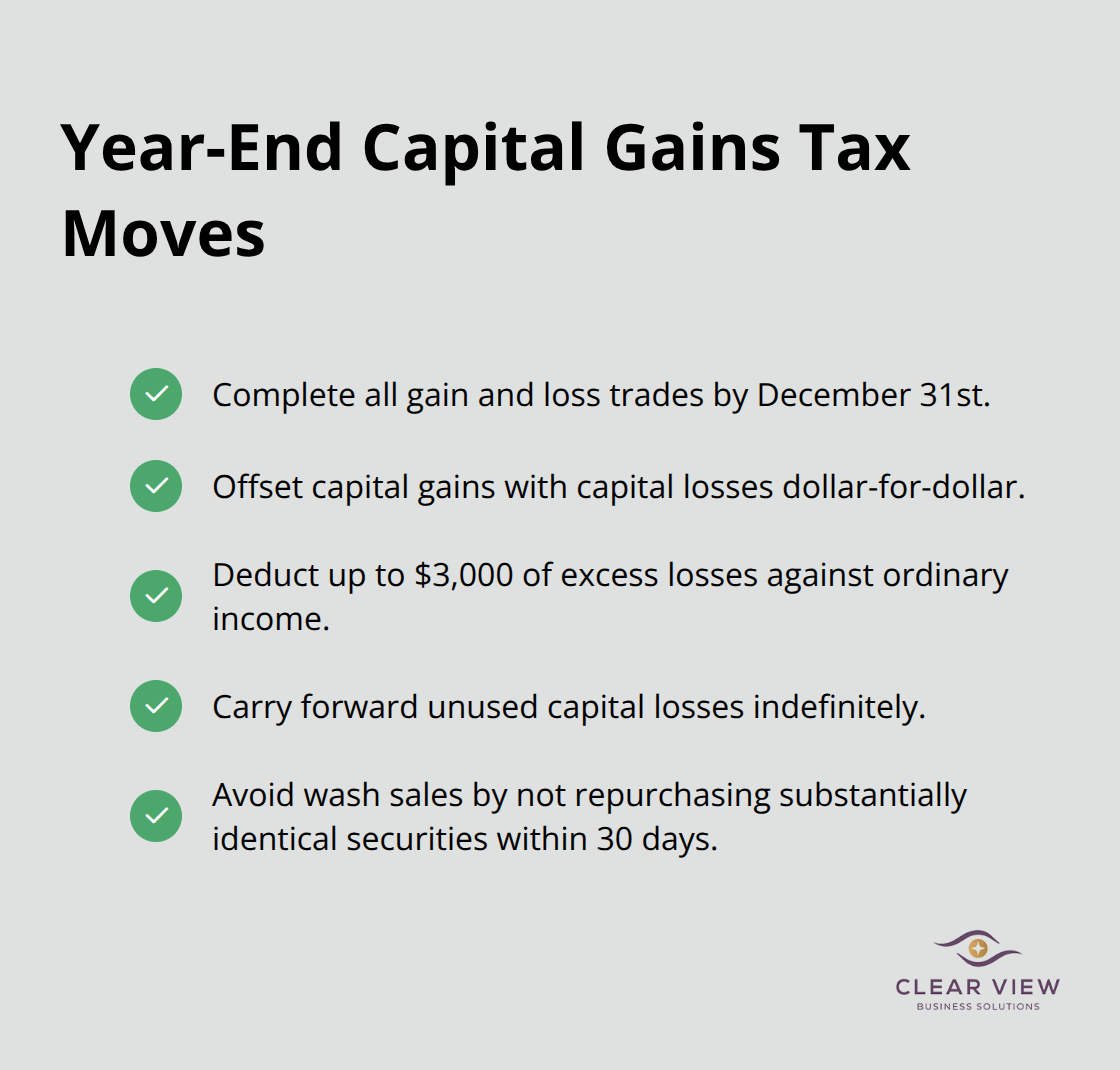
You can carry forward unused losses indefinitely to future tax years. The wash-sale rule prohibits repurchasing the same or substantially identical securities within 30 days before or after the sale (so plan replacement investments carefully). Tax-loss harvesting works particularly well in volatile market years when you have both winners and losers in your portfolio.
Businesses control when they pay year-end bonuses and commissions, which creates opportunities for both employer and employee tax optimization. Companies can accelerate bonus payments into December to claim immediate deductions. Employees might request January payments to defer income into lower tax bracket years.
Stock option exercises near year-end require careful analysis since nonqualified stock options create immediate taxable income equal to the spread between exercise price and fair market value. The decision depends entirely on your current versus projected future tax rates and cash flow needs (making professional guidance valuable for complex situations).
These income strategies work hand-in-hand with business-specific tax moves that can generate substantial additional savings for company owners.
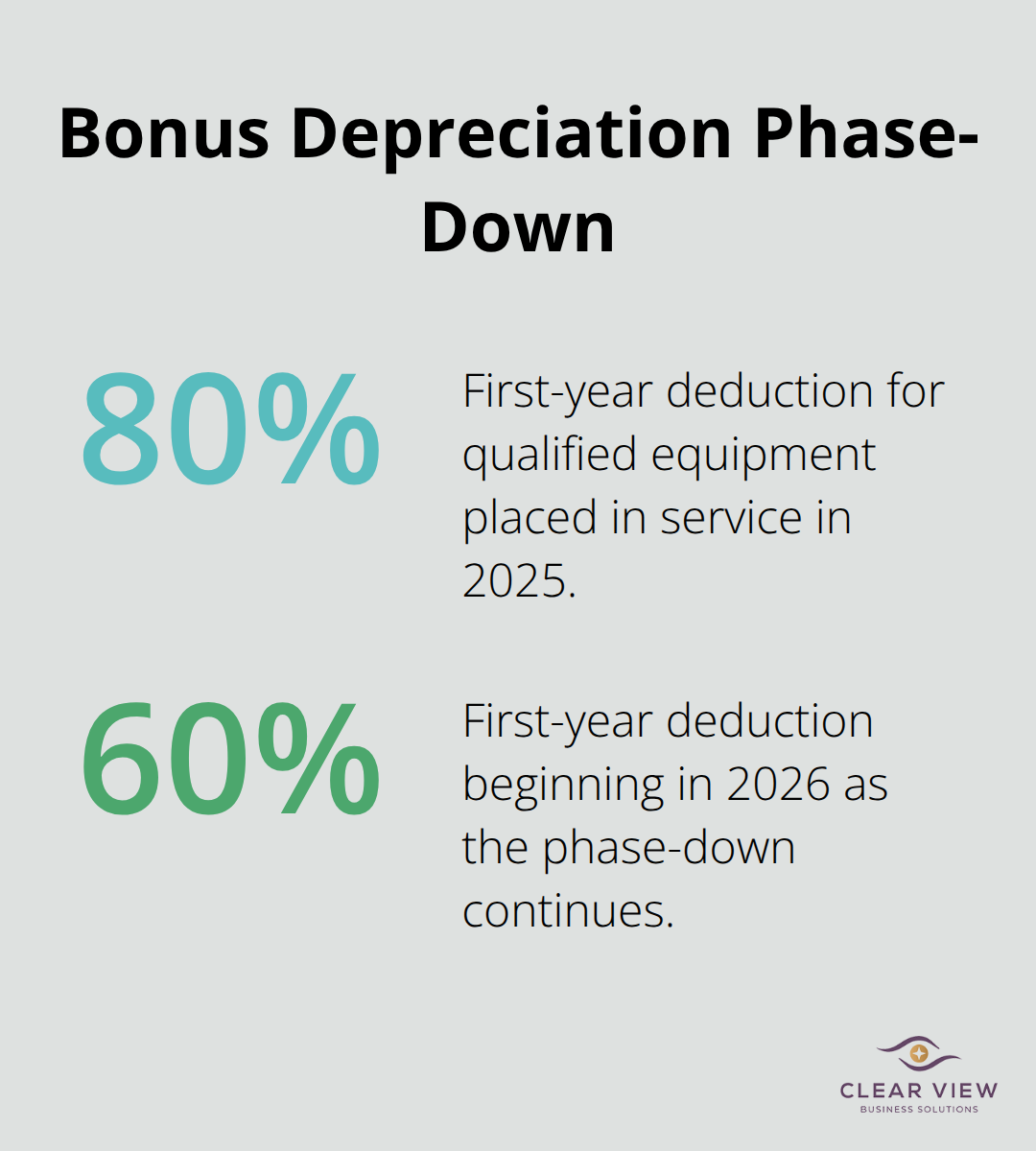
Business owners control the most powerful tax reduction tools available, but these opportunities disappear permanently after December 31st. Equipment purchases under Section 179 allow immediate write-offs up to $1.22 million for 2025, but you must place the asset in service by year-end. The IRS bonus depreciation rules let you deduct 80% of equipment costs in the first year, which drops to 60% in 2026. Smart businesses accelerate necessary purchases like computers, machinery, and vehicles into December rather than wait for January delivery.
The Section 179 deduction allows business taxpayers to deduct the cost of certain property as an expense when the property is first placed in service. Manufacturing equipment, office furniture, computer systems, and business vehicles all qualify for this powerful deduction. You must place assets in service during 2025 to claim the deduction (not just order them). The IRS phases out this deduction when total equipment purchases exceed $3.05 million, so high-volume buyers need careful planning to maximize benefits.
Inventory write-offs provide immediate tax relief for obsolete, damaged, or unsaleable merchandise in your warehouse. The IRS requires businesses to write down inventory to its lower cost or market value, which creates legitimate deductions for products you cannot sell at full price. Dead stock, expired goods, and damaged inventory should be properly documented and written off before December 31st. Asset disposals work similarly – old equipment, furniture, and technology assets can be disposed of to generate tax losses that offset business income.
Year-end bonus payments create immediate business deductions while you control when employees recognize the income. Accrual-basis businesses can deduct bonuses in 2025 even when paid in early January, provided the liability exists by December 31st and payment occurs within 75 days. Employee benefit contributions like health insurance premiums, retirement plan contributions, and education assistance programs must be funded by year-end for current-year deductions. The IRS allows businesses to establish SEP-IRA or SIMPLE IRA plans until December 31st and fund them through the tax deadline plus extensions.
The window for year-end tax planning strategies closes permanently on December 31st, which makes immediate action essential for your 2025 tax savings. Business owners must prioritize Section 179 equipment purchases, inventory write-offs, and employee benefit contributions before the deadline. Individual taxpayers need to complete retirement account contributions, charitable donations, and capital loss harvesting within the next few weeks.
Complex tax situations that involve multiple income streams, business ownership, or significant investment portfolios require professional guidance to navigate IRS regulations effectively. We at Clear View Business Solutions work with clients to develop comprehensive tax plans that maximize deductions while they maintain full compliance with federal requirements. Our team helps identify opportunities that many taxpayers overlook during this critical period.
Smart taxpayers establish systems for ongoing tax optimization rather than scramble each December. Monthly financial reviews, quarterly estimated tax payments, and systematic record-keeping create year-round tax efficiency (instead of last-minute panic). Professional tax advisory services provide the expertise needed to implement sophisticated strategies that reduce your tax burden across multiple years while they build sustainable wealth management practices.
At Clear View Business Solutions, we know you want your business to prosper without having to worry about whether you are paying more in taxes than you should or whether your business is set up correctly. The problem is it's hard to find a trusted advisor who can translate financial jargon to layman's terms and who can actually help you plan for better results.
We believe it doesn't have to be this way! No business owner should settle for working with a CPA firm that falls short of understanding what you want to achieve and how to help you get there.
Northwest Location:
7530 N. La Cholla Blvd., Tucson, AZ 85741
Central Location:
2933 N Campbell Avenue, Tucson, AZ 85719
© 2026 Clear View Business Solutions. All Rights Reserved.
At Clear View Business Solutions, we know you want your business to prosper without having to worry about whether you are paying more in taxes than you should or whether your business is set up correctly. The problem is it's hard to find a trusted advisor who can translate financial jargon to layman's terms and who can actually help you plan for better results.
We believe it doesn't have to be this way! No business owner should settle for working with a CPA firm that falls short of understanding what you want to achieve and how to help you get there. With over 20 years of experience serving hundreds of business owners like you, our team of experts combines financial expertise and proactive communication with our drive to help each client achieve results and have fun along the way.
Here's how we do it:
Discover: We start with a consultation to understand your specific goals, what's holding you back, and what success looks like for you.
Strategize & Optimize: Together, we design a customized strategy that empowers you to progress toward your goals, and we optimize our communication as partners.
Thrive: You enjoy a clear view of your business and your financial prosperity.
Schedule a consultation today, and take the first step toward being able to focus on your core business again without wondering if your numbers are right- or what they mean to your business.
In the meantime, download, "The Business Owner's Essential Guide to Tax Deductions" and make sure you aren't leaving money on the table.