


Nonprofits lose thousands of dollars every year to poor financial management. Without proper systems, tracking donations, grants, and expenses becomes chaotic, making it nearly impossible to prove impact to donors or meet compliance requirements.
QuickBooks training for nonprofits transforms how your organization handles money. At Clear View Business Solutions, we’ve seen firsthand how the right financial tools and knowledge empower teams to spend less time on spreadsheets and more time on your mission.
Nonprofits operating without structured financial systems face real consequences. According to research on nonprofit financial management, organizations with weak accounting practices experience donor attrition rates up to 30% higher than those with transparent financial reporting. Donors want proof that their money creates impact, and vague financial records signal mismanagement. QuickBooks training equips your team to produce donor reports within days instead of weeks, showing exactly where funds go and what results they produce. When a donor contributes $5,000 to a specific program, they expect to see how that $5,000 was spent. Proper training ensures you track restricted funds separately from unrestricted money, meeting donor expectations and legal requirements simultaneously. Grant funders increasingly demand detailed expense reporting and fund reconciliation, making trained staff non-negotiable for organizations pursuing larger grants. Without this capability, your nonprofit leaves funding on the table.
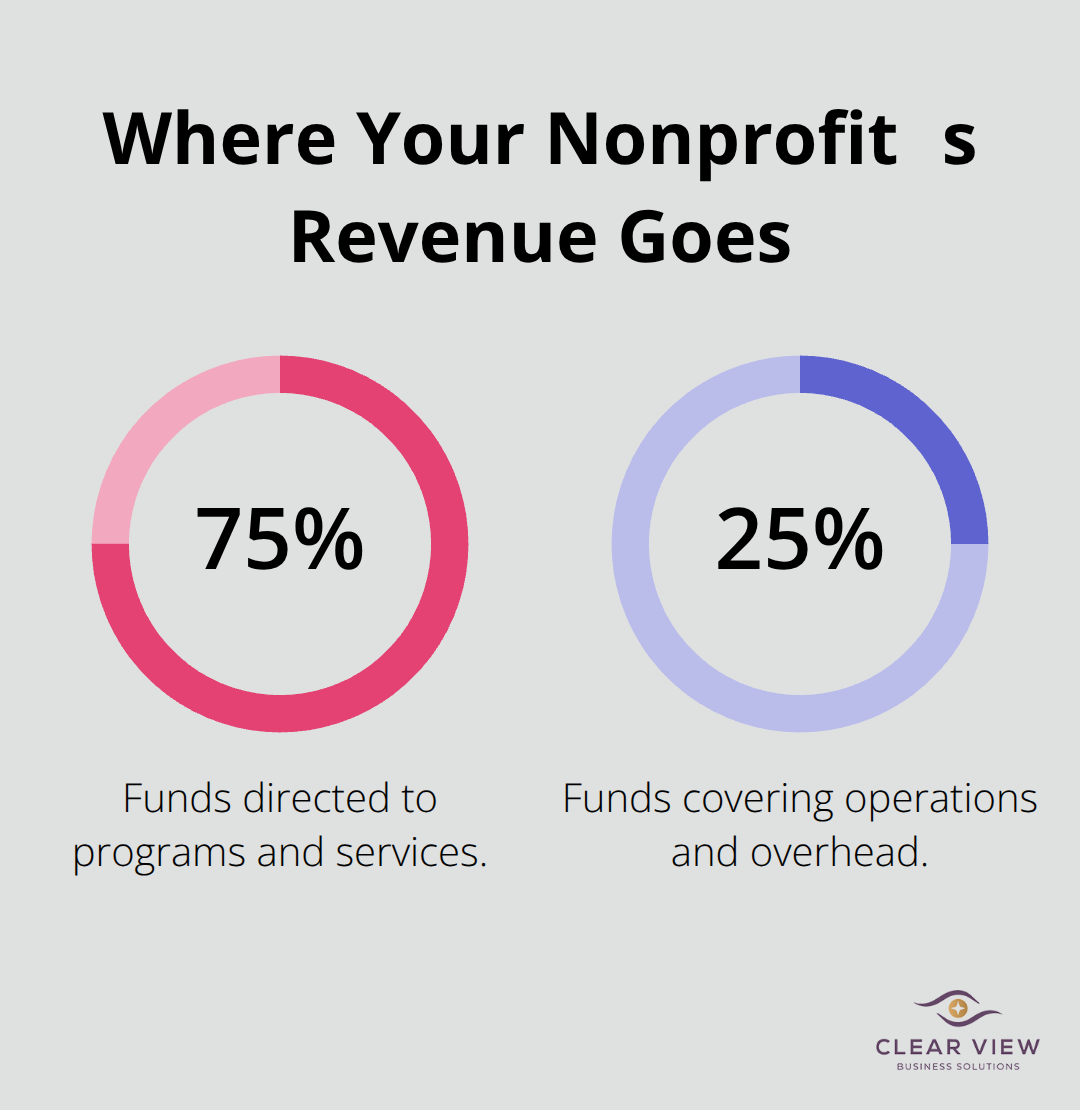
Transparency directly impacts donor retention and gift size. Nonprofits that produce timely financial reports see higher repeat donation rates compared to those sending annual reports late or incompletely. QuickBooks training teaches staff to categorize expenses by program, management, and fundraising costs, which directly addresses donor concerns about overhead. When you show that 75% of revenue funds programs and 25% covers operations, donors gain confidence in your stewardship.
Grant administrators reviewing your Form 990 scrutinize functional expense statements, and trained bookkeepers ensure these reports reflect actual spending accurately. Manual spreadsheets and incomplete records create audit vulnerabilities and donor skepticism. Proper financial systems demonstrate professionalism and commitment to accountability.
Grant deadlines don’t negotiate. Organizations with QuickBooks expertise complete grant reports faster because data is organized by fund and program from day one. Most grants carry restrictions requiring you to track spending separately by grant and program, and QuickBooks fund accounting handles this automatically when set up correctly. A nonprofit managing five active grants without proper training typically spends significant time monthly reconciling grant balances across spreadsheets. The same organization with trained staff accomplishes this more efficiently using automated reports. This time savings translates directly into pursuing additional funding opportunities. Grant administrators also notice when reports contain errors or incomplete documentation, and accurate QuickBooks records prevent reputational damage and funding delays. Training your team eliminates the scramble before grant deadlines and positions your organization as professionally managed.
Organizations without budget tracking spend more on overhead than necessary. QuickBooks training establishes budget discipline by showing real spending against projections monthly. When your program director requests $8,000 for supplies but the budget allocated $5,000, trained staff flag the variance immediately and adjust plans accordingly. This prevents mid-year budget crises where programs run out of funds before year-end. Zero-based budgeting, which QuickBooks supports effectively, forces departments to justify every expense, revealing waste and protecting mission funding. Organizations implementing this approach typically identify meaningful savings within the first year. These dollars shift directly to program delivery instead of administrative bloat.
Your team’s financial capability directly determines which training approach works best for your organization. The next section examines how to identify which staff members need training and whether in-house or external programs fit your nonprofit’s structure and budget.
QuickBooks transforms nonprofit accounting from spreadsheet chaos into organized, reportable systems. The software’s fund accounting structure addresses the core problem nonprofits face: tracking money that arrives with restrictions. When a donor restricts funds to youth programs or a grant specifies spending limits by category, QuickBooks keeps that money separate from general operations through fund and class tracking. You enable Class tracking in Settings, then create a separate Class for every fund or grant your organization manages. This simple step prevents the catastrophic error of commingling restricted and unrestricted funds, which triggers audit failures and donor disputes.
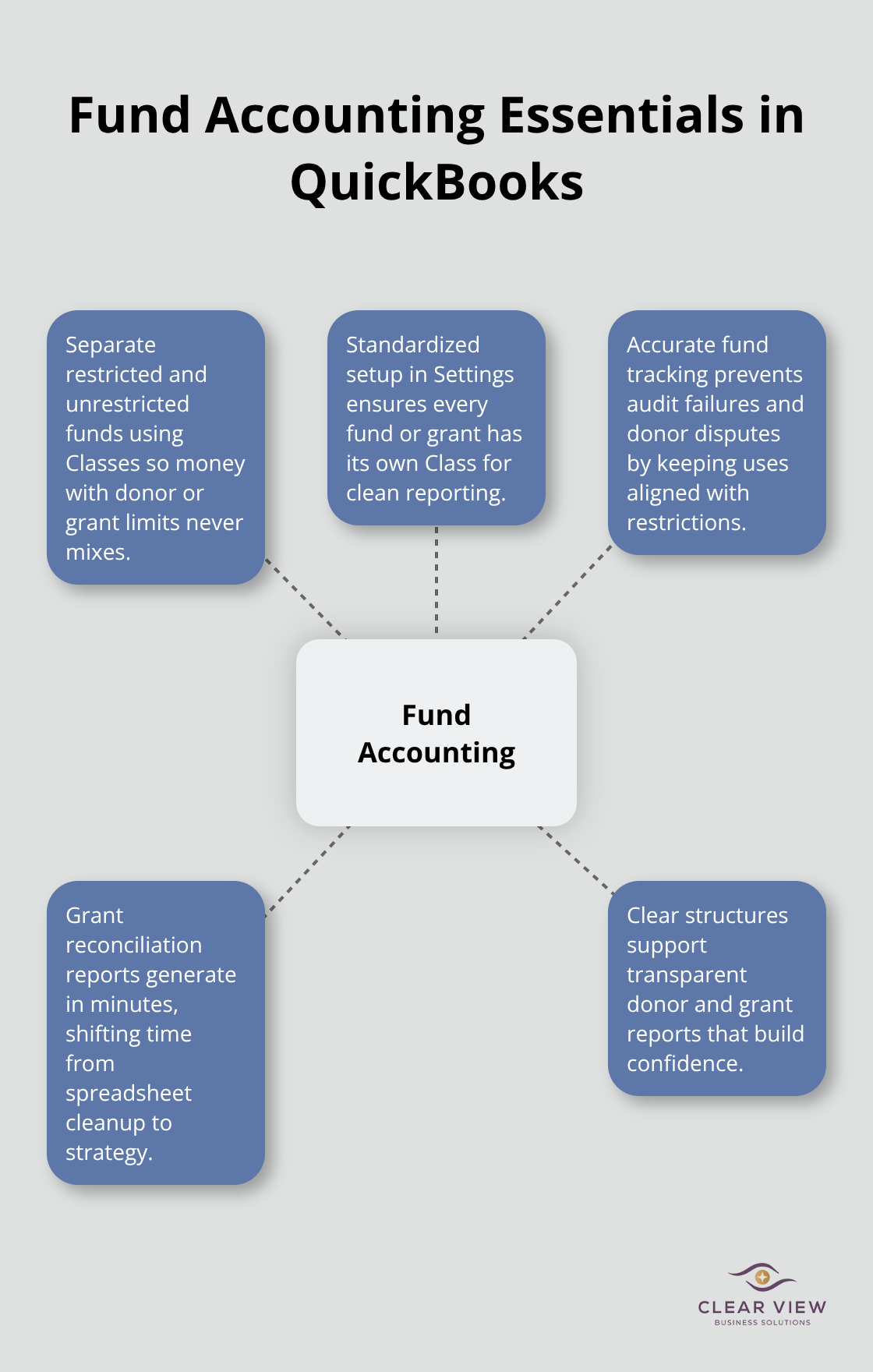
A nonprofit managing ten active grants without proper fund separation typically spends hours monthly reconciling grant balances manually across spreadsheets. The same organization with QuickBooks fund accounting set up correctly produces grant reconciliation reports in minutes. Your team shifts from spreadsheet wrestling to strategic financial work.
QuickBooks automates expense categorization by linking transactions to specific programs, management functions, or fundraising activities. When a staff member enters an office supply purchase, the system prompts for program assignment, ensuring the statement of functional expenses reflects accurate spending distribution. This automation eliminates the month-end scramble where finance staff manually categorize thousands of transactions, guessing which expenses belong to programs versus overhead. Organizations using this approach complete financial statements days earlier than those relying on manual categorization.
You can consider using the Class tracking feature to allocate each expense account by programs, fundraising, and management. Your accounting team stops treating month-end as a crisis period and starts treating it as routine reporting work.
The audit trail feature in QuickBooks creates an automatic record of every transaction change, showing who modified data, when, and what changed. This transparency satisfies external auditors and grant administrators who increasingly demand proof that financial records haven’t been altered. A nonprofit without audit trail capability faces skepticism when a donor or grant manager questions a transaction amount. With QuickBooks, you pull the audit trail and show exactly when the entry was created, modified, or corrected. This documentation protects your organization’s reputation and accelerates audits significantly.
Donor reports in QuickBooks generate within minutes rather than requiring days of manual compilation. You customize these reports to show specific donors exactly how their contributions were spent, broken down by program and time period. Grant administrators receive detailed fund utilization reports showing opening balances, receipts, expenditures, and closing balances for each grant separately. These reports demonstrate financial competence and increase funder confidence in your organization’s ability to manage larger grants.
Organizations that automate donor reporting through QuickBooks see measurable improvements in repeat donation rates because donors receive faster acknowledgments and impact documentation.
The software connects directly to your bank account, importing transactions automatically and flagging reconciliation discrepancies immediately. This real-time visibility prevents the common nonprofit problem where staff discover account errors weeks after they occur. Your finance team spots problems on the day they happen, not during the quarterly review. With organized fund structures, automated categorization, and transparent audit trails in place, your nonprofit operates with the financial clarity that donors and grant administrators expect. The next section examines which staff members need training and how to choose between in-house and external training programs that fit your organization’s structure and budget.
Your nonprofit’s financial success depends entirely on staff capability, not software alone. QuickBooks handles the mechanics, but your team must know how to use it correctly. The reality is that most nonprofits assign QuickBooks to whoever has time, not necessarily the person best suited for financial work. This mistake costs organizations thousands in lost time and incorrect fund tracking.
Start with identifying which staff members actually need hands-on QuickBooks training versus those who only need to understand how the system affects their work. Your bookkeeper or accountant absolutely requires comprehensive training covering fund accounting, restricted fund tracking, expense categorization, and report generation. Program directors need to understand how their spending decisions appear in fund reports, but they don’t need to master transaction entry. Development staff benefit from knowing how donor restrictions flow through QuickBooks and affect future fundraising capacity. Executive directors should understand financial statements well enough to spot problems during monthly reviews.
This role-based approach prevents training waste and ensures each person gains practical knowledge they’ll actually use. Many nonprofits waste resources training everyone identically when targeted training for specific roles produces better results faster.
Your choice between external training and in-house programs depends on your team’s current knowledge and your organization’s budget constraints. QuickBooks Made Easy for Nonprofits, led by CPA Gregg S. Bossen with over 20 years of nonprofit experience, offers specialized nonprofit-focused training that addresses fund accounting, donor-restricted funds, and grant reporting specifically. Their webinars cover tracking restricted funds in QuickBooks Online for donors with specific restrictions, directly addressing the problem most nonprofits face. External programs like this work best when your staff has minimal QuickBooks experience and your nonprofit manages multiple grants or donor-restricted funds. The investment typically pays back within months through faster grant reporting and fewer reconciliation errors.
Conversely, if your team has basic QuickBooks skills, in-house training from your accountant or a QuickBooks consultant costs less and customizes content to your specific fund structure and grant portfolio. Many nonprofits combine both approaches, using external training for foundational knowledge and in-house sessions for your organization’s specific setup.
Establish data entry standards immediately after training ends. Create written procedures documenting how transactions should be categorized, which fund they belong to, and who approves each transaction type. Without documented procedures, new staff members replicate errors from their predecessors, and turnover undermines your financial system.

Your bookkeeper should reconcile bank accounts to QuickBooks within five days of month-end, catching errors before they compound. Monthly financial statement reviews by your executive director and board treasurer catch problems early and reinforce that financial accuracy matters organizationally. Staff members responsible for grant reporting should run fund reconciliation reports weekly, not monthly, identifying discrepancies immediately rather than discovering them during year-end closing.
QuickBooks training for nonprofits transforms financial chaos into organized, reportable systems that donors and grant administrators trust. The investment in staff training pays dividends immediately through faster grant reporting, fewer reconciliation errors, and stronger donor relationships. Organizations that implement proper QuickBooks practices stop losing funding opportunities because their financial records demonstrate competence and accountability.
Your nonprofit’s financial capability directly determines fundraising success. Donors increasingly scrutinize how organizations spend money, and vague financial records signal mismanagement. When your team produces donor reports within days showing exactly where funds went and what results they produced, repeat donation rates climb measurably, and grant administrators reviewing your applications notice whether your financial systems reflect professional management or spreadsheet improvisation.
We at Clear View Business Solutions help nonprofits implement QuickBooks systems that work for your organization’s unique structure and grant portfolio. Our team provides QuickBooks training and setup services tailored to your specific needs, and we understand the accounting challenges nonprofits face. Your nonprofit’s mission deserves financial systems that support growth, not hinder it.




At Clear View Business Solutions, we know you want your business to prosper without having to worry about whether you are paying more in taxes than you should or whether your business is set up correctly. The problem is it's hard to find a trusted advisor who can translate financial jargon to layman's terms and who can actually help you plan for better results.
We believe it doesn't have to be this way! No business owner should settle for working with a CPA firm that falls short of understanding what you want to achieve and how to help you get there.
Northwest Location:
7530 N. La Cholla Blvd., Tucson, AZ 85741
Central Location:
2933 N Campbell Avenue, Tucson, AZ 85719
© 2026 Clear View Business Solutions. All Rights Reserved.
At Clear View Business Solutions, we know you want your business to prosper without having to worry about whether you are paying more in taxes than you should or whether your business is set up correctly. The problem is it's hard to find a trusted advisor who can translate financial jargon to layman's terms and who can actually help you plan for better results.
We believe it doesn't have to be this way! No business owner should settle for working with a CPA firm that falls short of understanding what you want to achieve and how to help you get there. With over 20 years of experience serving hundreds of business owners like you, our team of experts combines financial expertise and proactive communication with our drive to help each client achieve results and have fun along the way.
Here's how we do it:
Discover: We start with a consultation to understand your specific goals, what's holding you back, and what success looks like for you.
Strategize & Optimize: Together, we design a customized strategy that empowers you to progress toward your goals, and we optimize our communication as partners.
Thrive: You enjoy a clear view of your business and your financial prosperity.
Schedule a consultation today, and take the first step toward being able to focus on your core business again without wondering if your numbers are right- or what they mean to your business.
In the meantime, download, "The Business Owner's Essential Guide to Tax Deductions" and make sure you aren't leaving money on the table.