


Most Tucson startups fail because they skip the accounting basics. Getting your financial systems right from day one prevents costly mistakes and keeps you compliant with tax laws.
We at Clear View Business Solutions help startups build accounting foundations that actually work. This guide walks you through the systems, mistakes to avoid, and tax strategies that matter for your business.
Your chart of accounts is the backbone of everything that follows. It’s not something to rush through. A poorly organized chart creates confusion later and makes tax time a nightmare. Start with five main categories: assets, liabilities, revenue, expenses, and equity. Under expenses, create specific sub-accounts like office supplies, advertising, wages, payroll taxes, software subscriptions, and rent. The more detailed you are now, the easier it becomes to spot where money actually goes.
Many Tucson startups use too few accounts and end up with massive catch-all categories that tell them nothing about their business. Don’t do that. If you’re a service business, separate client acquisition costs from operations costs. If you sell products, track cost of goods sold separately from overhead. This granularity matters when you decide whether to cut expenses or raise prices.
Commit to either cash or accrual accounting before you open your software. Cash basis accounting is simpler: you record income when money hits your account and expenses when you pay them. Accrual basis records income when you earn it and expenses when you incur them, regardless of payment timing.
If your revenue will stay under $25 million, you can legally choose either method. Most Tucson startups under $500,000 in annual revenue should use cash basis because it’s straightforward and matches how you actually manage cash flow. However, if you carry inventory or extend credit to clients regularly, accrual accounting gives you a more accurate picture of profitability. Once you choose, stick with it. Switching methods mid-year creates reconciliation problems and confuses your tax picture.
For your accounting software, Wave is a solid option for startups because it’s free on the basic plan and handles invoicing, expense tracking, and receipt scanning without overwhelming you. If you need more automation, QuickBooks Online or FreshBooks work well for growing businesses, though they cost more.
The key is picking software that connects to your bank automatically so transactions import without manual entry. That single feature saves hours every month and reduces data entry errors significantly.
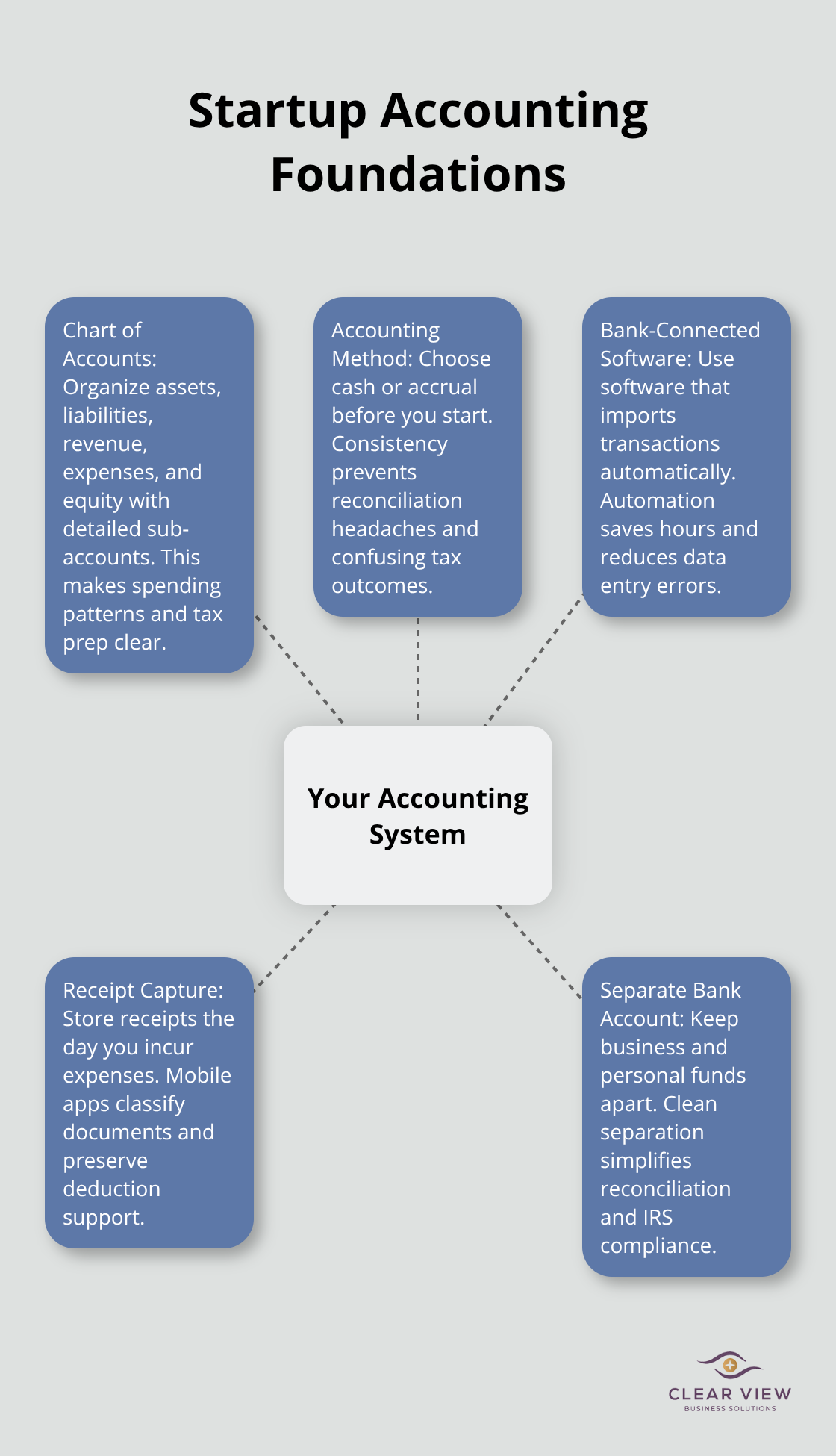
Set up your chart of accounts in your chosen software before your first transaction, then connect your business bank account for automatic feeds. This foundation prevents the common trap of disorganized finances that plague startups later.
With your chart of accounts organized and your accounting method locked in, you now have the infrastructure to track money accurately. The next step is understanding the mistakes that trip up most Tucson startups-and how to sidestep them before they damage your business.
Mixing personal and business finances creates a tax nightmare fast. When you pay for office supplies from your personal account or transfer business revenue to your personal checking without documentation, you destroy the paper trail that makes tax filing straightforward. The IRS expects clear separation, and more importantly, you lose visibility into what your business actually costs to run.
Open a dedicated business bank account before your first transaction. This single action eliminates the guesswork when tax time arrives and makes reconciliation take minutes instead of hours. If a client asks about your business expenses or you need to apply for a loan, mixed finances make you look unprofessional and unreliable. Your accountant will charge more to untangle a mess than to set it up correctly from the start.
Neglecting expense tracking creates a second major problem. Many Tucson startups think they can remember expenses or reconstruct receipts later, but the IRS requires documentation for every deduction you claim. Without receipts, you lose the deduction entirely.
Scan or photograph receipts the day you incur the expense. Wave and QuickBooks both have mobile apps that let you capture receipts on the spot, and they automatically organize them by category. Set a weekly reminder to reconcile your accounts and match receipts to transactions.
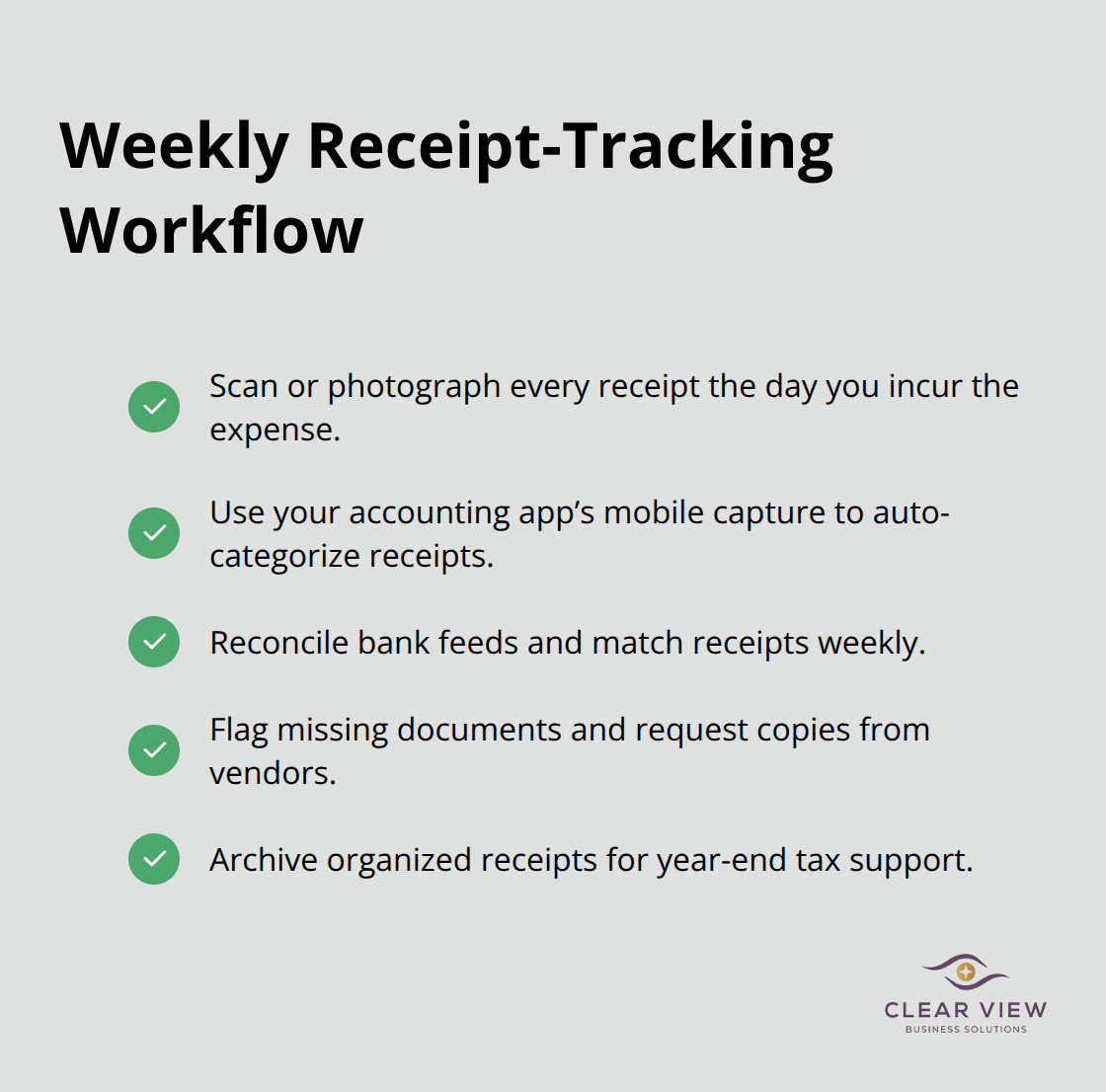
This fifteen-minute habit prevents the scramble in December when you realize you have no proof for thousands in expenses.
Expense tracking documentation requirements include identifying the payee, the amount paid, proof of payment, the date incurred, and a description of the item. A study from the National Federation of Independent Business found that small business owners lose an average of 20 percent of potential deductions because they lack documentation. That translates to unnecessary taxes you could have avoided with basic organization.
Failing to plan for taxes is the third killer mistake. Many startups operate profitably on paper but face a tax bill they cannot pay because they never set aside funds quarterly. Arizona’s tax code includes the Small Business Income election, which allows eligible business owners to file a separate SBI return at a lower rate than regular income tax rates.
Calculate your estimated tax liability every quarter and set that money aside in a separate savings account. Most startups owe quarterly estimated taxes if their liability exceeds one thousand dollars, and missing these payments triggers penalties and interest. Work with your accountant in January to forecast your annual income and determine your quarterly payment schedule. This approach keeps tax obligations from ambushing you and lets you make informed decisions about reinvesting profits or taking distributions. Once you address these three mistakes, you’re ready to explore the tax strategies that actually reduce what you owe.
Your entity structure determines how much you pay in taxes, and most Tucson startups pick the wrong one or never optimize it as their business grows. An S corporation election saves owners thousands annually compared to sole proprietorships or partnerships, but only if your business generates consistent profit. The IRS allows you to switch entity types, and Arizona’s tax code gives you additional opportunities that most startups ignore entirely.
If you operate as a sole proprietor and earn $60,000 in net profit, you owe self-employment tax of roughly 15.3 percent on that income, totaling approximately $9,180. Elect S corporation status, and you can pay yourself a reasonable salary of $40,000 and take the remaining $20,000 as a distribution, reducing your self-employment tax to around $6,120. That $3,000 annual savings compounds over time and funds your growth.
Arizona’s Small Business Income election creates another layer of tax reduction. If you qualify as an SBI taxpayer, you can file a separate SBI return using Form 140-SBI at a preferential rate of 3.0 percent instead of the standard individual income tax rates that reach 2.98 percent for most brackets. This election applies to business income from self-employment, rental property, farming, or capital gains from business asset sales.
You must file Form 140-SBI with your regular Arizona return to activate this election, and the deadline matches your regular tax return deadline. Missing this filing means you lose the benefit for that year and cannot amend it retroactively unless you file within the statute of limitations. The SBI election requires careful attention to deadlines and proper documentation, so working with a tax professional ensures you capture this benefit.
Deductions available to new businesses are far broader than most owners realize. The National Federation of Independent Business reports that small business owners lose an average of 20 percent of potential deductions through poor tracking. Office supplies, software subscriptions, vehicle mileage for business purposes, home office space proportional to your business use, professional development courses, and equipment purchases all qualify.
If you work from home, calculate the square footage of your dedicated workspace divided by your total home square footage, then multiply that percentage by your annual rent or mortgage interest and property taxes. A 200-square-foot office in a 2,000-square-foot home equals 10 percent, which could generate $3,000 to $5,000 in annual deductions depending on your housing costs. New business startup costs up to $5,000 can be deducted immediately, with amounts exceeding $5,000 amortized over 15 years.

Quarterly estimated tax payments prevent penalties and keep cash flow manageable. If your Arizona tax liability exceeds $1,000 annually, the state requires quarterly payments by April 15, June 15, September 15, and January 15. Calculate your estimated liability in January based on your prior year income and current year projections, then divide by four to determine each quarterly payment.
Underpayment penalties apply even if you eventually pay everything owed, so accuracy matters. If you cannot pay the full amount due, Arizona’s Department of Revenue allows payment plans through AZTaxes.gov, and the process typically takes 60 days after your liability is billed. Try setting aside 25 to 30 percent of net profit each quarter to prevent the scramble in April and maintain compliance with state requirements.
Getting your startup accounting in Tucson right from the beginning separates businesses that survive from those that collapse under financial chaos. You now understand how to build a chart of accounts, choose your accounting method, avoid the three mistakes that sink most startups, and implement tax strategies that actually reduce what you owe. The systems you set up today become the foundation for every financial decision you make as your business grows.
Professional accounting support accelerates this process and prevents costly errors. We at Clear View Business Solutions work with Tucson startups to build accounting systems that work, not just systems that exist. Our team handles bookkeeping, tax planning, and IRS representation so you can focus on running your business instead of wrestling with spreadsheets, and we help you maximize tax benefits like Arizona’s Small Business Income election and S corporation elections that most startups miss entirely.
Open a dedicated business bank account this week if you haven’t already, then set up your chart of accounts in Wave or QuickBooks. Contact Clear View Business Solutions to review your entity structure and confirm you’re positioned for tax efficiency, because a professional review now costs far less than fixing disorganized finances later or paying unnecessary taxes because you missed available deductions and elections.




At Clear View Business Solutions, we know you want your business to prosper without having to worry about whether you are paying more in taxes than you should or whether your business is set up correctly. The problem is it's hard to find a trusted advisor who can translate financial jargon to layman's terms and who can actually help you plan for better results.
We believe it doesn't have to be this way! No business owner should settle for working with a CPA firm that falls short of understanding what you want to achieve and how to help you get there.
Northwest Location:
7530 N. La Cholla Blvd., Tucson, AZ 85741
Central Location:
2933 N Campbell Avenue, Tucson, AZ 85719
© 2026 Clear View Business Solutions. All Rights Reserved.
At Clear View Business Solutions, we know you want your business to prosper without having to worry about whether you are paying more in taxes than you should or whether your business is set up correctly. The problem is it's hard to find a trusted advisor who can translate financial jargon to layman's terms and who can actually help you plan for better results.
We believe it doesn't have to be this way! No business owner should settle for working with a CPA firm that falls short of understanding what you want to achieve and how to help you get there. With over 20 years of experience serving hundreds of business owners like you, our team of experts combines financial expertise and proactive communication with our drive to help each client achieve results and have fun along the way.
Here's how we do it:
Discover: We start with a consultation to understand your specific goals, what's holding you back, and what success looks like for you.
Strategize & Optimize: Together, we design a customized strategy that empowers you to progress toward your goals, and we optimize our communication as partners.
Thrive: You enjoy a clear view of your business and your financial prosperity.
Schedule a consultation today, and take the first step toward being able to focus on your core business again without wondering if your numbers are right- or what they mean to your business.
In the meantime, download, "The Business Owner's Essential Guide to Tax Deductions" and make sure you aren't leaving money on the table.