


Most business owners confuse tax planning with tax preparation, treating them as the same service. This costly mistake can result in missed deductions and higher tax bills.
We at Clear View Business Solutions see this confusion regularly. Understanding the tax planning vs tax preparation difference can save you thousands of dollars annually.
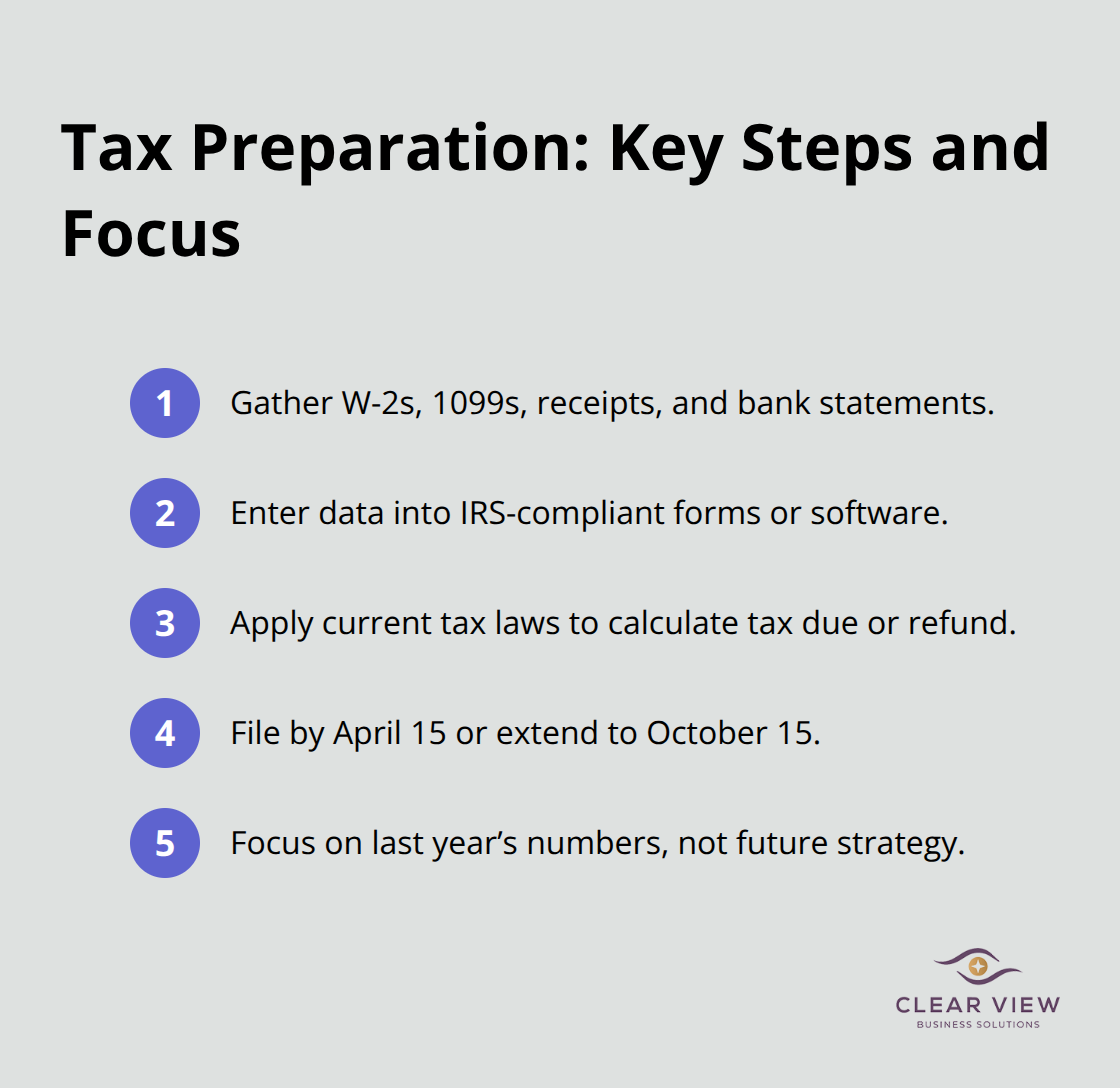
Tax preparation focuses on the completion and submission of your annual tax return to the IRS. This process requires you to collect financial documents such as W-2s, 1099s, receipts, and bank statements to calculate your exact tax liability for the previous year. Tax preparers enter this information into tax software or forms, then apply current tax laws to determine whether you owe money or will receive a refund. The IRS mandates that most taxpayers file returns by April 15th, though extensions allow additional time until October 15th for document preparation.
The IRS requires a professional certification like a PTIN as well as an official copy of your fingerprints for tax preparation work. This creates significant variation in preparer expertise compared to CPAs or enrolled agents who possess advanced credentials. Many preparers operate with minimal tax knowledge, which can impact the quality of service you receive. Some states impose additional licensing requirements, but federal standards remain minimal across the industry.
Tax preparation operates within a compressed timeframe from January through April, which creates rushed conditions that often result in missed deductions. Most preparers handle hundreds of returns during this peak period, typically allocating 2-3 hours maximum per return. The seasonal nature limits communication with your preparer outside tax season, leaving questions unanswered for months. Small business owners face particular challenges since their complex financial situations require more attention than the standard 15-minute consultation provides.
Simple returns may suit online software, which can cost as little as $50–$150, while business returns cost $500-$1,200 based on complexity. These fees cover only the actual preparation and submission process, not strategic advice or ongoing support throughout the year. Most preparers concentrate exclusively on compliance rather than optimization, which means they miss opportunities to reduce your tax burden through strategic approaches.
Tax preparation serves an important compliance function, but its reactive nature contrasts sharply with the proactive strategies available through comprehensive tax planning approaches.
Tax planning transforms your financial strategy through continuous analysis and strategic decisions throughout the year. This approach examines your current financial position, projected income, and potential deductions to minimize tax liability before deadlines arrive. The National Association of Tax Professionals reports that businesses with strategic tax plans save 15-30% on annual tax obligations compared to those who rely solely on preparation services. Tax plans evaluate entity structure changes, retirement contribution schedules, equipment purchases under Section 179, and R&D tax credit opportunities that many startups overlook entirely.
Effective tax plans require quarterly reviews to adjust withholdings, accelerate or defer income, and time major purchases for optimal tax benefits. The IRS allows businesses to deduct up to $1,220,000 in equipment purchases through Section 179 in 2024, but this benefit requires advance plans to structure purchases correctly. Tax plans also involve conversions of traditional IRA funds to Roth accounts when income drops, capital loss harvests to offset gains, and maximized HSA contributions that offer triple tax advantages. Charitable donations can reduce taxable income up to 60% of adjusted gross income (but strategic bunches of contributions across tax years amplify these benefits significantly).

Tax plans demand continuous collaboration with CPAs or enrolled agents who understand complex tax code changes and industry-specific opportunities. These professionals conduct annual tax projections, recommend entity structure modifications, and identify credits like the Work Opportunity Tax Credit worth up to $2,400 per qualified employee. Quarterly strategy sessions cost $200-500 but typically generate savings of $2,000-10,000 annually for small businesses through proactive adjustments and strategic implementations.
These fundamental differences in approach, schedule, and professional involvement create distinct advantages that separate tax plans from simple preparation services.
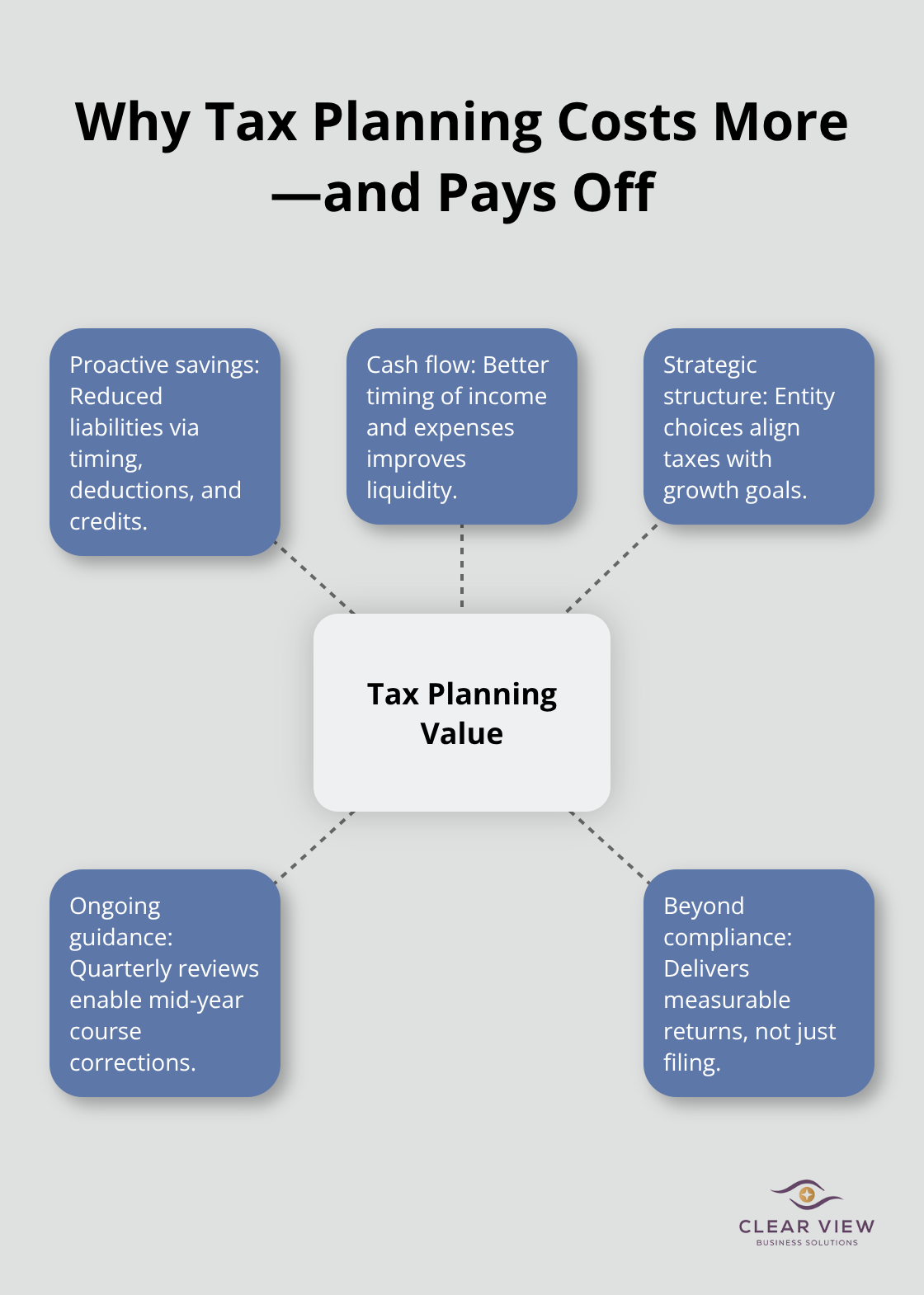
Tax preparation and tax planning operate on completely different financial models that reflect their distinct value propositions. Tax preparation costs range from $200 for basic individual returns to $1,200 for complex business filings, which represents a one-time annual expense with no benefits beyond compliance. Tax planning requires monthly or quarterly investments of $200-500 but generates measurable returns through reduced tax liabilities, improved cash flow management, and strategic financial positions.
Businesses that invest in year-round tax planning benefit from staying on top of adjusted gross income and tracking receipts for optimal tax savings.
Tax preparation operates within the compressed January-April window, which creates rushed conditions where preparers handle 300-500 returns during peak season with minimal time per client. Tax planning spreads strategic decisions across 12 months, which allows for optimal income recognition, expense acceleration, and investment decisions that maximize deductions. Quarterly tax planning sessions enable mid-year course corrections such as increased retirement contributions to $23,500 in 2025, tax-loss harvesting strategies, or timed equipment purchases to capture Section 179 benefits.
This extended timeframe creates opportunities that disappear under preparation deadlines, such as traditional IRA fund conversions to Roth accounts during low-income years or bunched charitable donations to exceed standard deduction thresholds.
Tax planning builds cumulative advantages through strategic entity structure decisions, retirement plan coordination, and proactive compliance management that compound over multiple years. Businesses with consistent tax planning show varying effective tax rates based on their specific circumstances and entity structures. Tax preparation addresses only historical compliance without future optimization, which misses opportunities like R&D tax credits worth up to 20% of qualified expenses or Work Opportunity Tax Credits that provide $2,400-9,600 per eligible employee.
The upfront investment in tax planning pays dividends through strategic decisions that preparation services cannot provide. Businesses that implement quarterly tax reviews typically recover their planning fees within the first year through optimized deductions and credit identification. Tax preparation offers no return on investment beyond compliance, while tax planning creates measurable financial improvements that accumulate over time.
The tax planning vs tax preparation decision depends on your financial complexity and growth goals. Business owners with fluctuating income, multiple revenue streams, or expansion plans benefit significantly from year-round tax planning services. Individuals with simple W-2 income and standard deductions may find basic tax preparation sufficient for compliance needs.
Tax preparation works for straightforward situations where you need annual filing completed correctly and on time. Tax planning becomes essential when you want to minimize tax liability, optimize cash flow, and build long-term wealth through strategic financial decisions. Professional services make the difference between reactive compliance and proactive optimization (CPAs and enrolled agents provide expertise that identifies opportunities worth thousands in annual savings).
We at Clear View Business Solutions specialize in comprehensive tax services that combine preparation accuracy with strategic planning benefits. Our approach helps Tucson businesses and individuals maximize deductions while maintaining full compliance with IRS requirements. Your choice between these services shapes your financial future through strategic decisions that compound over time.




At Clear View Business Solutions, we know you want your business to prosper without having to worry about whether you are paying more in taxes than you should or whether your business is set up correctly. The problem is it's hard to find a trusted advisor who can translate financial jargon to layman's terms and who can actually help you plan for better results.
We believe it doesn't have to be this way! No business owner should settle for working with a CPA firm that falls short of understanding what you want to achieve and how to help you get there.
Northwest Location:
7530 N. La Cholla Blvd., Tucson, AZ 85741
Central Location:
2933 N Campbell Avenue, Tucson, AZ 85719
© 2026 Clear View Business Solutions. All Rights Reserved.
At Clear View Business Solutions, we know you want your business to prosper without having to worry about whether you are paying more in taxes than you should or whether your business is set up correctly. The problem is it's hard to find a trusted advisor who can translate financial jargon to layman's terms and who can actually help you plan for better results.
We believe it doesn't have to be this way! No business owner should settle for working with a CPA firm that falls short of understanding what you want to achieve and how to help you get there. With over 20 years of experience serving hundreds of business owners like you, our team of experts combines financial expertise and proactive communication with our drive to help each client achieve results and have fun along the way.
Here's how we do it:
Discover: We start with a consultation to understand your specific goals, what's holding you back, and what success looks like for you.
Strategize & Optimize: Together, we design a customized strategy that empowers you to progress toward your goals, and we optimize our communication as partners.
Thrive: You enjoy a clear view of your business and your financial prosperity.
Schedule a consultation today, and take the first step toward being able to focus on your core business again without wondering if your numbers are right- or what they mean to your business.
In the meantime, download, "The Business Owner's Essential Guide to Tax Deductions" and make sure you aren't leaving money on the table.