

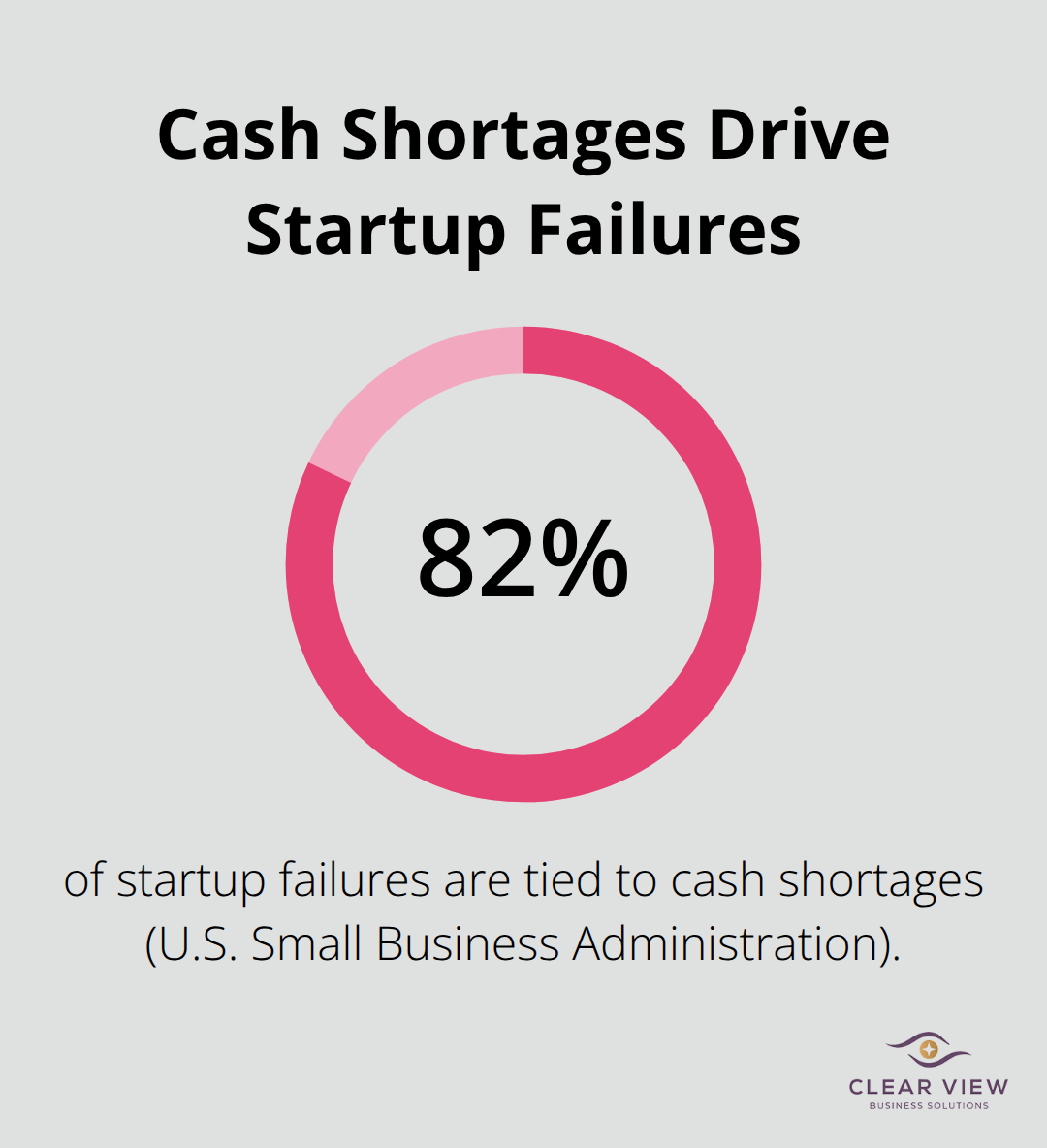
Most startups collapse not because their business idea is flawed, but because they run out of money. Poor startup budget setup is the silent killer behind 82% of startup failures, according to the U.S. Small Business Administration.
At Clear View Business Solutions, we’ve seen firsthand how the right budget framework transforms financial chaos into predictable growth. This guide walks you through building a budget that actually works.
Most founders underestimate what it actually costs to run a business. They account for obvious expenses like salaries and rent, then face surprises from software subscriptions, accounting fees, legal compliance, insurance, and infrastructure costs that weren’t on their radar. Research from the U.S. Small Business Administration shows that cash shortages are a leading cause of startup failure, yet founders routinely operate with budgets missing 20-40% of real expenses. The problem isn’t laziness-it’s that many startup expenses hide in plain sight. You might budget $5,000 monthly for operations, then discover you need $2,000 more just for tax compliance, professional services, and regulatory filings. Without accounting for these hidden costs upfront, your budget becomes fiction within three months.
Cash flow forecasting separates startups that survive from those that don’t. A business can be profitable on paper yet collapse because money doesn’t arrive when bills are due. If you sell a product with 30-day payment terms to customers but need to pay suppliers within 14 days, you face a cash gap that kills many early-stage companies. Most founders create a monthly budget but never model when money actually flows in and out.
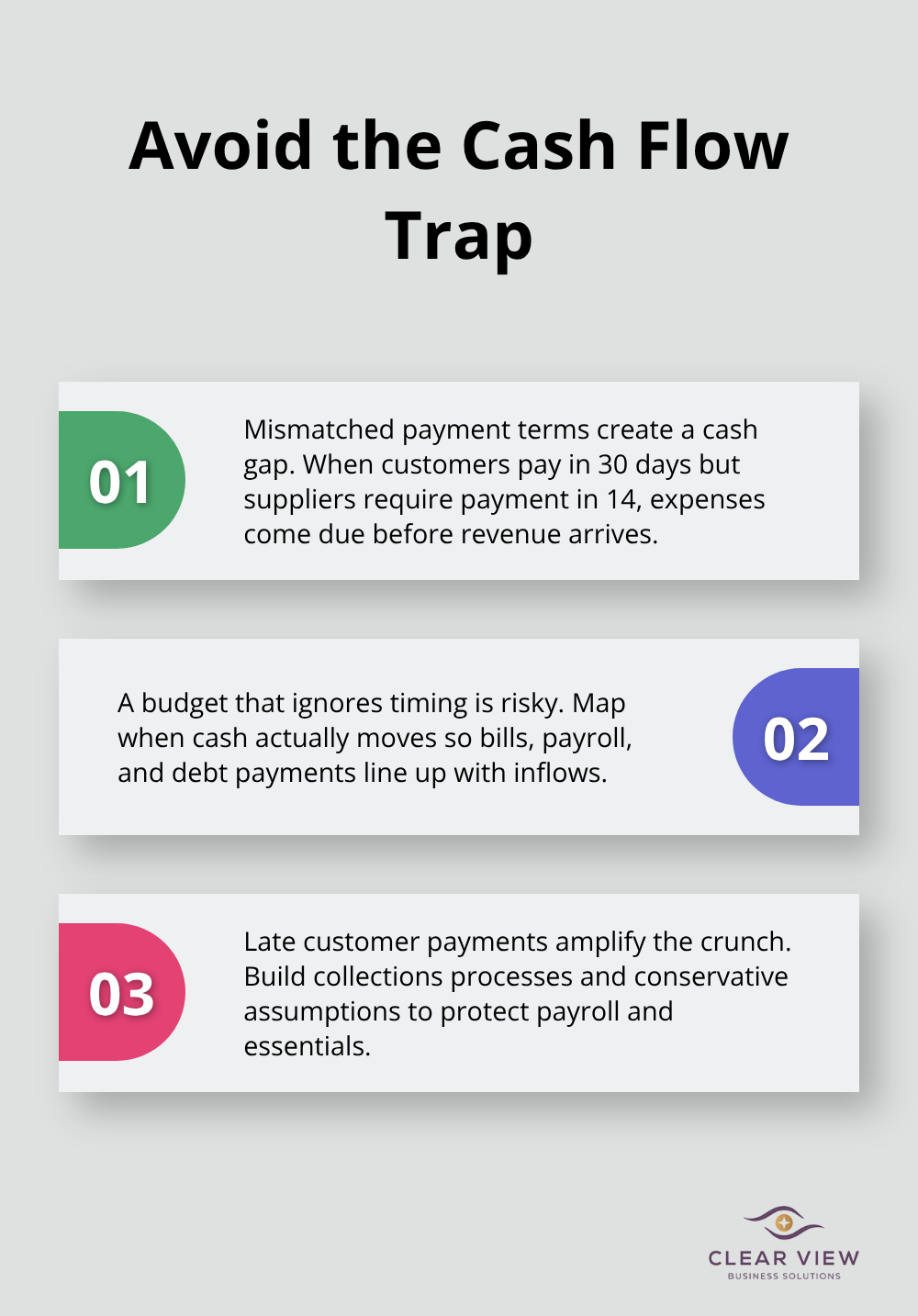
You might project $50,000 in revenue for month three, but if half your customers pay late, you’re short on cash when payroll hits on the 15th.
Separate your budget into two documents: one shows projected profit and loss, another tracks when cash enters and leaves your account. This second document is what keeps you alive. Track accounts receivable aging and payment terms with every customer, then adjust your monthly cash needs accordingly.
Startups that survive unexpected shocks set aside 5-10% of their budget as contingency funds before the year starts. This isn’t optional-it’s the difference between weathering a supplier price increase or a key team member departure versus running out of money. Most founders treat contingency planning as hoping nothing goes wrong. Instead, list your actual risks: What if your main customer delays payment by 60 days? What if a critical tool’s price doubles? What if you need to hire faster than planned? Assign a dollar amount to each realistic scenario, then add those costs to your budget before you commit to spending plans.
Without this buffer, the first unexpected expense forces you to cut corners on things that matter, like hiring or product development. Your next step involves building the actual framework that transforms these lessons into a working budget structure.
Your budget needs a skeleton before it becomes useful. Most founders mix revenue projections with expense categories in a single messy spreadsheet, then wonder why their forecasts fall apart by month two. Start by separating fixed costs from variable costs, then add revenue projections tied to real market data, not wishful thinking.
Fixed costs stay the same regardless of sales volume: rent, salaries, insurance premiums, and software subscriptions you pay monthly. Variable costs fluctuate with business activity: materials, shipping, payment processing fees, and contractor hours. The split matters because fixed costs create your minimum monthly burn rate-the absolute floor you need to hit before revenue even matters.
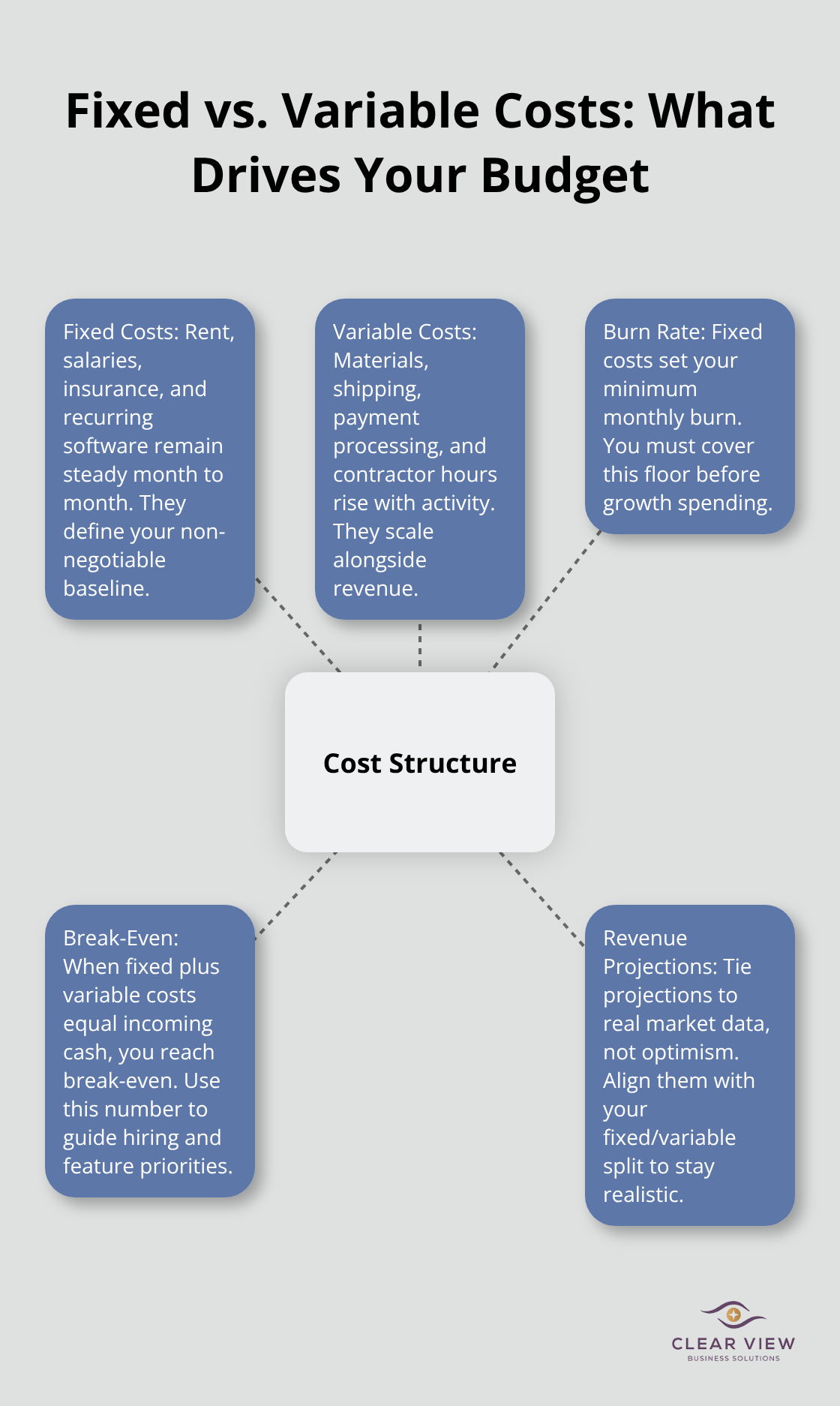
If your fixed costs are $15,000 monthly, you need $15,000 in cash flow every single month or you bleed capital. Variable costs scale with growth, so as revenue increases, some expenses rise proportionally. Separate these two categories in your budget spreadsheet, then calculate your break-even point-the revenue level where variable costs plus fixed costs equal your incoming cash.
Most startups discover their break-even point is lower than they feared once they actually map it out. If you run a SaaS company with $15,000 fixed costs and 40% variable costs on revenue, your break-even sits around $25,000 monthly revenue. Knowing this number shapes every hiring and feature decision you make in the first year.
Revenue projections require more than optimism. Look at comparable companies in your market and their growth trajectories, check industry reports from sources like Gartner or Forrester if they cover your space, and talk directly to customers about realistic adoption timelines.
If you sell B2B software, your first customer might take four months to close. If you sell physical products, supply chain delays could push your launch back. Don’t project month-one revenue as if sales start immediately-they don’t.
Build a realistic ramp: months one through three might generate 20% of your projected annual revenue, months four through six another 40%, and months seven through twelve the final 40%. This spreads revenue more honestly across the year instead of creating a false cliff. Once you have fixed costs, variable cost percentages, and a revenue ramp, your budget becomes grounded in reality rather than hope.
Build monthly and quarterly milestones once you have your cost structure and revenue projections in place. Month one should show your fixed costs against minimal revenue, month two slightly higher revenue, and so on. Quarterly milestones matter because they align with investor reporting and tax planning cycles.
Many startups operate with monthly budgets but miss quarterly cash tax payments because they never tracked cumulative quarterly numbers. Your monthly budget shows operational health; your quarterly view flags tax obligations and larger financial patterns. These two perspectives work together to keep you on track.
The foundation is now in place. With fixed and variable costs separated, revenue projections grounded in market data, and both monthly and quarterly milestones mapped out, you have a budget that reflects reality. The next challenge is avoiding the mistakes that derail even well-intentioned founders.
Most founders treat tax obligations as an afterthought, something to handle when the accountant calls in Q4. This approach costs startups thousands in penalties and forces hasty decisions that damage cash flow. Quarterly estimated tax payments are legally required for most business structures, yet founders who ignore them discover they owe significant amounts in April when they thought they had breathing room. The IRS doesn’t wait for your annual return-it expects quarterly payments from self-employed founders and S-corp owners.
If you’re profitable but haven’t set aside 25-35% of net income for federal, state, and self-employment taxes, you’re operating on borrowed time. Calculate your effective tax rate based on your business structure (sole proprietor, LLC, S-corp, or C-corp each have different rates), then transfer that percentage into a separate tax reserve account monthly. Don’t wait for quarterly deadlines. Move money immediately after you recognize revenue so the temptation to spend it vanishes. Many startups fail not because they’re unprofitable but because they spent their tax liability on inventory or hiring.
Tracking actual spending against projections separates founders who course-correct from those who crash. You build a beautiful budget in month one, then never compare it to reality. Within six months, you’re spending 40% more than projected without knowing why or where to cut.
The solution is ruthless monthly reconciliation: pull your actual bank and credit card statements, categorize every transaction against your budget line items, then calculate the variance. If you budgeted $3,000 for software subscriptions and spent $4,200, investigate immediately-you probably signed up for tools you forgot about or duplicated subscriptions across team members. Most founders discover 15-25% of their software spend is waste once they actually track it.
Use a tool like QuickBooks Online or Xero to automate this comparison, then spend 30 minutes monthly reviewing variances larger than 10%. This monthly discipline prevents the surprise of discovering in month nine that you’ve burned through your runway 60 days early.
Professional accounting support isn’t a luxury for larger companies-it’s a survival tool for startups. Founders who try to manage their own books for the first year often face a disaster: misclassified expenses that trigger an audit, missed tax deadlines that create penalties, or revenue recognition errors that make financial statements useless for fundraising.
A fractional accountant or bookkeeper costs $500-$2,000 monthly but catches problems that cost $5,000-$50,000 to fix later. They reconcile your accounts monthly, flag suspicious transactions, ensure tax compliance, and provide the quarterly financial statements investors actually want to see. If you’re serious about surviving your first three years, budget for professional support from month one. The cost of getting it right is far smaller than the cost of getting it wrong.
Your startup budget setup determines whether you survive your first three years or join the 82% that fail from cash shortages. The framework we’ve outlined-separating fixed and variable costs, grounding revenue projections in market reality, tracking actual spending monthly, and building contingency buffers-transforms budgeting from guesswork into a working financial system. Monthly reconciliation catches spending creep before it becomes a crisis, and quarterly reviews align your operations with tax obligations so you’re never surprised by what you owe.
Many founders delay professional help because they think they’ll save money managing finances alone. A fractional accountant or bookkeeper catches misclassified expenses, flags duplicate software subscriptions, and ensures revenue recognition is correct for fundraising-these catches typically pay for themselves within the first month. Professional accounting support ensures your financial statements are accurate enough for investors and your tax filings are compliant enough to avoid penalties.
Pull together your current expenses, map your revenue projections, and separate fixed costs from variable costs this week. Then schedule a consultation with a professional accountant who understands startups-at Clear View Business Solutions, we work specifically with startups to build accounting systems that support growth while keeping you compliant. The difference between startups that survive and those that fail often comes down to one thing: founders who take their budget seriously from day one.




At Clear View Business Solutions, we know you want your business to prosper without having to worry about whether you are paying more in taxes than you should or whether your business is set up correctly. The problem is it's hard to find a trusted advisor who can translate financial jargon to layman's terms and who can actually help you plan for better results.
We believe it doesn't have to be this way! No business owner should settle for working with a CPA firm that falls short of understanding what you want to achieve and how to help you get there.
Northwest Location:
7530 N. La Cholla Blvd., Tucson, AZ 85741
Central Location:
2933 N Campbell Avenue, Tucson, AZ 85719
© 2026 Clear View Business Solutions. All Rights Reserved.
At Clear View Business Solutions, we know you want your business to prosper without having to worry about whether you are paying more in taxes than you should or whether your business is set up correctly. The problem is it's hard to find a trusted advisor who can translate financial jargon to layman's terms and who can actually help you plan for better results.
We believe it doesn't have to be this way! No business owner should settle for working with a CPA firm that falls short of understanding what you want to achieve and how to help you get there. With over 20 years of experience serving hundreds of business owners like you, our team of experts combines financial expertise and proactive communication with our drive to help each client achieve results and have fun along the way.
Here's how we do it:
Discover: We start with a consultation to understand your specific goals, what's holding you back, and what success looks like for you.
Strategize & Optimize: Together, we design a customized strategy that empowers you to progress toward your goals, and we optimize our communication as partners.
Thrive: You enjoy a clear view of your business and your financial prosperity.
Schedule a consultation today, and take the first step toward being able to focus on your core business again without wondering if your numbers are right- or what they mean to your business.
In the meantime, download, "The Business Owner's Essential Guide to Tax Deductions" and make sure you aren't leaving money on the table.