

Tucson startups leave thousands of dollars on the table every year by missing obvious tax deductions and choosing the wrong business structure. The difference between a haphazard approach and a strategic one can mean tens of thousands in savings.
At Clear View Business Solutions, we’ve seen firsthand how tax planning for Tucson startups transforms a company’s bottom line. The strategies in this post work-if you implement them before year-end.
Most Tucson startup owners fail to claim legitimate deductions worth $3,000 to $8,000 annually, according to data from the National Association of the Self-Employed. The IRS allows home office deductions using either the simplified method at $5 per square foot or the actual expense method, which captures mortgage interest, utilities, insurance, and depreciation. If you operate from a dedicated room in your home, you’re likely leaving money on the table.
Calculate your actual square footage and apply it to your rent or mortgage-this single step recovers thousands for many startups. Equipment purchases for your startup qualify as deductions too: laptops, software subscriptions, office furniture, and machinery all reduce your taxable income in the year you acquire them. Many startup owners miss these because they assume only large capital purchases count, but the IRS has specific rules about what qualifies as a business asset versus personal property.

Tucson startups with company vehicles or vehicles used partly for business often underestimate their deduction. The IRS standard mileage rate for 2026 is 72.5 cents per mile for business use, and you can track mileage throughout the year to claim this deduction. If you drive to client meetings, attend business conferences, or travel between job sites, document those miles meticulously. Alternatively, you can deduct actual vehicle expenses including gas, maintenance, insurance, and depreciation if you keep detailed records. Many startup owners pick one method and stick with it, but switching to whichever method yields a larger deduction is perfectly legal.
Health insurance premiums and retirement contributions represent another major category that startups overlook. If you’re self-employed, you can deduct 100% of your health insurance premiums as an above-the-line deduction, meaning you don’t need to itemize to claim it. Setting up a SEP-IRA or Solo 401(k) allows you to contribute up to 20% of your net self-employment income (and these contributions reduce your taxable income dollar-for-dollar). Starting these accounts before December 31 positions your startup to capture significant tax savings immediately.
Your business structure determines how much of these deductions actually benefit you, which is why the choice between sole proprietorship, LLC, and S-Corp matters far more than most startups realize.
Choosing between a sole proprietorship, LLC, and S-Corp isn’t a philosophical decision-it’s a financial one that directly impacts how much you owe in taxes. Most Tucson startups operate as sole proprietorships or LLCs by default, but this choice often costs them thousands annually in unnecessary self-employment taxes.
A sole proprietorship passes all business income to your personal tax return, meaning you pay both income tax and self-employment tax on 100% of your profits. An LLC treated as a sole proprietorship works the same way-no tax savings. However, an S-Corp election changes everything. With an S-Corp, you split income into salary (which you pay self-employment taxes on) and distributions (which you don’t). If your startup generates $80,000 in annual profit, you might pay yourself a reasonable salary of $50,000 and take $30,000 as a distribution. This approach saves roughly 15% in self-employment taxes on that $30,000 distribution, translating to approximately $4,500 in annual savings.
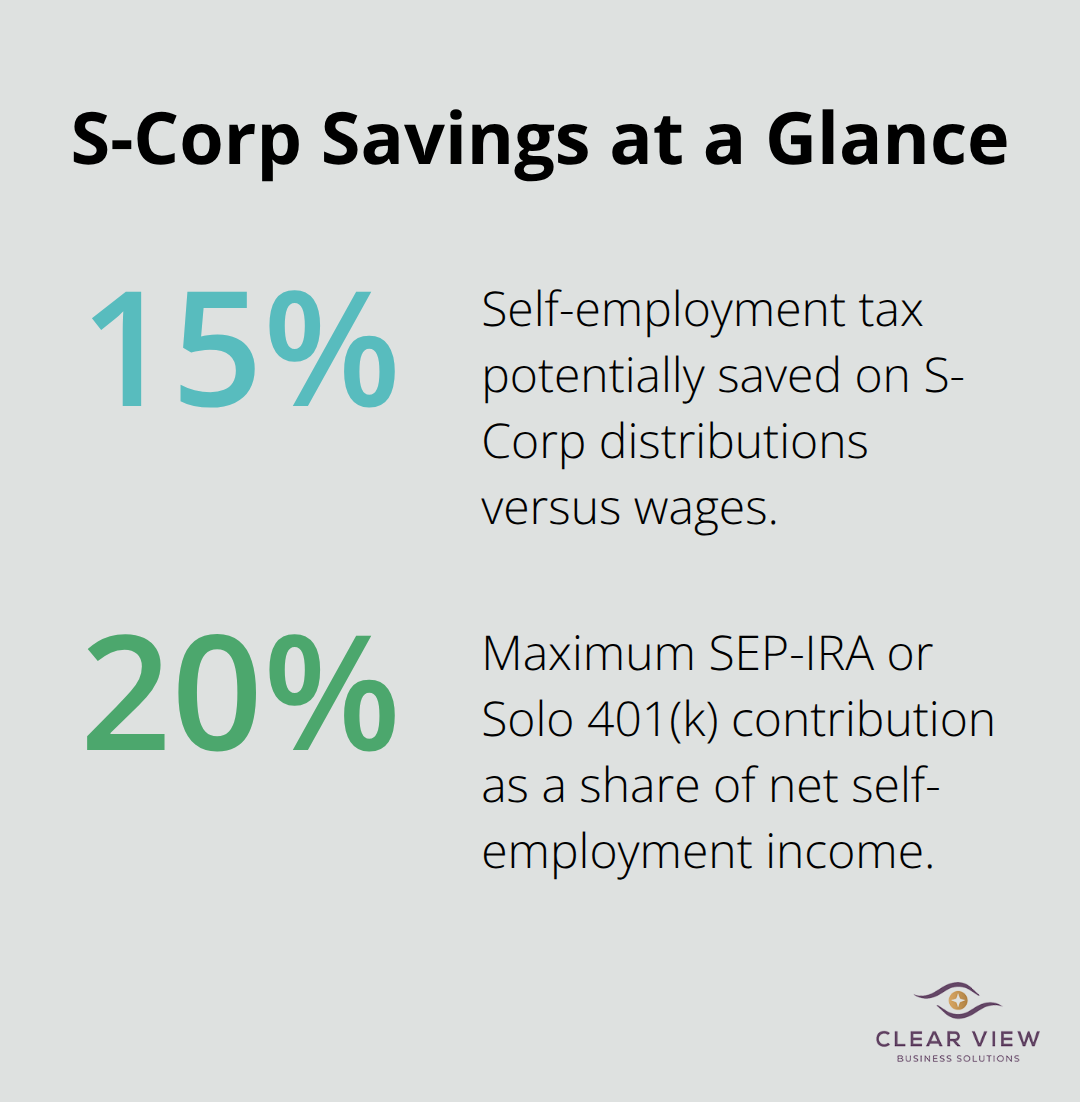
The IRS requires S-Corp reasonable salary requirement IRS rules to pay reasonable salaries, so you can’t minimize this to $10,000 and claim the rest as distributions. The threshold for making an S-Corp worthwhile typically sits around $60,000 in annual net profit-below that, the additional accounting and filing fees ($800 to $1,500 yearly) usually exceed your tax savings. Your business structure determines how much of your deductions actually benefit you, which is why this choice matters far more than most startups realize.
Sole proprietors and single-member LLCs must pay estimated taxes quarterly if they expect to owe $1,000 or more in taxes for the year. Missing these payments triggers penalties and interest charges that compound throughout the year. Calculate your estimated quarterly payments by projecting your annual income and dividing by four, then adjust based on actual results each quarter. Many startups front-load income early in the year, then slow down later-paying uniform quarterly estimates leaves you overpaying early and underpaying later. Work with a tax professional to adjust your payment schedule based on actual cash flow. S-Corp owners face the same quarterly requirement but have more flexibility because distributions aren’t subject to self-employment tax, allowing better cash management.
The entity choice you make today determines your tax bill for years to come. Getting this decision right upfront prevents expensive restructuring later, but timing matters just as much as structure. Strategic planning around when you recognize income and claim expenses can reduce your tax burden significantly.
December 31 isn’t just a calendar milestone for Tucson startups-it’s a hard deadline that determines your tax bill for the entire year. Most startup owners treat year-end tax planning as an afterthought, but the difference between acting in October versus January can cost $5,000 to $15,000 or more. The IRS has specific rules about when deductions count and when income must be reported, and these rules heavily favor startups that plan strategically rather than reactively.
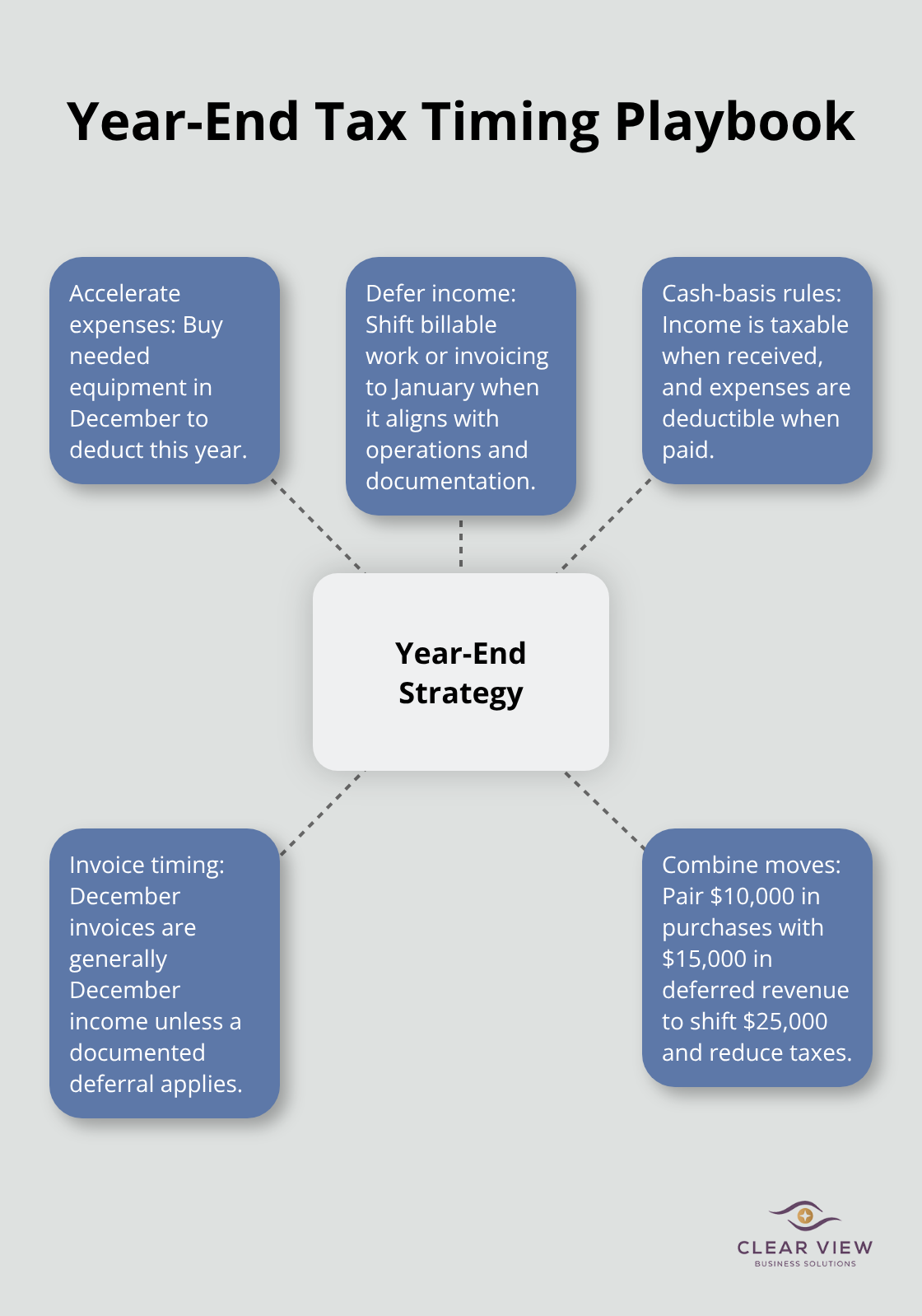
If your business operates on a calendar year (which most do), expenses must be incurred before December 31 to count as deductions on that year’s return. A $3,000 software subscription purchased on January 2 saves you nothing for the current year, but that same purchase on December 20 reduces your taxable income immediately. Cash-basis businesses like most Tucson startups report income in the tax year you receive it, and deduct expenses in the tax year in which you pay the expenses. This distinction matters enormously because you control the timing entirely.
Accelerating legitimate business expenses into the current year requires planning that starts months earlier, not weeks. Identify equipment your startup needs anyway-computers, office furniture, machinery, vehicles-and purchase these items before year-end rather than waiting until spring. A startup that needs a new laptop can buy it in December and claim the deduction immediately, or wait until February and lose that deduction entirely for the current tax year. The math is straightforward: accelerate $10,000 in equipment purchases into December and your taxable income drops by $10,000, potentially saving $2,000 to $3,700 depending on your tax strategy.
Deferring income works differently and requires more caution because the IRS scrutinizes aggressive income deferral strategies. If you invoice a client in December, you typically must report that income in December regardless of when the client pays you, unless you have a documented agreement to defer payment into the next year. However, you can legitimately delay sending invoices or completing billable work until January if that aligns with your actual business cycle. Defer $15,000 in consulting revenue to January and you push that income into the next tax year entirely (reducing your current-year tax burden significantly).
These two strategies combined-aggressive expense acceleration and selective income deferral-form the foundation of effective year-end tax planning for Tucson startups that are serious about protecting their bottom line. A startup that accelerates $10,000 in equipment purchases and defers $15,000 in revenue can shift $25,000 in taxable income to the following year, potentially saving $5,000 to $9,250 in taxes depending on your bracket and business structure.
Tax planning for Tucson startups compounds year after year when you implement it consistently. The three strategies covered here work together to create real savings: claiming deductions you’ve been missing, structuring your business correctly, and timing your income and expenses strategically. A startup that implements all three approaches can reduce its tax burden by $10,000 to $25,000 annually, money that flows directly back into growth and operations.
Missing $5,000 in deductions costs you $1,000 to $1,850 in taxes depending on your bracket, while choosing the wrong business structure costs you $4,500 or more annually in unnecessary self-employment taxes. Failing to plan year-end timing leaves thousands on the table, and these aren’t theoretical numbers-they’re real dollars that Tucson startups lose every single year. Professional guidance matters because tax law changes constantly and mistakes prove expensive.
We at Clear View Business Solutions work with Tucson startups to identify missed deductions, evaluate entity structure options, and build year-end tax strategies tailored to your specific situation. Contact Clear View Business Solutions for a consultation to review your current business structure and identify which deductions you’ve been missing. The investment in professional guidance pays for itself many times over through tax savings and compliance protection.




At Clear View Business Solutions, we know you want your business to prosper without having to worry about whether you are paying more in taxes than you should or whether your business is set up correctly. The problem is it's hard to find a trusted advisor who can translate financial jargon to layman's terms and who can actually help you plan for better results.
We believe it doesn't have to be this way! No business owner should settle for working with a CPA firm that falls short of understanding what you want to achieve and how to help you get there.
Northwest Location:
7530 N. La Cholla Blvd., Tucson, AZ 85741
Central Location:
2933 N Campbell Avenue, Tucson, AZ 85719
© 2026 Clear View Business Solutions. All Rights Reserved.
At Clear View Business Solutions, we know you want your business to prosper without having to worry about whether you are paying more in taxes than you should or whether your business is set up correctly. The problem is it's hard to find a trusted advisor who can translate financial jargon to layman's terms and who can actually help you plan for better results.
We believe it doesn't have to be this way! No business owner should settle for working with a CPA firm that falls short of understanding what you want to achieve and how to help you get there. With over 20 years of experience serving hundreds of business owners like you, our team of experts combines financial expertise and proactive communication with our drive to help each client achieve results and have fun along the way.
Here's how we do it:
Discover: We start with a consultation to understand your specific goals, what's holding you back, and what success looks like for you.
Strategize & Optimize: Together, we design a customized strategy that empowers you to progress toward your goals, and we optimize our communication as partners.
Thrive: You enjoy a clear view of your business and your financial prosperity.
Schedule a consultation today, and take the first step toward being able to focus on your core business again without wondering if your numbers are right- or what they mean to your business.
In the meantime, download, "The Business Owner's Essential Guide to Tax Deductions" and make sure you aren't leaving money on the table.