

Most Tucson startups skip proper bookkeeping in their first year. They think they’ll handle finances later, after they’ve grown.
That’s a mistake. We at Clear View Business Solutions have seen how poor startup bookkeeping in Tucson leads to missed tax deductions, cash flow problems, and costly penalties down the road. Getting your books right from day one changes everything.
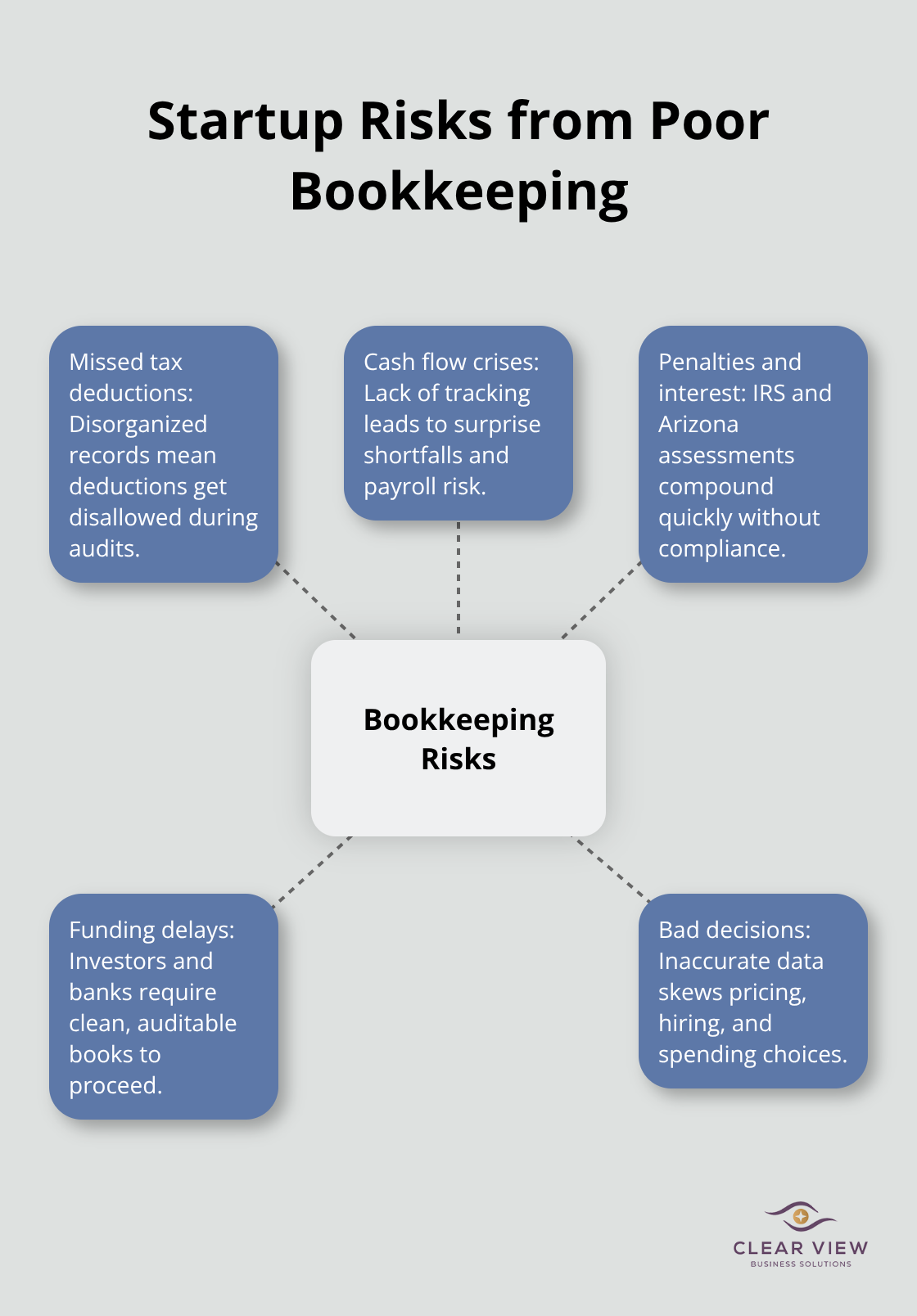
Tucson startups that operate without proper bookkeeping face real financial damage. The IRS catches tax compliance gaps quickly, and Arizona’s state requirements add another layer of scrutiny. A single missed quarterly estimated tax payment triggers penalties that compound throughout the year. Meanwhile, without accurate records, you have no way to know if your business actually made money or simply moved cash around. This blind spot costs founders critical decision-making time and often leads to cash flow crises that could have been prevented.
The numbers matter here. According to the IRS, IRS failure-to-file penalties start at 5% of unpaid taxes per month, capped at 25%. Failure-to-pay penalties run 0.5% per month on top of that. If you owe $5,000 in taxes and miss the deadline by six months, you face $1,250 in penalties alone before interest accrues. Arizona adds its own state penalties on top. Startups that skip bookkeeping until tax season discover these penalties too late to prevent them.
The number 0% seems to be not appropriate for this chart. Please use a different chart type. You cannot negotiate your way out of penalties once the IRS assesses them. Proper bookkeeping from day one gives you documented proof of expenses, income, and deductions that reduce your actual tax liability in the first place. This is not about caution-it is about protecting cash that should stay in your business.
Most Tucson startups fail because of cash problems, according to research on startup failure rates. Without monthly bookkeeping cash flow tracking, you cannot answer basic questions: Did last month’s revenue actually exceed expenses? How much cash do you have left before payroll fails? Which customers are profitable? Are you spending too much on inventory? Guessing at these answers leads to decisions that drain your runway. A founder who tracks cash flow monthly catches problems in weeks, not months. You can adjust spending, negotiate better vendor terms, or adjust pricing before the situation becomes critical. Monthly reconciliation takes a few hours but prevents the cash flow surprises that force founders to choose between paying employees and paying suppliers.
Proper bookkeeping from day one creates a financial foundation that grows with your business. When investors or lenders evaluate your startup, they ask for auditable records spanning multiple years. A startup with clean, organized books from month one closes funding faster and on better terms. Banks reviewing your application want to see consistent, documented cash flow over time. Without that history, lenders see risk and charge higher rates or deny you entirely. The effort you invest in accurate records today becomes the competitive advantage that accelerates growth tomorrow.
The next step is understanding which bookkeeping practices actually work for early-stage Tucson startups-and which mistakes most founders make that derail their financial health.
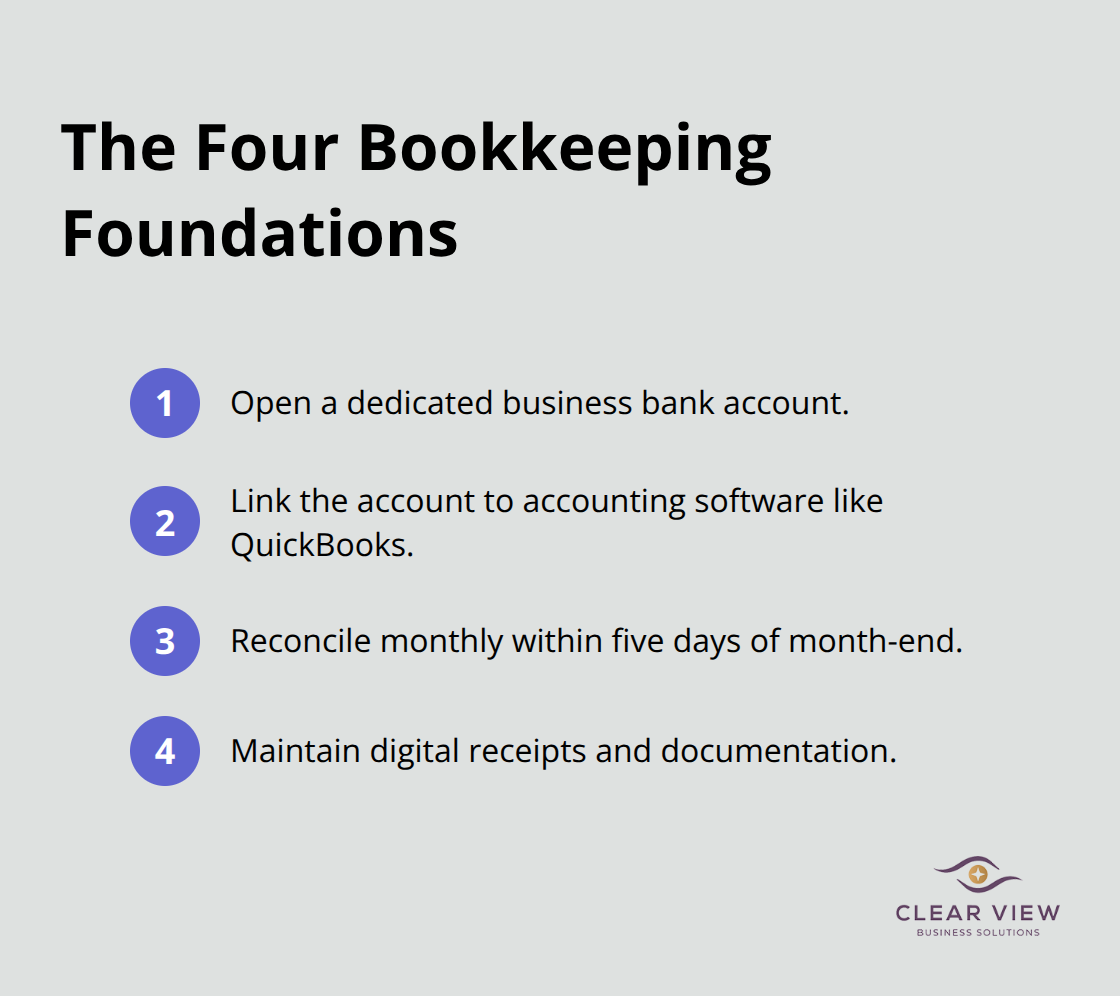
Your first decision as a Tucson startup founder should be opening a separate business bank account. This single action stops the financial bleeding that derails most early-stage operations. When personal and business money mix in one account, your tax preparer spends extra hours sorting transactions, you lose track of actual business profitability, and the IRS flags mixed accounts as a red flag during audits. Open a dedicated business checking account before you deposit your first customer payment. Link it to accounting software like QuickBooks, which costs between $15 and $55 monthly depending on your transaction volume. The software automatically categorizes deposits and expenses, cutting your manual data entry from hours per month to minutes. A separated account with automated tracking gives you instant visibility into whether you’re profitable.
Set a specific day each month, ideally within five days of month-end, to reconcile your bank account against your bookkeeping records. Compare your bank statement line-by-line against what QuickBooks shows you received and spent. Most startups skip this step until they hit a cash crisis and discover missing transactions or duplicate entries that created false balances. Reconciliation catches these errors when they’re small and fixable.
Spend two hours monthly on this task and you’ll spot problems that would otherwise cost thousands in misdirected decisions.
During reconciliation, you’ll also identify which customers haven’t paid invoices and which expenses were unusually high. A startup that reconciles monthly knows its actual cash position within a few dollars. One that waits until tax season discovers surprises that can’t be corrected. After reconciliation, spend another hour reviewing your profit and loss statement. This shows whether your revenue exceeded expenses and by how much. If profit is lower than expected, investigate immediately. Did one customer delay payment? Did a vendor raise prices? Did you overspend on marketing? Monthly review forces these conversations with yourself before small problems become existential ones.
Every transaction needs a paper trail. When the IRS questions a deduction, you need proof that the expense actually happened and was business-related. Keep digital scans of every receipt, invoice, and expense document. QuickBooks lets you attach photos directly to transactions, so the receipt lives with the transaction record permanently. For larger expenses like equipment purchases or contractor payments, save the original receipt plus the invoice or contract. Organize these by month and category so you find them easily.
Most startups lose receipts because they shove them in a drawer and forget them. Instead, take a photo of each receipt on the day you incur the expense and upload it immediately. This takes 30 seconds per receipt and saves hours of panic during tax season. The IRS allows you to claim deductions only if you have documentation. Without receipts, you lose the deduction entirely, even if the expense was legitimate.
QuickBooks and similar platforms transform bookkeeping from a painful monthly chore into a system that works in the background. The software connects directly to your business bank account and automatically pulls transactions. You categorize them once, and the system learns your patterns. Future similar transactions categorize themselves. This automation means you spend minutes reviewing and approving entries instead of hours entering data manually.
The real power emerges when you run reports. QuickBooks generates profit and loss statements, balance sheets, and cash flow projections in seconds. A startup that manually tracks expenses in a spreadsheet spends days creating these reports and often makes calculation errors. One that uses accounting software has accurate financial statements ready whenever you need them (whether for a bank meeting, investor conversation, or your own decision-making).
Your next challenge is understanding which mistakes most Tucson startups make that undo all this foundational work-and how to avoid them before they damage your financial health.
Most Tucson startups make the same preventable mistakes that transform good intentions into financial chaos. The first and most damaging mistake is mixing personal and business money. A founder opens a business account but continues using it like a personal checking account, depositing customer payments alongside personal transfers and withdrawals. This creates an immediate problem: you cannot tell what money actually belongs to the business. When tax season arrives, your accountant spends extra hours sorting through transactions to separate business income from personal transfers. The IRS specifically flags mixed accounts during audits because they make it nearly impossible to verify business legitimacy. More importantly, you lose visibility into actual profitability. If you deposit $10,000 from a customer and withdraw $3,000 for personal use from the same account, your records show $7,000 in revenue when you actually earned $10,000. This false picture leads to terrible decisions about pricing, hiring, and spending. The fix is absolute: every single business transaction flows through a dedicated business account. No personal expenses, no personal transfers, no exceptions.
This single discipline eliminates hours of reconciliation work and removes the audit red flag that mixed accounts create.
The second critical mistake is abandoning monthly bookkeeping until tax season approaches. A founder tracks expenses sporadically, misses reconciliation deadlines, and lets receipts pile up. Then in January, faced with a tax deadline, they frantically gather documents and ask an accountant to reconstruct six months or a year of financial activity. This approach costs money twice over: first, the accountant charges premium rates for emergency reconstruction work, and second, you miss deductions because supporting documentation has disappeared. Arizona requires sales tax filing monthly or quarterly depending on your business type, and missing these deadlines triggers automatic penalties even if you eventually pay the tax owed. Payroll tax deadlines follow a strict federal schedule with no flexibility. Missing a single payroll tax deposit creates a penalty that cannot be negotiated away. A founder who reconciles monthly catches these obligations weeks in advance and builds payment time into their cash flow planning. One who waits until tax season discovers missed deadlines too late to prevent penalties. The discipline here is non-negotiable: reconciliation on the same day every month takes two hours and prevents thousands in penalties and reconstruction fees.
The third mistake compounds from the first two: founders ignore sales tax collection and payroll obligations entirely because they lack accurate records. Arizona requires sales tax registration for most retail and service businesses, with monthly or quarterly filing depending on your revenue threshold. If you collect sales tax but fail to remit it, Arizona treats that money as a debt you owe the state, with interest and penalties accumulating monthly. Payroll taxes work the same way. If you have employees, federal and state payroll taxes are withheld from their paychecks and must be deposited on strict schedules. Treating payroll tax withholdings as optional cash flow money is theft, and the IRS pursues this aggressively. A startup that maintains accurate monthly records knows exactly what sales tax liability it has accumulated and plans payments accordingly. One without records discovers these obligations only when a tax notice arrives demanding payment plus penalties.
The final mistake is waiting until tax season to organize financial data. This approach guarantees stress, higher accounting fees, and missed deductions. A founder who maintains organized records throughout the year spends a single afternoon with their accountant reviewing the year and answering clarification questions. One who shows up with a shoebox of receipts and incomplete records forces the accountant to spend days reconstructing activity, charges accordingly, and still misses deductions because documentation is incomplete. More importantly, organized records enable tax planning throughout the year rather than tax scrambling at year-end. A startup that reviews its profit and loss statement monthly can adjust spending, timing of payments, or income recognition to optimize its tax position. One that waits until December has no options left.
These mistakes are not inevitable consequences of running a startup. They are deliberate choices that can be prevented through simple systems and consistent discipline. Startups that establish bookkeeping practices from day one avoid the chaos most founders experience.
Proper bookkeeping from day one separates Tucson startups that survive from those that struggle through preventable financial crises. The practices outlined here-separating accounts, reconciling monthly, organizing receipts, and using accounting software-form the operational backbone that keeps your business solvent and compliant. A startup that implements these systems spends a few hours monthly on bookkeeping and gains complete visibility into profitability, cash position, and tax obligations.
Most founders lack the expertise to navigate startup bookkeeping Tucson tax requirements alone, and attempting to handle this yourself while building your business stretches your focus too thin. Arizona’s sales tax rules, federal payroll obligations, and IRS compliance standards create a complex landscape where mistakes carry real financial consequences. Professional guidance removes this burden and protects your cash runway far more effectively than solo efforts ever could.
We at Clear View Business Solutions work specifically with Tucson startups to establish bookkeeping systems that scale with your business. Our team handles full-cycle bookkeeping with QuickBooks training and tax planning tailored to your startup structure. Contact Clear View Business Solutions to discuss how we can simplify your startup finances and keep your business on solid financial ground.




At Clear View Business Solutions, we know you want your business to prosper without having to worry about whether you are paying more in taxes than you should or whether your business is set up correctly. The problem is it's hard to find a trusted advisor who can translate financial jargon to layman's terms and who can actually help you plan for better results.
We believe it doesn't have to be this way! No business owner should settle for working with a CPA firm that falls short of understanding what you want to achieve and how to help you get there.
Northwest Location:
7530 N. La Cholla Blvd., Tucson, AZ 85741
Central Location:
2933 N Campbell Avenue, Tucson, AZ 85719
© 2026 Clear View Business Solutions. All Rights Reserved.
At Clear View Business Solutions, we know you want your business to prosper without having to worry about whether you are paying more in taxes than you should or whether your business is set up correctly. The problem is it's hard to find a trusted advisor who can translate financial jargon to layman's terms and who can actually help you plan for better results.
We believe it doesn't have to be this way! No business owner should settle for working with a CPA firm that falls short of understanding what you want to achieve and how to help you get there. With over 20 years of experience serving hundreds of business owners like you, our team of experts combines financial expertise and proactive communication with our drive to help each client achieve results and have fun along the way.
Here's how we do it:
Discover: We start with a consultation to understand your specific goals, what's holding you back, and what success looks like for you.
Strategize & Optimize: Together, we design a customized strategy that empowers you to progress toward your goals, and we optimize our communication as partners.
Thrive: You enjoy a clear view of your business and your financial prosperity.
Schedule a consultation today, and take the first step toward being able to focus on your core business again without wondering if your numbers are right- or what they mean to your business.
In the meantime, download, "The Business Owner's Essential Guide to Tax Deductions" and make sure you aren't leaving money on the table.