

Small business owners in Tucson often struggle with bookkeeping, and it shows in their financial records. Poor bookkeeping practices lead to missed deductions, compliance problems, and bad business decisions.
We at Clear View Business Solutions have seen firsthand how mastering bookkeeping basics in Tucson transforms a business. This guide walks you through the skills you need to keep your finances in order.
Accurate bookkeeping is not optional for small businesses in Tucson-it’s the foundation that separates thriving companies from those that struggle financially. By keeping accurate records, business owners can track their cash flow, monitor expenses, and identify trends. The National Federation of Independent Business reports that poor financial management ranks among the top reasons small businesses fail within five years.
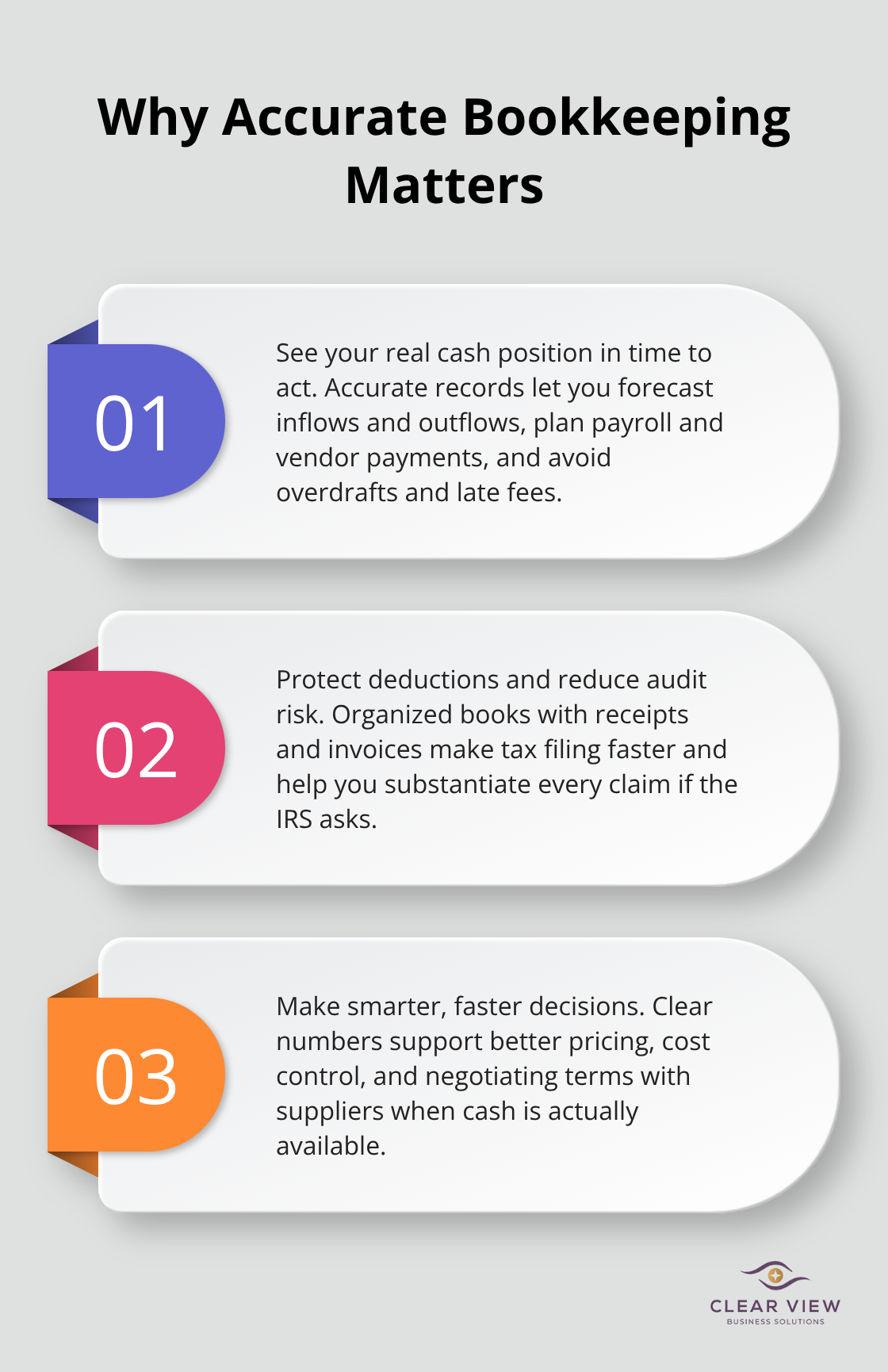
When you track every transaction and reconcile accounts regularly, you gain visibility into your cash flow position. This means you spot problems before they become crises, negotiate better payment terms with suppliers, and make strategic investments when cash is available.
Many Tucson business owners assume profitability equals cash availability-this is dangerously wrong. A company can show profit on paper while having zero cash in the bank. This happens when customers pay late, inventory sits unsold, or expenses outpace revenue collection. Accurate bookkeeping reveals the timing of money moving in and out, letting you plan payroll, supplier payments, and growth investments with confidence. You’ll know exactly when to expect revenue from invoices and when bills are due, preventing overdraft fees and missed payment deadlines. Without this visibility, you make decisions based on guesses rather than facts.
The IRS expects small businesses to maintain organized financial records, and the penalties for poor bookkeeping are steep. Disorganized records trigger audits at higher rates, and when audits happen, inadequate documentation puts you at risk of losing deductions you’re legally entitled to claim. Accurate bookkeeping means you can substantiate every deduction with receipts, invoices, and proper categorization. You’ll also catch errors early rather than discovering them during an audit. Clean records make tax filing faster and less expensive, whether you work with a professional or file yourself.
Strong bookkeeping practices protect your business from financial chaos and regulatory problems. You control your financial narrative instead of scrambling to explain missing records to the IRS. The skills you develop-organizing transactions, reconciling accounts, and reading financial statements-directly impact your ability to grow. These fundamentals form the foundation for everything that follows in this guide. Understanding what accurate bookkeeping looks like prepares you to tackle the specific skills every Tucson business owner should master.
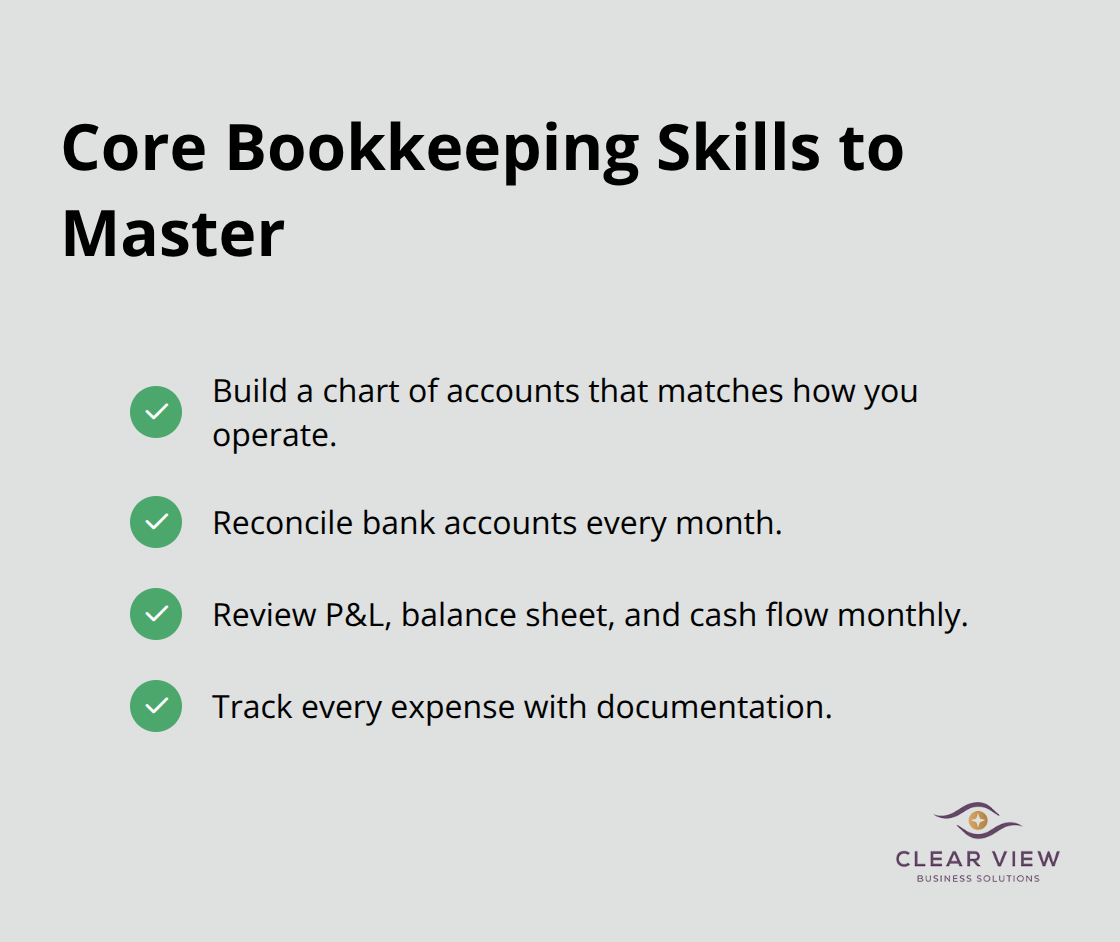
Organizing your financial records means establishing a system you’ll actually use, not creating an elaborate filing structure that collects dust. Most Tucson business owners fail here because they treat bookkeeping like an annual tax-season project rather than an ongoing process. The reality is simpler: you need a chart of accounts that mirrors how your business operates, then you categorize every transaction consistently. If you sell products and services separately, create distinct accounts for each. If you have multiple revenue streams, treat them as separate line items. This granular approach takes an extra five minutes per week but reveals which parts of your business generate profit and which drain resources. Many owners discover they’re spending time on low-margin work while neglecting high-profit activities simply because their records never showed the difference. Accounting software like QuickBooks makes this automatic once you set it up correctly, but the foundation starts with your chart of accounts matching reality, not textbook theory.
You must reconcile your bank account monthly. The consequences of skipping this step are severe: you miss fraudulent charges, fail to catch accounting errors, and lose track of outstanding checks that artificially inflate your cash position. Monthly bank reconciliation takes 30 to 45 minutes if you’ve categorized transactions properly. Start with your bank statement balance, subtract outstanding checks, add deposits in transit, then compare the result to your accounting software balance. They should match exactly. When they don’t, the discrepancy usually stems from a transaction you forgot to record or a misclassified expense. Catching these monthly prevents the nightmare of tracking down a six-month-old error in December. For Tucson businesses with multiple accounts or significant monthly volume, automated reconciliation tools save time and eliminate human error.
Your profit and loss statement, balance sheet, and cash flow statement aren’t accounting exercises-they’re diagnostic tools that reveal business performance. The profit and loss statement shows whether you’re profitable, but it ignores timing. You might show a $50,000 profit while having $8,000 in the bank because customers haven’t paid invoices. Your balance sheet captures this (showing accounts receivable as an asset), giving you the complete picture. Most Tucson owners read their P&L and assume they understand their business, but they’re missing critical context. The cash flow statement connects profitability to actual cash movement, answering the question that matters most: do I have money to pay bills this month? You should generate these statements monthly, not annually. Quarterly is the absolute minimum. Review them alongside your bank balance to spot trends before they become problems. If your revenue stayed flat while expenses climbed 15 percent, your statements show this immediately, forcing a conversation about pricing or cost reduction before your business hits a wall.
You must track every expense with supporting documentation-receipts, invoices, and credit card statements. This practice protects you during tax season and reveals spending patterns that drain cash. Many Tucson business owners lose thousands in deductions simply because they can’t substantiate them when the IRS asks. Expense tracking also exposes waste: you might discover you’re paying for software subscriptions nobody uses or vendor contracts that no longer serve your business. Set up expense categories that match your chart of accounts, then assign every transaction to the correct category as it occurs. This takes seconds per transaction but saves hours during tax preparation. When tax time arrives, you’ll have organized, documented expenses ready to go rather than scrambled receipts and vague memories of what you spent money on.
These skills-chart of accounts setup, monthly reconciliation, financial statement review, and expense tracking-form the foundation that separates small businesses that thrive from those that merely survive. Mastering them takes weeks, not months, and the payoff compounds immediately. Once you control your financial records, you’re ready to identify the mistakes that drain profit from even well-intentioned Tucson businesses.
Most Tucson business owners don’t intentionally sabotage their bookkeeping-they simply don’t realize how quickly small oversights compound into major problems. The mistakes that drain thousands of dollars annually aren’t complicated or exotic. They’re the same three patterns repeated across nearly every struggling business: mixing personal and business money, letting receipts pile up uncategorized, and skipping monthly reconciliation. These aren’t character flaws or signs of incompetence. They’re the result of treating bookkeeping as something you’ll handle later, which means you never handle it at all. The cost is steep.
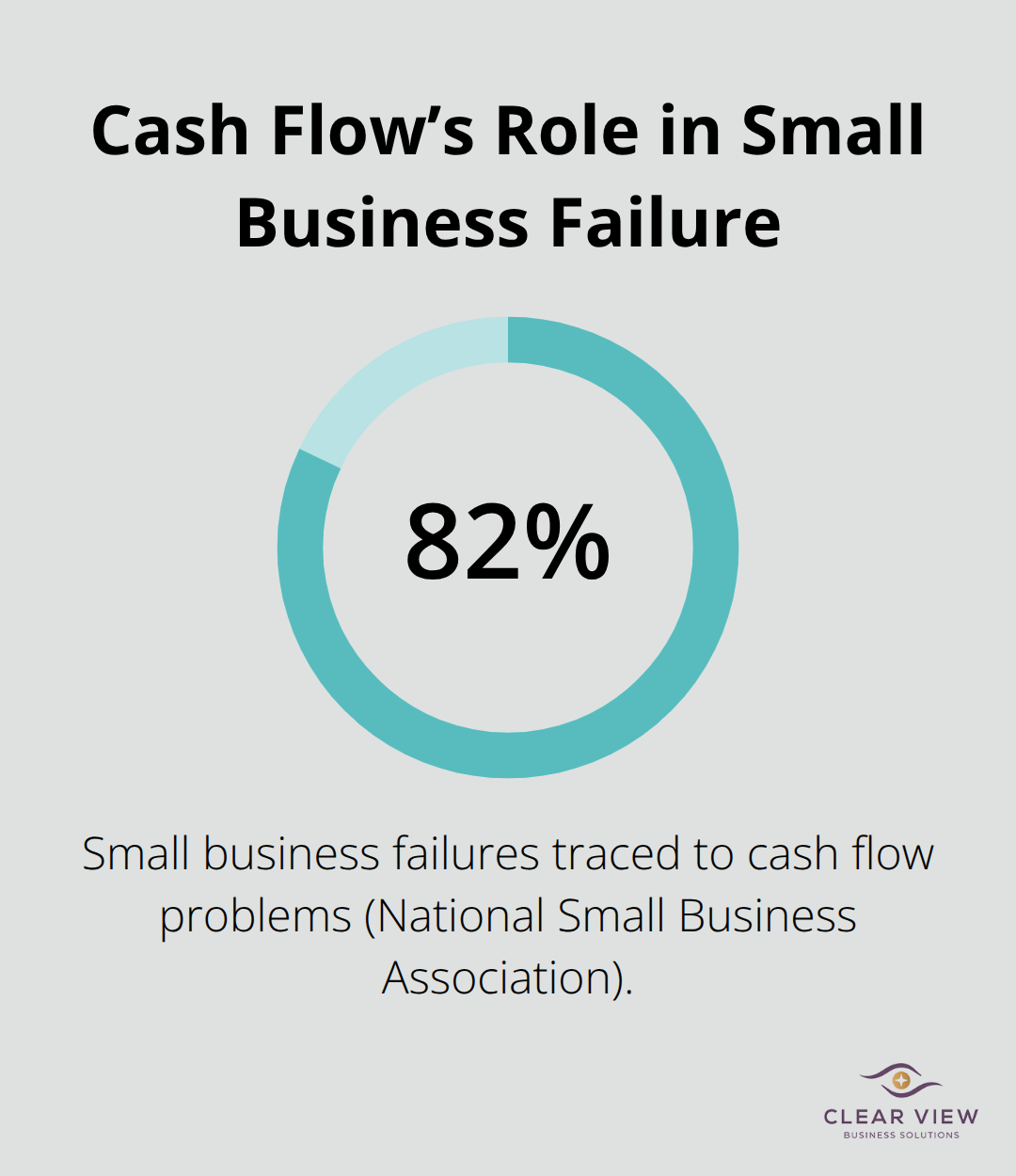
According to the National Small Business Association, 82 percent of small business failures stem from cash flow problems, and cash flow problems almost always trace back to poor financial record-keeping. You can’t manage what you don’t measure, and you can’t measure what you don’t track consistently.
The first mistake-mixing personal and business finances-creates a nightmare that compounds monthly. When you pay business expenses from your personal account or use your business account for groceries, tax time becomes a guessing game. The IRS views commingled accounts with suspicion, and if you face an audit, you’ll spend hours reconstructing what was business and what wasn’t. More immediately, you can’t calculate accurate profit because you’re including personal spending in your business expenses. One Tucson restaurant owner discovered this the hard way. He was convinced his business was barely breaking even, yet his personal bank account showed steady growth. When he finally separated accounts, he found he was actually more profitable than his mixed records suggested-he’d simply been blind to it. The solution is absolute: open a separate business checking account today and never deposit personal income into it or pay personal expenses from it. This single decision eliminates the confusion and gives you clean financial records from day one.
The second mistake-neglecting receipts and invoices-creates an even bigger problem because it destroys your ability to substantiate deductions. You might have legitimate business expenses, but without documentation, the IRS won’t accept them. More practically, you lose visibility into spending patterns. If you don’t track your office supplies spending, you won’t notice when costs spike unexpectedly. Most Tucson business owners think they’ll remember what each charge was for, then discover in March that they can’t recall whether that $340 transaction was supplies or meals with clients. The fix requires discipline: photograph receipts immediately, use accounting software that captures credit card transactions automatically, and assign every expense to the correct category within 48 hours. This approach prevents the scramble to find documentation when tax season arrives.
The third mistake-skipping monthly reconciliation-is the one that hides the other two. When you skip reconciliation, discrepancies hide for months. A vendor might charge you twice, a customer payment might not post, or an accounting error might inflate your cash balance. You won’t know until you reconcile. Tucson business owners who reconcile monthly catch problems in weeks rather than discovering them during tax season. Consistent reconciliation helps you avoid errors and keep accurate records. These three mistakes feed each other: commingled accounts make reconciliation harder, poor receipt tracking makes categorization impossible, and skipping reconciliation means you never catch either problem until damage is done.
Mastering bookkeeping basics in Tucson comes down to three core practices: separating personal and business finances, tracking receipts consistently, and reconciling your accounts monthly. These fundamentals aren’t glamorous, but they’re the difference between a business that survives and one that thrives. When you implement them, you gain control over your cash flow, reduce tax risk, and make decisions based on actual numbers instead of assumptions.
Most Tucson business owners can handle basic bookkeeping themselves once they establish the right systems. A chart of accounts that matches your business, monthly reconciliation, and organized expense tracking take a few hours to set up and minutes per week to maintain. Accounting software like QuickBooks automates much of the work once you’ve built the foundation correctly, though professional support often proves valuable when your time is worth more spent growing your business than wrestling with financial records.
We at Clear View Business Solutions help Tucson business owners move beyond survival mode by handling the bookkeeping work that drains your time and attention. Our full-cycle bookkeeping service includes QuickBooks training, tax planning, and IRS representation, so you understand your financial position without getting buried in the details. Audit your current bookkeeping practices against the three mistakes covered in this guide, identify which problems apply to your business, then fix them immediately or contact us to handle it for you.




At Clear View Business Solutions, we know you want your business to prosper without having to worry about whether you are paying more in taxes than you should or whether your business is set up correctly. The problem is it's hard to find a trusted advisor who can translate financial jargon to layman's terms and who can actually help you plan for better results.
We believe it doesn't have to be this way! No business owner should settle for working with a CPA firm that falls short of understanding what you want to achieve and how to help you get there.
Northwest Location:
7530 N. La Cholla Blvd., Tucson, AZ 85741
Central Location:
2933 N Campbell Avenue, Tucson, AZ 85719
© 2026 Clear View Business Solutions. All Rights Reserved.
At Clear View Business Solutions, we know you want your business to prosper without having to worry about whether you are paying more in taxes than you should or whether your business is set up correctly. The problem is it's hard to find a trusted advisor who can translate financial jargon to layman's terms and who can actually help you plan for better results.
We believe it doesn't have to be this way! No business owner should settle for working with a CPA firm that falls short of understanding what you want to achieve and how to help you get there. With over 20 years of experience serving hundreds of business owners like you, our team of experts combines financial expertise and proactive communication with our drive to help each client achieve results and have fun along the way.
Here's how we do it:
Discover: We start with a consultation to understand your specific goals, what's holding you back, and what success looks like for you.
Strategize & Optimize: Together, we design a customized strategy that empowers you to progress toward your goals, and we optimize our communication as partners.
Thrive: You enjoy a clear view of your business and your financial prosperity.
Schedule a consultation today, and take the first step toward being able to focus on your core business again without wondering if your numbers are right- or what they mean to your business.
In the meantime, download, "The Business Owner's Essential Guide to Tax Deductions" and make sure you aren't leaving money on the table.