

Nonprofit bookkeeping basics often get overlooked, yet they form the foundation of financial health for mission-driven organizations. When your records are clear and accurate, your team can focus on what matters most: advancing your mission.
At Clear View Business Solutions, we’ve seen firsthand how proper bookkeeping transforms nonprofit operations. This guide walks you through the systems, tools, and practices that keep your finances organized and compliant.
Nonprofit bookkeeping operates under fundamentally different rules than for-profit accounting, and ignoring these differences costs organizations thousands in compliance violations and lost funding. The IRS treats nonprofit finances differently because donations, grants, and restricted contributions create legal obligations that standard business income never does. When a donor restricts funds for a specific program, your nonprofit must track and spend that money exactly as promised-failure to do so can trigger audit findings, damage relationships with major donors, and jeopardize your 501(c)(3) status.
For-profit businesses track revenue and expenses by department; nonprofits must track funds by restriction level, which means separating unrestricted donations (money the board can allocate freely) from restricted and unrestricted funds (money earmarked for particular programs or time periods). This dual-tracking requirement changes everything about how you design your chart of accounts and reconcile your bank statements. Grant funding adds another layer of complexity because funders require detailed expense reports showing exactly how their money was spent, often down to the percentage of staff time allocated to grant-funded work.
Standard bookkeeping software built for restaurants or retail shops cannot handle these restrictions without significant customization or workarounds. Nonprofit-specific software like QuickBooks for Nonprofits, Aplos, or Blackbaud Financial Edge NXT includes fund accounting capabilities that automatically separate restricted and unrestricted money, preventing the most common nonprofit bookkeeping error: mixing restricted grant funds with operating expenses.
The distinction between restricted and unrestricted funds is not theoretical-it directly affects your financial statements and compliance obligations. When a donor gives $5,000 to fund youth programming, that money cannot pay your executive director’s salary or cover office rent, even if the organization desperately needs it. Many smaller nonprofits fail here because they use a single checking account and track restrictions only in spreadsheets or memory, leading to accidental misuse of funds.
The IRS scrutinizes nonprofit financial records far more intensely than standard business bookkeeping; revenue misclassification remains one of the most frequently cited nonprofit audit findings. Your accounting system must prevent this at the software level by requiring staff to designate each transaction as restricted or unrestricted at the moment of entry. Reconciling your bank statement becomes exponentially harder without this separation because you cannot easily verify whether restricted funds were actually spent on their intended purpose.
Monthly reconciliation (ideally within the first few days of the next month) is non-negotiable for nonprofits managing grant money, since delays in identifying misallocations can result in having to repay funders with interest.
For-profit companies report net income and retained earnings; nonprofits report net assets split into restricted and unrestricted categories, alongside functional expenses that show what percentage of spending went to programs versus administration. The Statement of Activities, Statement of Financial Position, and Statement of Cash Flows all carry nonprofit-specific requirements under GAAP that differ from standard business reporting.
Your board and donors expect to see how much money reached your actual programs versus overhead, and the IRS Form 990 (required for most tax-exempt organizations) specifically asks for a breakdown of program expenses, administrative costs, and fundraising spending. Functional expense reporting reveals whether your organization follows reasonable spending ratios; actual targets vary by organization type and funder expectations.
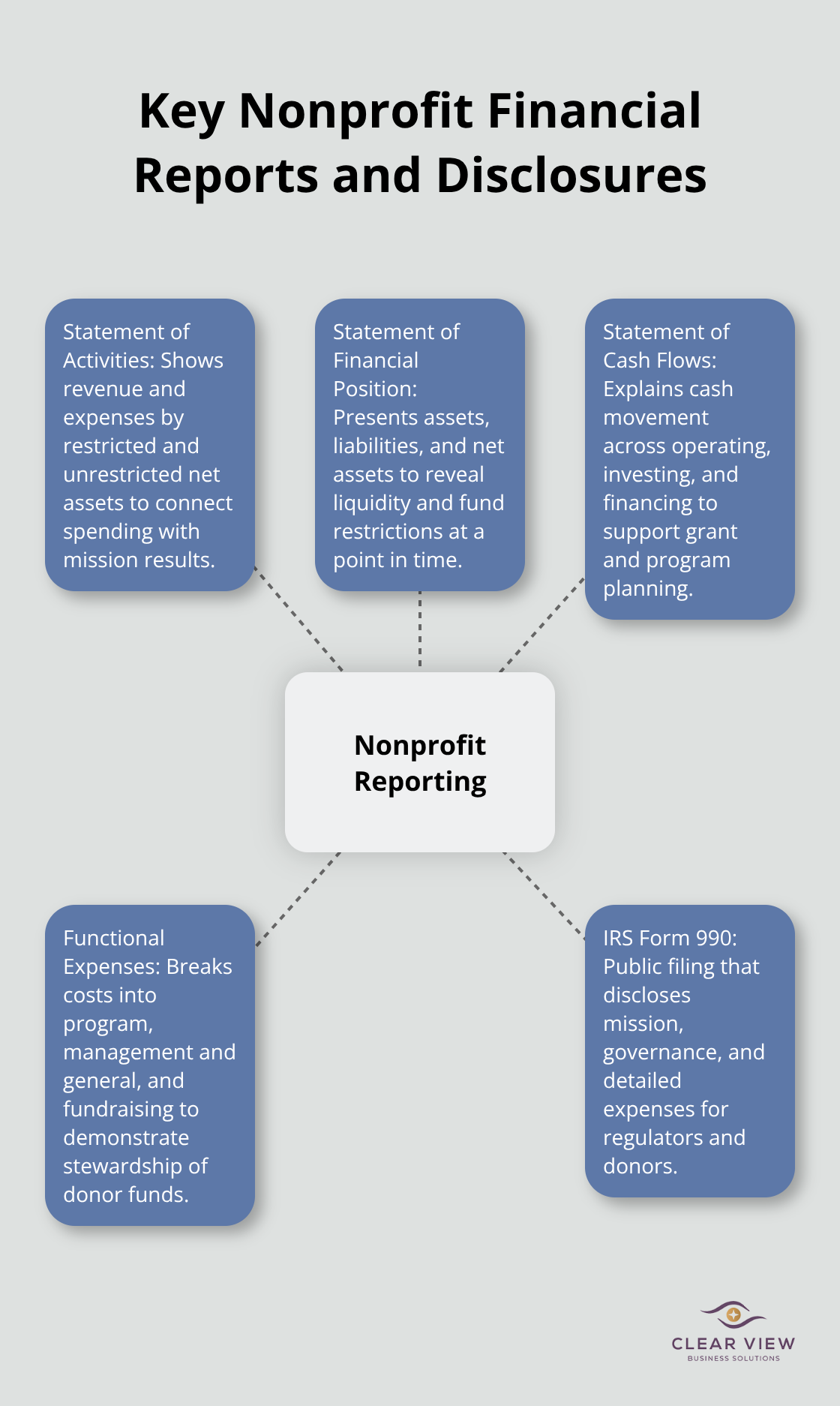
Transparency here builds trust; nonprofits that publish their financial statements publicly and show clear program-to-overhead ratios attract more donor support. Standard for-profit accounting systems do not generate these functional expense reports automatically, making nonprofit-specific software or a knowledgeable bookkeeper essential for accurate reporting. Understanding these reporting differences sets the stage for selecting the right systems and tools that actually support your nonprofit’s unique financial needs.
Your chart of accounts is the backbone of nonprofit bookkeeping, and you must design it specifically for restricted and unrestricted fund tracking from day one. Unlike for-profit businesses that organize accounts by department or product line, nonprofits need accounts structured around fund restrictions and program categories simultaneously. This dual structure sounds complicated but becomes intuitive once you implement it correctly.
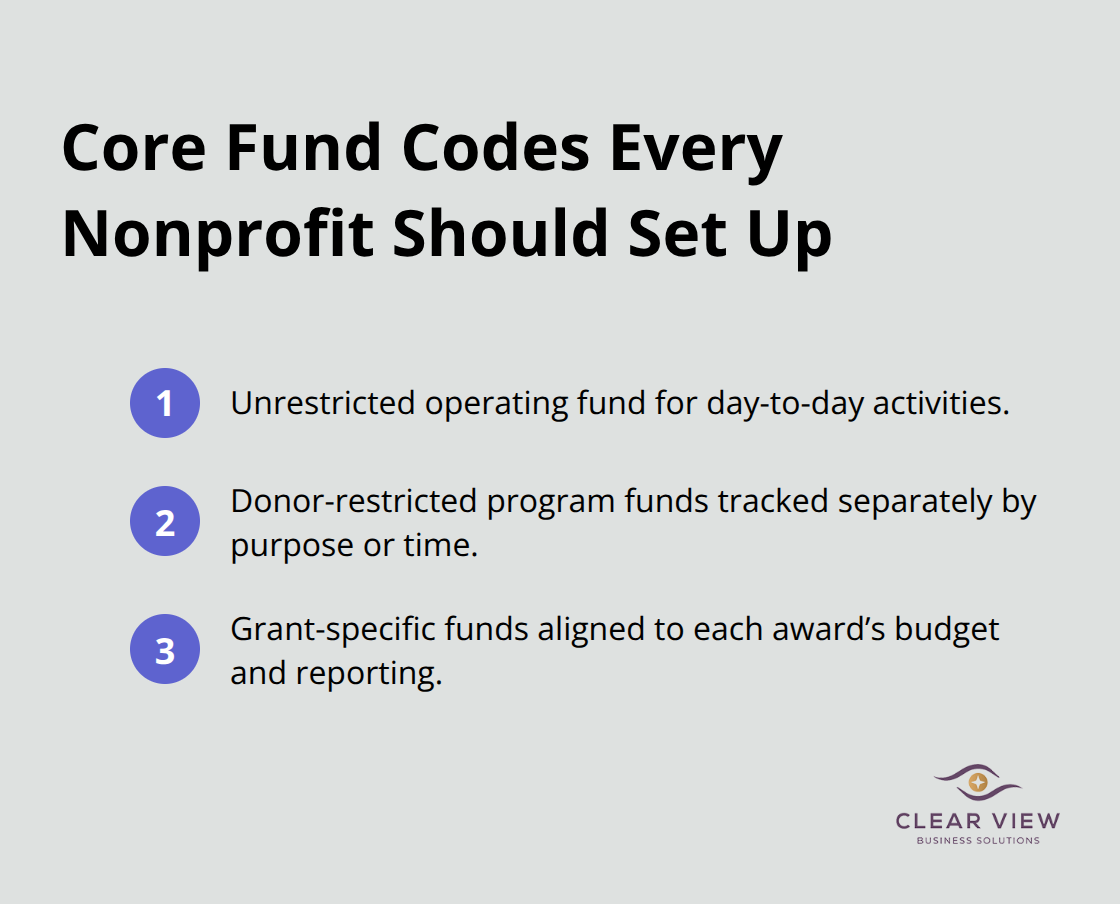
Start by creating separate fund codes for each major restriction type: unrestricted operating funds, donor-restricted program funds, and grant-specific funds. Within each fund, establish accounts for revenue categories (donations, grants, earned income, investment returns) and expense categories organized by program function (program services, management and general, fundraising).
QuickBooks for Nonprofits automates much of this setup with pre-built nonprofit templates, but many nonprofits using standard QuickBooks or other platforms like Aplos or Blackbaud Financial Edge NXT require manual configuration to prevent revenue misclassification errors that trigger IRS audit findings.
The practical difference between a well-designed and poorly designed chart of accounts becomes obvious during monthly reconciliation and grant reporting. If your accounts are disorganized, reconciling restricted funds takes hours because you cannot quickly verify whether grant money was spent correctly. A nonprofit managing five active grants should have at least five separate fund codes within the accounting system, each with its own revenue and expense accounts.
When staff enter a transaction, they select the fund code first, which prevents accidental mixing of restricted and unrestricted money. Blackbaud Financial Edge NXT includes role-based access control that restricts which staff members can enter transactions in which funds, adding an internal control layer that spreadsheets cannot provide.
For smaller nonprofits on tighter budgets, Aplos offers affordable fund accounting with built-in donation tracking and grant budgeting features starting around $99 per month, making professional-grade structure accessible without the cost of enterprise software. The investment in proper chart of accounts setup pays for itself immediately through reduced reconciliation time, faster grant reporting, and the ability to generate accurate financial statements without manual adjustments or corrections.
Once your chart of accounts is in place, you need systems to track the actual flow of money through these funds-which brings us to the specific fund accounting practices that separate well-managed nonprofits from those constantly struggling with financial confusion.
Nonprofits fail at bookkeeping not because the work is complicated, but because they treat it as something that can happen casually alongside mission work. The three mistakes we see repeatedly are mixing restricted and unrestricted funds into a single spending pool, losing track of expenses and donated goods without proper documentation, and letting months pass without reconciling bank statements. These are not accounting theory problems-they are operational disasters that cost nonprofits grant funding, damage donor relationships, and create audit findings that can threaten tax-exempt status.
Restricted fund violations happen because nonprofit staff operate from spreadsheets or memory instead of enforcing separation at the point of transaction entry. A grant arrives earmarked for youth programming, but three weeks later when rent is due and cash is tight, someone transfers that grant money to cover overhead. The spreadsheet gets updated, the person thinks they will move it back, and suddenly six months have passed with misallocated funds. When auditors arrive, the nonprofit faces a choice: repay the funder with interest or request a formal amendment they may deny.
The IRS Form 990 audit data shows revenue misclassification remains among the top nonprofit findings because organizations lack systems that prevent this at the moment of transaction entry. Use accounting software where staff must select the fund code before entering any transaction-this friction point prevents accidental misallocation. Aplos, Blackbaud Financial Edge NXT, and QuickBooks for Nonprofits all enforce this at the software level, making it impossible to deposit a grant without assigning it to the correct restricted fund.
For nonprofits managing multiple grants simultaneously, this is not optional; it is the difference between compliance and audit findings. Monthly reconciliation within the first few days of the next month catches fund mixing immediately, before it compounds into larger problems. Small nonprofits should establish a written policy stating that restricted funds cannot be touched without explicit board approval and documentation of the reason, which creates accountability beyond software controls.
In-kind donations like vehicles, equipment, or professional services represent real value that nonprofits fail to record properly. A nonprofit receives a donated vehicle worth $8,000 but records it as a generic in-kind contribution without documenting the make, model, year, condition, or fair market value. When the auditor asks for supporting documentation, the nonprofit cannot prove the valuation, and the donation gets disallowed or reduced.
Every donation-cash, goods, or services-needs a receipt or written record showing the donor name, date, amount or description, and fair market value for in-kind gifts. This documentation supports both IRS compliance and donor communication; donors want to see their contributions recorded accurately for their own tax deductions. Expense documentation requires the same rigor: keep receipts, invoices, and supporting detail for every transaction, especially grant-funded expenses where funders conduct their own audits.
Many nonprofits lose grant funding eligibility because they cannot produce documentation for expenses they clearly incurred. Create a simple system where transactions are recorded with a description explaining what the money purchased or funded, who approved it, and which program it supports. This takes five extra seconds per transaction but eliminates hours of scrambling during audits or grant closeouts. Without this documentation, your financial statements become unreliable, and your board cannot trust the numbers they are reviewing.
Nonprofits that reconcile bank statements quarterly or annually operate blind. Monthly reconciliation catches data entry errors, unauthorized transactions, and fraud before they grow into five-figure problems. When reconciliation is delayed, errors compound across multiple months, making it exponentially harder to identify where the mistake occurred.
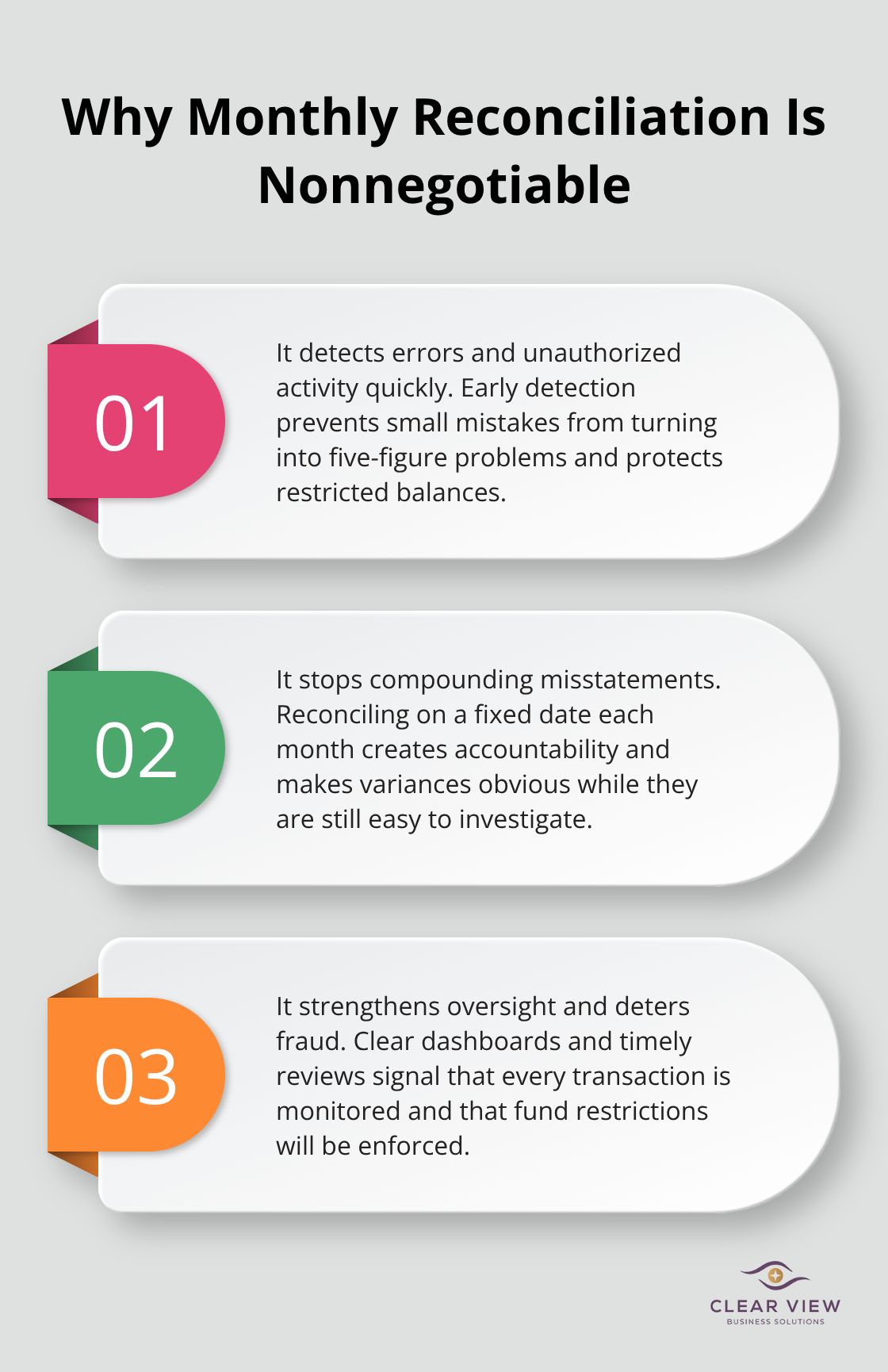
A staff member enters a $5,000 grant as $500, the nonprofit spends the other $4,500 thinking it is unrestricted operating funds, and at year-end close, the nonprofit has already promised those funds to another program. Monthly reconciliation prevents this because the discrepancy between expected and actual grant balance becomes obvious immediately. Set a specific date each month-the fifth or tenth-when reconciliation must be completed, and assign it to someone with authority to investigate discrepancies.
Do not allow reconciliation to be pushed to the next month because of other priorities; it is a financial control, not an administrative task that can wait. For nonprofits with multiple bank accounts or grant funds, reconciliation becomes more complex but also more essential. Sage Intacct and Blackbaud Financial Edge NXT provide real-time dashboards showing account balances and cash flow across all funds, making it easier to spot anomalies. Weak reconciliation practices invite fraud because they signal to anyone handling money that oversight is absent. Nonprofits with strong monthly reconciliation cultures deter theft and misallocation simply through consistent, visible accountability.
Strong nonprofit bookkeeping basics transform how your organization operates. When your financial records are accurate and organized, your board makes better decisions, your donors trust your stewardship, and your team stops wasting hours on administrative confusion. The three mistakes we covered-mixing restricted funds, poor documentation, and infrequent reconciliation-are entirely preventable through systems and discipline.
Your nonprofit bookkeeping foundation directly supports mission success because clean finances free your leadership to focus on programs instead of scrambling to answer donor questions or prepare for audits. Organizations with strong bookkeeping practices attract more funding because grantmakers and major donors see transparent, well-managed finances as a sign of operational maturity. Monthly reconciliation, proper fund separation, and detailed expense documentation protect your 501(c)(3) status and build long-term sustainability.
Start by selecting nonprofit-specific software that enforces fund accounting at the point of transaction entry. Aplos, QuickBooks for Nonprofits, and Blackbaud Financial Edge NXT all prevent the most common errors through their design. If your nonprofit lacks in-house accounting expertise or you manage multiple grants simultaneously, Clear View Business Solutions provides full-cycle bookkeeping with QuickBooks training and personalized guidance to help you establish compliant, sustainable financial systems.




At Clear View Business Solutions, we know you want your business to prosper without having to worry about whether you are paying more in taxes than you should or whether your business is set up correctly. The problem is it's hard to find a trusted advisor who can translate financial jargon to layman's terms and who can actually help you plan for better results.
We believe it doesn't have to be this way! No business owner should settle for working with a CPA firm that falls short of understanding what you want to achieve and how to help you get there.
Northwest Location:
7530 N. La Cholla Blvd., Tucson, AZ 85741
Central Location:
2933 N Campbell Avenue, Tucson, AZ 85719
© 2026 Clear View Business Solutions. All Rights Reserved.
At Clear View Business Solutions, we know you want your business to prosper without having to worry about whether you are paying more in taxes than you should or whether your business is set up correctly. The problem is it's hard to find a trusted advisor who can translate financial jargon to layman's terms and who can actually help you plan for better results.
We believe it doesn't have to be this way! No business owner should settle for working with a CPA firm that falls short of understanding what you want to achieve and how to help you get there. With over 20 years of experience serving hundreds of business owners like you, our team of experts combines financial expertise and proactive communication with our drive to help each client achieve results and have fun along the way.
Here's how we do it:
Discover: We start with a consultation to understand your specific goals, what's holding you back, and what success looks like for you.
Strategize & Optimize: Together, we design a customized strategy that empowers you to progress toward your goals, and we optimize our communication as partners.
Thrive: You enjoy a clear view of your business and your financial prosperity.
Schedule a consultation today, and take the first step toward being able to focus on your core business again without wondering if your numbers are right- or what they mean to your business.
In the meantime, download, "The Business Owner's Essential Guide to Tax Deductions" and make sure you aren't leaving money on the table.