


Startups face a tax burden that can drain resources needed for growth. The good news is that tax reduction for startups isn’t just possible-it’s built into the system through credits, deductions, and strategic planning moves.
At Clear View Business Solutions, we’ve seen firsthand how startups leave thousands on the table by missing these opportunities. This guide walks you through the credits you qualify for, the planning strategies that work, and the mistakes to avoid.
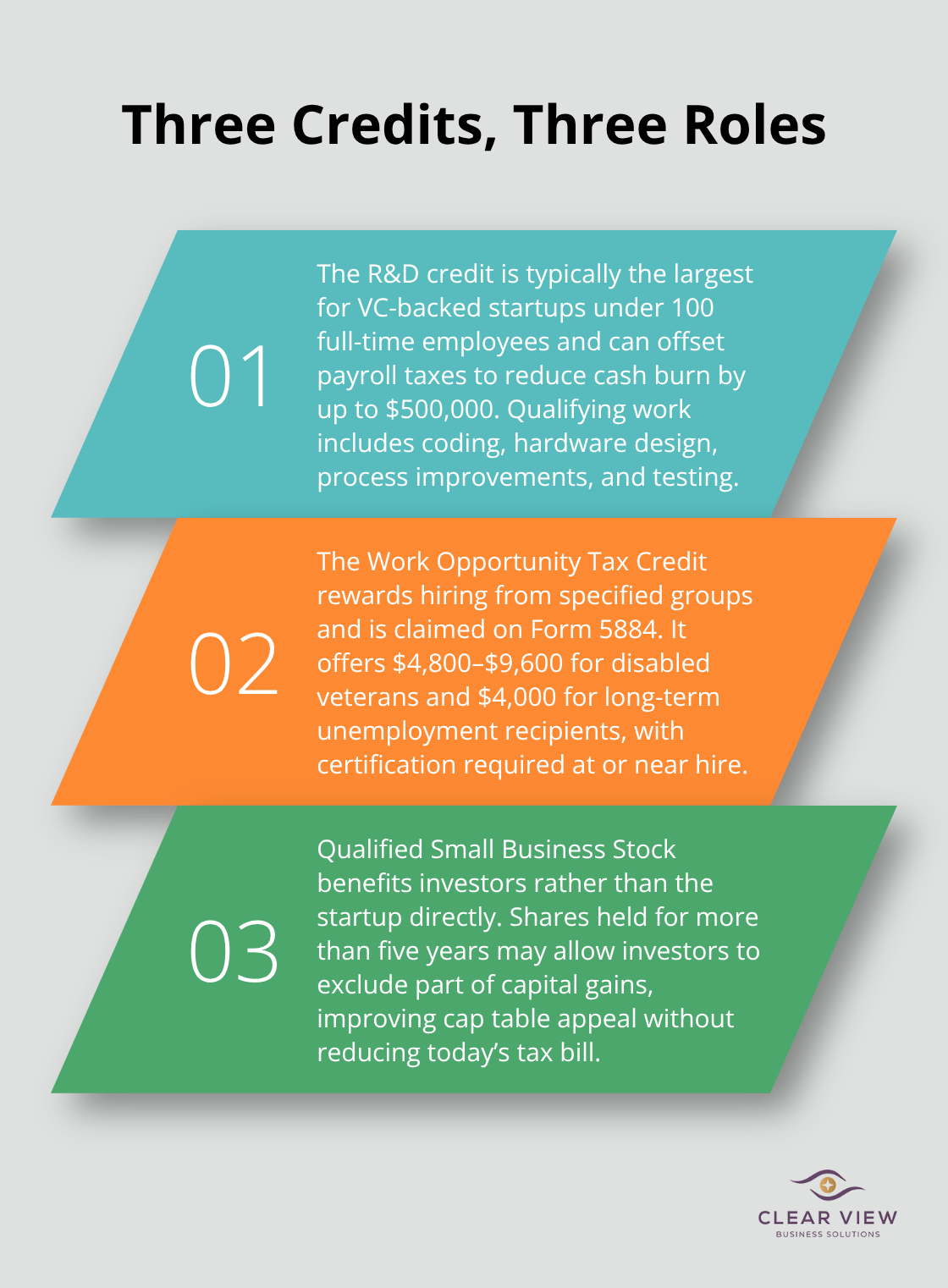
The R&D tax credit stands as the heavyweight champion for startups burning cash on product development. According to Kruze, a startup accounting firm that works with venture-backed companies, the R&D credit ranks as the biggest credit available for VC-backed startups with fewer than 100 full-time employees, often offsetting payroll taxes and reducing burn by up to $500,000. If your team writes code, designs hardware, improves processes, or tests new features, you’re likely performing qualifying R&D work. Form 6765 lets you claim credits for wages, supplies, and contractor costs tied directly to development activities.
Documentation creates the real challenge here. The IRS changed the rules in 2022 to require amortizing domestic R&D expenses over five years, which means you need detailed records of what work qualifies and when it happened. Most startups miss this credit entirely because they fail to connect their daily development work to tax law. If you operate unprofitably, the R&D credit becomes especially valuable because it offsets payroll taxes directly, cutting your actual cash burn regardless of whether you turn a profit.
The Work Opportunity Tax Credit rewards you for hiring from specific groups-formerly incarcerated individuals, disabled veterans, long-term unemployment recipients, and others. You claim it on Form 5884 and receive a federal tax credit for each eligible hire. The credit provides reimbursement up to $4,800 to $9,600 for disabled veterans and $4,000 for long-term unemployment recipients. Most startups fail to track this proactively. You need to have new hires complete the required certification before or shortly after they start. This credit shouldn’t drive your hiring decisions, but if you’re already building a diverse team, you should capture it.
Small Business Stock, formally called Qualified Small Business Stock or QSBS, works differently from the other two credits. It functions as an investor benefit, not a startup benefit. If your investors hold shares for more than five years, they can exclude a portion of capital gains from federal tax. That matters for your cap table and investor appeal, but it doesn’t directly reduce your tax burden today.
Understanding these three credits requires recognizing their distinct purposes. The R&D credit serves as your cash-flow lifeline, the WOTC functions as a compliance bonus, and QSBS acts as an investor incentive. Most startups should prioritize the R&D credit first and work with a startup-focused CPA to document it properly.
Once you’ve captured the R&D opportunity, the next strategic move involves examining how your business structure and timing decisions shape your overall tax position.
Your choice of business structure determines how much you pay in taxes before you ever claim a credit. Most startups default to a C-Corporation because venture investors expect it, but this decision costs real money if you’re not profitable yet. A C-Corp pays corporate income tax on earnings, then you pay personal income tax again when you withdraw funds-creating double taxation. However, if you’re raising venture capital, the C-Corp structure remains the practical choice because investors demand it and the long-term exit strategy typically justifies the tax inefficiency during growth years.
The alternative-an S-Corporation or LLC taxed as an S-Corp-works only if you have consistent profits to distribute, which most early-stage startups lack. If you operate as a sole proprietor or partnership without formal structure, you’re missing liability protection and paying self-employment taxes on all net income at roughly 15.3%. That burden disappears once you incorporate. Incorporating before you generate substantial revenue means your equity grants to employees receive favorable tax treatment under Section 83(b), while incorporating after significant revenue growth creates messy tax complications. If you haven’t incorporated yet, do it immediately.
Once your structure is locked in, your second lever involves controlling when you recognize income and when you claim deductions. Startups with volatile revenue face a real choice each December: accelerate expenses into the current year or defer them into the next year depending on whether you expect profitability. If you’re running unprofitably and you have R&D credits waiting, accelerating deductible expenses into the current year doesn’t help your tax bill directly, but it strengthens your documentation for R&D credit claims.
If you expect a profitable year, deferring expenses into January reduces current-year taxable income. This requires discipline-many founders waste this opportunity because they don’t track their cash position closely enough. Treating tax planning as an ongoing process separates founders who keep more profit from those who leave money on the table.
Retirement contributions provide your most powerful deduction lever. A solo 401(k) allows you to contribute up to $69,000 in 2024 as both employer and employee, reducing your taxable income dollar-for-dollar. If you have employees, a standard 401(k) costs more to administer but remains deductible and strengthens your culture. A SEP-IRA offers simpler administration with contributions up to 25% of net self-employment income.
The catch: you must establish the plan by December 31st to claim deductions for that tax year, so procrastination costs you. Pairing retirement planning with your R&D credit strategy creates compounding benefits-you reduce taxable income through contributions while simultaneously offsetting payroll taxes through credits, effectively cutting your cash burn from two angles. This dual approach transforms your tax position from reactive to proactive, setting the stage for the next critical decision: identifying which common mistakes drain your resources and how to avoid them.
The gap between what startups owe and what they actually pay often comes down to three preventable mistakes that compound throughout the year. Each one drains resources that should fuel growth, and each one stems from treating taxes as an annual event rather than an ongoing process.
Misclassifying workers as contractors when they should be employees tops the list because the IRS actively audits this issue, and the penalties hit hard. If you hire contractors but control how they work, set their hours, or provide tools and equipment, the IRS will reclassify them as employees retroactively. That means back taxes, income tax withholding, unpaid FICA contributions, and penalties.
The threshold matters less than control. A developer you hire for a specific project with a fixed deadline and independent work method stays a contractor. A developer who works in your office, attends your meetings, and reports to your CTO becomes an employee regardless of what your agreement says. Your business structure determines everything about your tax liability, so start now by documenting exactly how each person works. If you cannot answer yes to independent work method, independent business operation, and lack of company control, reclassify them immediately before an audit forces you to.
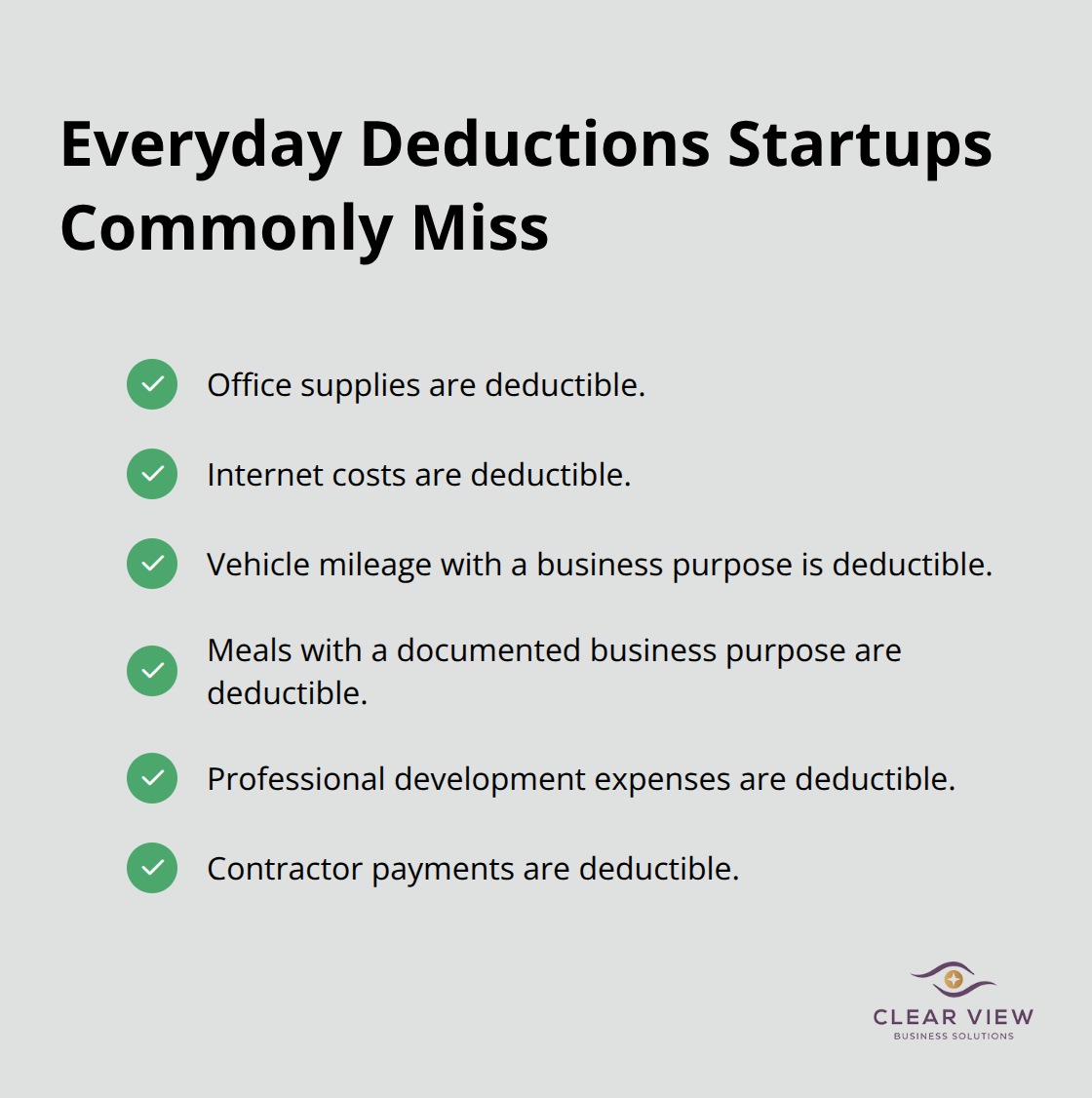
Failing to track business expenses and missing daily deductions represents the second major leak. Most founders track large purchases like software subscriptions or equipment but miss the daily deductions that add up. Office supplies, internet costs, vehicle mileage, meals with business purpose, professional development, and contractor payments all reduce taxable income.
The IRS requires contemporaneous records, which means you cannot reconstruct expenses from memory six months later. You need receipts, dates, amounts, and business purpose documented when the expense occurs. Cloud accounting software automatically categorizes spending and creates an audit trail. Without this system, you claim a fraction of your actual deductible expenses and lose thousands in tax savings.
Quarterly tax payments create the final problem because founders who stay unprofitable assume they owe nothing. If you have self-employment income, investment gains, or quarterly revenue, you owe quarterly estimated taxes four times per year regardless of profitability status. Skipping these payments triggers penalties starting at 5% per quarter, compounded quarterly.
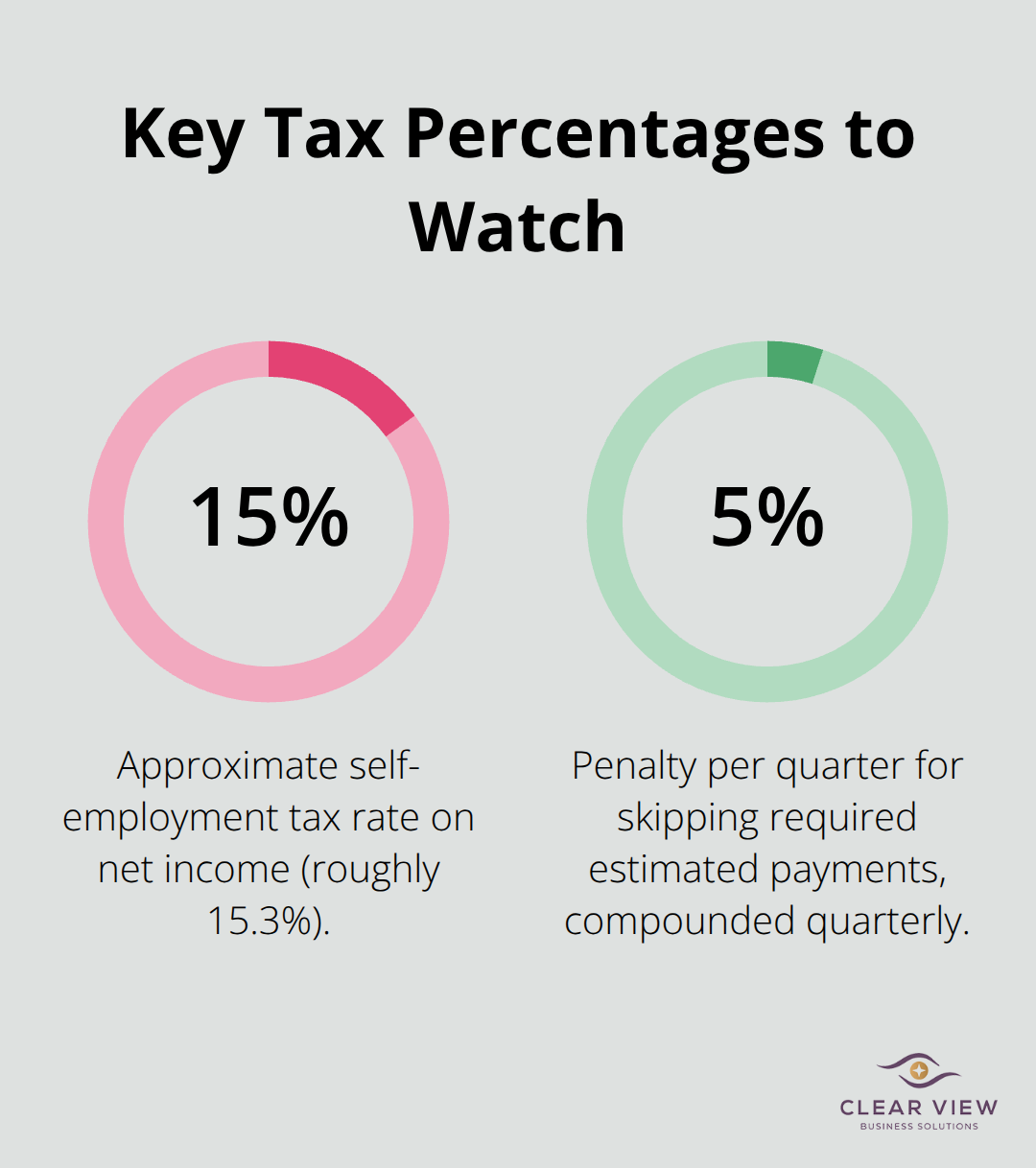
A founder earning $50,000 in consulting income while building a startup owes roughly $12,500 in self-employment taxes split across four quarters. Skipping those payments costs $625 in penalties plus interest. Setting up a quarterly tax calendar in January and calculating your obligation in March prevents this entirely. The IRS does not wait for your annual filing to assess penalties-they accumulate throughout the year.
Tax reduction for startups requires three parallel actions: claiming the credits you qualify for, structuring your business correctly, and avoiding the mistakes that trigger audits and penalties. The R&D credit alone can reduce your cash burn by $500,000 if you document it properly, while the WOTC captures value from hiring decisions you’re already making. Strategic timing of income and deductions, paired with retirement contributions, compounds your tax savings throughout the year.
Misclassifying workers, skipping expense tracking, and ignoring quarterly payments erase these gains faster than you can build them. The real cost of tax planning mistakes isn’t just the money you owe the IRS-it’s the opportunity cost of capital that should fund product development, hiring, or customer acquisition instead flowing toward penalties and back taxes. Founders who treat taxes as an annual filing event leave thousands on the table, while founders who treat taxes as an ongoing process keep that money working for their business.
A startup-focused CPA understands the R&D credit documentation requirements, knows which business structure matches your funding stage, and catches misclassification issues before audits happen. Clear View Business Solutions specializes in tax reduction for startups in Tucson and beyond, handling everything from tax planning and bookkeeping to IRS representation so you can focus on building your company. Audit your current tax position against the three credits outlined here, review your worker classifications, and set up a system for tracking expenses-then connect with a tax professional who understands startups.




At Clear View Business Solutions, we know you want your business to prosper without having to worry about whether you are paying more in taxes than you should or whether your business is set up correctly. The problem is it's hard to find a trusted advisor who can translate financial jargon to layman's terms and who can actually help you plan for better results.
We believe it doesn't have to be this way! No business owner should settle for working with a CPA firm that falls short of understanding what you want to achieve and how to help you get there.
Northwest Location:
7530 N. La Cholla Blvd., Tucson, AZ 85741
Central Location:
2933 N Campbell Avenue, Tucson, AZ 85719
© 2026 Clear View Business Solutions. All Rights Reserved.
At Clear View Business Solutions, we know you want your business to prosper without having to worry about whether you are paying more in taxes than you should or whether your business is set up correctly. The problem is it's hard to find a trusted advisor who can translate financial jargon to layman's terms and who can actually help you plan for better results.
We believe it doesn't have to be this way! No business owner should settle for working with a CPA firm that falls short of understanding what you want to achieve and how to help you get there. With over 20 years of experience serving hundreds of business owners like you, our team of experts combines financial expertise and proactive communication with our drive to help each client achieve results and have fun along the way.
Here's how we do it:
Discover: We start with a consultation to understand your specific goals, what's holding you back, and what success looks like for you.
Strategize & Optimize: Together, we design a customized strategy that empowers you to progress toward your goals, and we optimize our communication as partners.
Thrive: You enjoy a clear view of your business and your financial prosperity.
Schedule a consultation today, and take the first step toward being able to focus on your core business again without wondering if your numbers are right- or what they mean to your business.
In the meantime, download, "The Business Owner's Essential Guide to Tax Deductions" and make sure you aren't leaving money on the table.