


Nonprofits in Tucson face unique tax challenges that can cost thousands in missed deductions and compliance penalties. Getting tax planning right means the difference between thriving and struggling financially.
At Clear View Business Solutions, we’ve helped dozens of Tucson nonprofits optimize their tax positions and avoid costly mistakes. This guide walks you through the deductions, structures, and strategies that actually work.
Tax-exempt status for nonprofits is not automatic and requires active maintenance. The IRS grants 501(c)(3) status to organizations that serve charitable, educational, religious, or scientific purposes, but you must file Form 990 annually to keep that status. Missing the Form 990 deadline for three consecutive years triggers automatic revocation of your tax-exempt status according to IRS rules. Calendar-year nonprofits have a May 15 deadline, and the form must be filed by the 15th day of the 5th month after your accounting period ends. Maintaining your tax-exempt status requires consistent compliance, as organizations whose status is revoked must apply for reinstatement with the IRS and pay applicable user fees.
The Form 990 is a public document reviewed by donors, grantmakers, and journalists to evaluate your finances and governance, so errors damage credibility and funding opportunities. Filing the wrong tax year or duplicating filings for the same year causes rejections, so verify your tax year and dates before submission. Reconcile your financial reporting on Form 990 with reviewed or audited statements to avoid discrepancies that raise IRS questions. Functional expense allocations must be clearly documented and consistently applied throughout the form. Balance sheet items on Form 990 should reconcile with your internal financial statements to prevent confusion during audits or donor reviews.
Nonprofits deduct ordinary and necessary business expenses, but the catch is that charitable contribution deductions belong to donors, not the organization itself. Donors who contribute $250 or more must receive a written acknowledgment letter from you that states the cash amount, describes noncash donations, and discloses whether goods or services were provided in return. The IRS requires this documentation to substantiate deductions, and without it donors cannot claim the deduction. Your operational expenses-salaries, rent, utilities, program supplies-reduce your unrelated business income if you earn revenue outside your exempt purpose.
If your unrelated business income exceeds $1,000 annually, you must file Form 990-T and potentially pay tax on that income. Energy credits for solar, wind, or geothermal projects can offset unrelated business income taxes, and exempt organizations must make the elective payment election on a timely filed Form 990-T. Coordinate energy credits with a tax advisor to maximize benefits and ensure proper documentation. Independent contractors paid $600 or more in 2025 trigger Form 1099-NEC reporting requirements, though this threshold rises to $2,000 in 2026 according to IRS guidance.
Accurate employee versus contractor classification matters because misclassification exposes you to payroll tax penalties and back taxes. The distinction between these two categories affects your tax obligations significantly, and getting it wrong creates substantial liability. Proper classification also determines which forms you file and which withholding requirements apply to your organization. These payroll decisions set the foundation for your nonprofit’s tax position and directly impact your compliance standing with federal and state authorities.
The legal structure you choose determines your tax obligations, reporting requirements, and operational flexibility. Most Tucson nonprofits operate as 501(c)(3) corporations under Arizona law, which provides liability protection and clear governance standards that donors and grantmakers expect. Some organizations incorporate as charitable trusts or unincorporated associations, each with different compliance demands. The 501(c)(3) corporate structure separates personal liability from organizational liability, meaning board members and staff gain protection if the nonprofit faces legal claims. Arizona requires nonprofits to file Articles of Incorporation with the Arizona Corporation Commission, maintain bylaws, hold board meetings, and keep minutes. The structure you select affects how you file Form 990, which schedules you must complete, and whether state-level audits apply to your organization. Larger nonprofits with annual gross receipts of $200,000 or more must file the full Form 990, while smaller organizations with receipts under $50,000 can file Form 990-N electronically. Getting this foundation right prevents costly restructuring later and protects your organization from governance challenges that donors scrutinize.
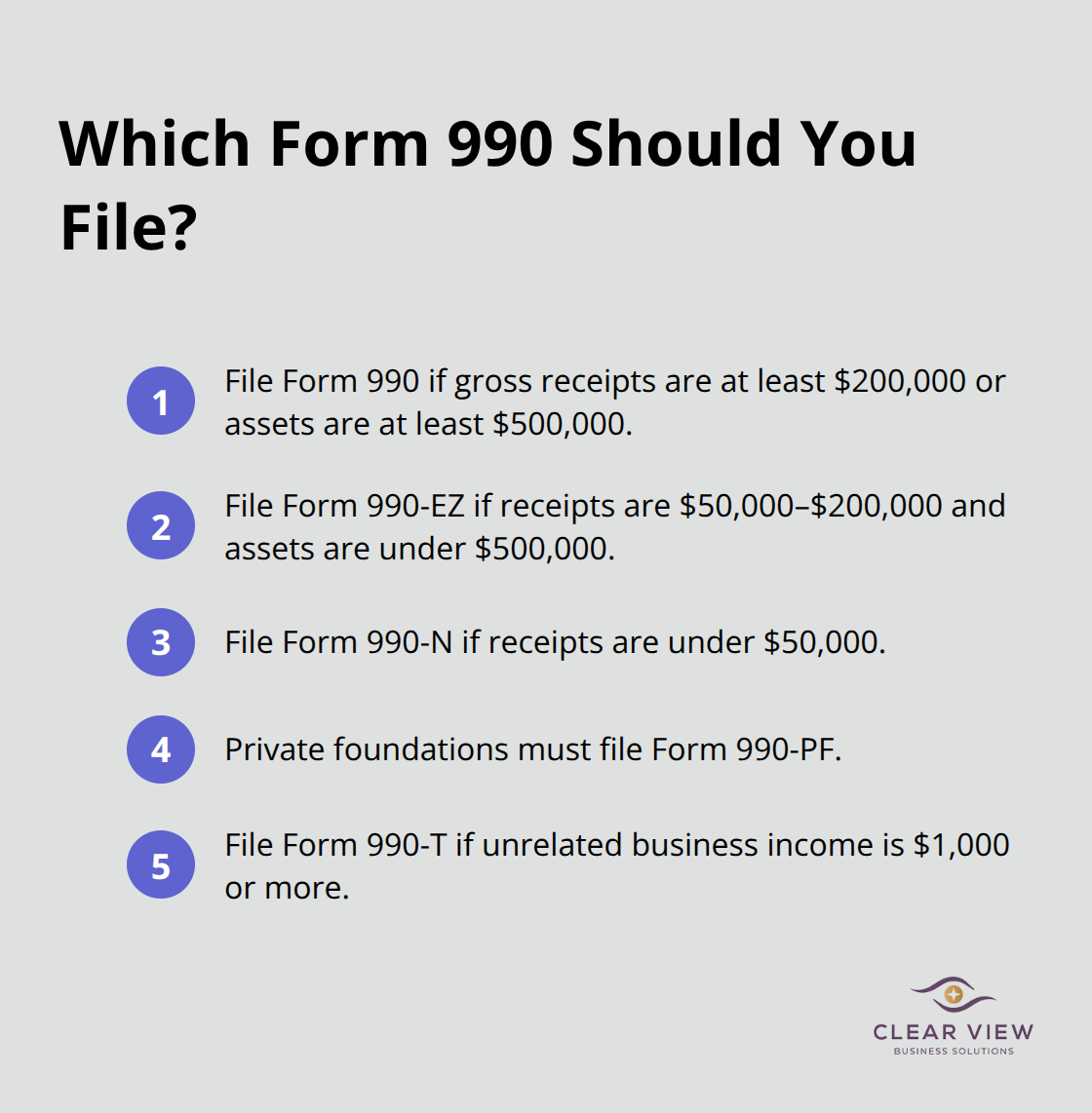
Your revenue and assets determine which Form 990 version you file, and this classification affects your compliance burden significantly. Organizations with gross receipts of $200,000 or more or assets of $500,000 or more file the complete Form 990. Those with receipts between $50,000 and $200,000 and assets under $500,000 may file Form 990-EZ or elect to file the Form 990. Organizations with receipts under $50,000 file Form 990-N, a simplified electronic notification. Private foundations file Form 990-PF instead, and organizations with unrelated business income of $1,000 or more file Form 990-T.
Verify your financial reporting to file the correct form, as filing the wrong version creates rejections and delays that jeopardize your compliance standing.
If your nonprofit files 10 or more information returns such as 1099s, W-2s, or W-2Gs, you must e-file these documents with the IRS by February 2, 2026 according to IRS requirements. Independent contractors paid $600 or more in 2025 trigger Form 1099-NEC reporting requirements, though this threshold rises to $2,000 in 2026. Rents, royalties, and similar payments of $600 or more require Form 1099-MISC reporting in 2025, with the threshold also rising to $2,000 in 2026. Raffle or gaming activities trigger Form W-2G reporting when winnings meet IRS thresholds, and withholding may apply. Your organization must file Form W-2 for each employee to report wages accurately to the IRS. These reporting obligations demand attention to detail because errors trigger IRS inquiries and potential penalties.
Your organization must file Form 8822-B if executives or responsible parties change, ensuring the IRS can communicate with you about compliance matters. Arizona nonprofits must certify nondiscrimination annually using Form 5578 if you operate private religious schools or hold group exemptions, with a deadline 15 days into the fifth month after year-end. Payroll taxes demand particular attention because nonprofit status does not exempt you from withholding income taxes, Social Security, and Medicare from employee wages. State-level requirements also matter in Arizona, where your nonprofit must maintain current registration and file annual reports with the Arizona Corporation Commission. These overlapping federal and state obligations create complexity that many organizations underestimate.
Create a compliance calendar in January that maps all deadlines through December, assigning responsibility to specific team members and establishing backup procedures so deadlines never slip. This approach transforms compliance from a reactive scramble into a predictable process that your team executes consistently. When you establish clear ownership and timelines, you reduce the risk of missed filings that damage your tax-exempt status or trigger penalties. Your next step involves identifying which specific forms and deadlines apply to your organization based on your revenue, structure, and activities-a determination that requires careful review of your nonprofit’s unique circumstances.
Three tax mistakes drain Tucson nonprofits of thousands annually, and the worst part is they’re entirely preventable. We at Clear View Business Solutions have watched organizations hemorrhage funds through sloppy documentation, misclassified workers, and ignored payroll deadlines. The good news: fixing these mistakes costs far less than the penalties they generate. Your nonprofit’s financial health depends on treating tax compliance as seriously as program delivery, not as an afterthought you handle in April.
Donors who contribute $250 or more must receive a written acknowledgment letter stating the exact cash amount, describing noncash items, and disclosing whether they received goods or services in return. Without this documentation, donors cannot claim the deduction on their personal tax returns, which means they stop giving to organizations that don’t provide it. The IRS doesn’t accept vague letters or verbal confirmations. You need written records that specify whether someone received a t-shirt, dinner ticket, or naming recognition in exchange for their gift.
Most Tucson nonprofits fail here by either skipping the letter entirely or writing something so generic it wouldn’t withstand IRS scrutiny. Start a system now: create a donation log that captures donor name, amount, date, description of noncash items, and services provided. Keep this log in a spreadsheet or nonprofit accounting software, and generate acknowledgment letters within 30 days of receipt. If your nonprofit receives donations through fundraising events, you need separate documentation for each donor at that event, not one blanket letter. This single step prevents donor complaints, protects your organization’s reputation with grantmakers, and keeps your nonprofit from becoming known as the organization with sloppy records.
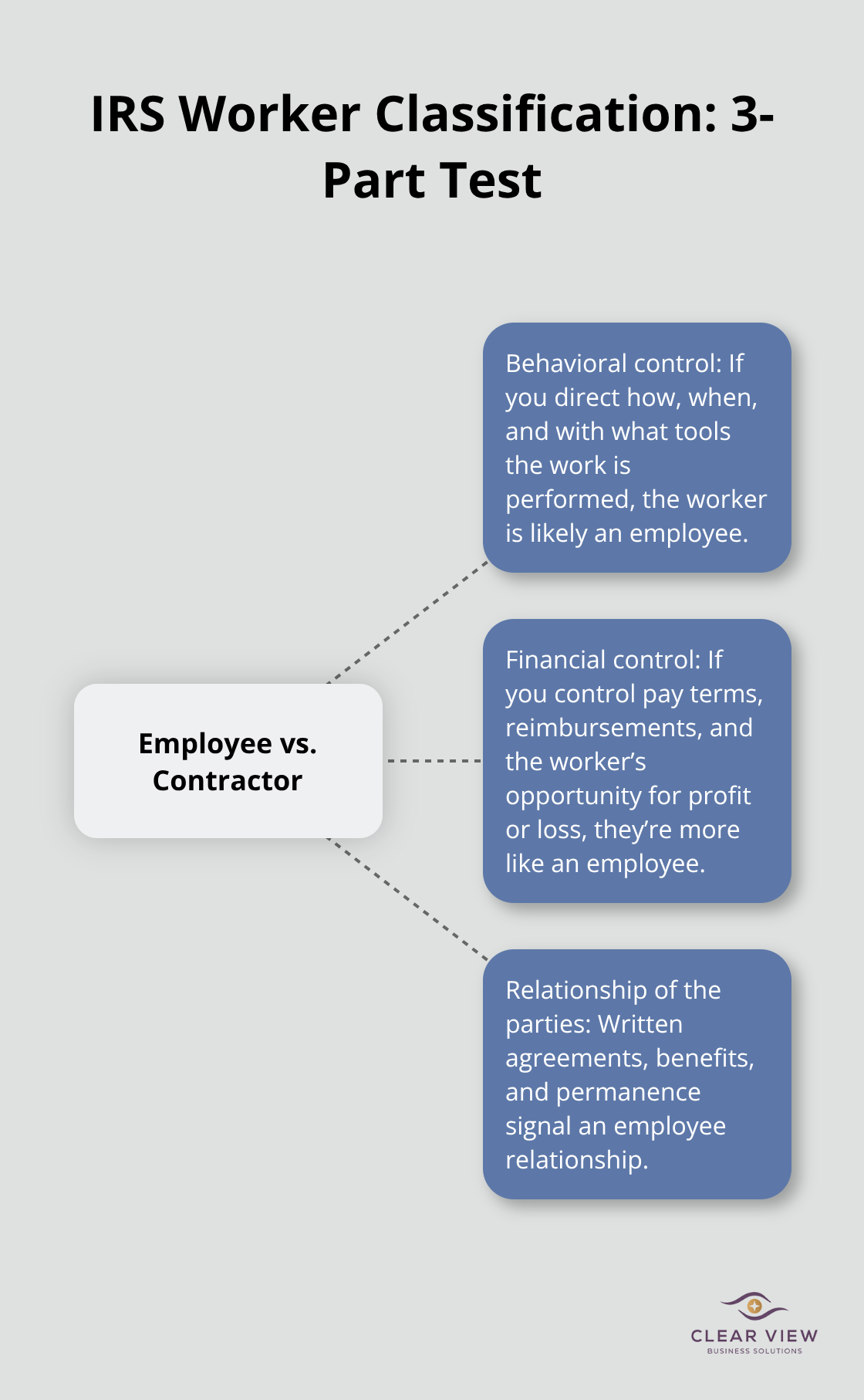
Misclassifying an employee as an independent contractor creates massive liability because you skip payroll taxes, workers compensation insurance, and unemployment insurance contributions. The IRS applies a three-part test based on behavioral control, financial control, and the relationship between parties, and most Tucson nonprofits get this wrong. If you control how someone works, when they work, and what tools they use, that person is an employee, period.
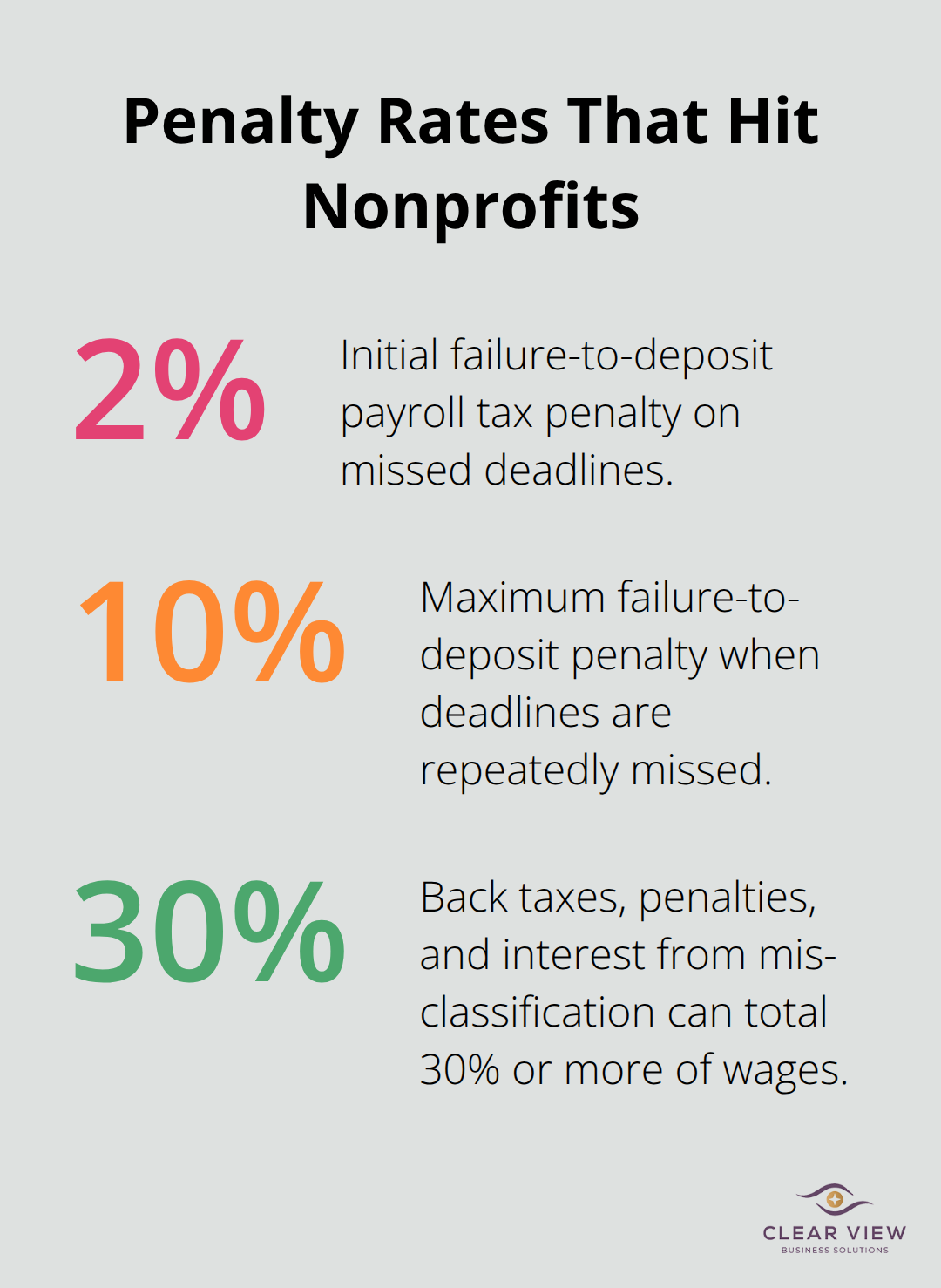
Paying someone a 1099 doesn’t make them independent; the IRS focuses on actual work arrangements, not labels on paperwork. When you misclassify, you owe back payroll taxes plus penalties and interest that can total 30 percent or more of the wages paid. Your organization also faces liability for unpaid workers compensation premiums and unemployment insurance. The solution is straightforward: classify someone as an employee if you direct their work or they work exclusively for your nonprofit. Use independent contractors only for specialized services like consulting, audit work, or one-time projects where the person controls their schedule and methods. Document the distinction in writing when you hire each person.
If you currently have contractors, audit your arrangements now. A 1099 contractor who works 30 hours weekly under your direction is really an employee, and the IRS will discover this during any audit. We at Clear View Business Solutions recommend nonprofits perform this audit annually because worker classifications sometimes shift as roles evolve.
Federal payroll taxes are due on specific dates regardless of your nonprofit status, and the IRS enforces these deadlines with zero flexibility. If you have employees, you withhold federal income tax, Social Security, and Medicare from their wages and deposit these amounts with the IRS on a schedule determined by your deposit frequency. Most nonprofits deposit monthly, meaning payments are due on the 15th of the following month.
Missing even one deposit triggers a penalty of 2 to 10 percent of the unpaid amount, and the penalties compound if you continue missing deadlines. Annual Form W-2 filing for employees is due by January 31, and e-filing requirements apply if you file 10 or more information returns. Your state unemployment insurance taxes also have separate deadlines, typically quarterly.
Create a payroll calendar in January that lists every deposit due date, every filing deadline, and every reporting requirement specific to your nonprofit. Assign one person primary responsibility and one backup so absences never cause missed deadlines (this redundancy protects your organization when staff take time off). Use your nonprofit accounting software to generate payroll on the same day each pay period so deposits are never late. If you currently miss deadlines or deposit late, contact the IRS immediately to discuss payment arrangements before they contact you. Late payments are far less damaging when you initiate contact than when the agency discovers the violation during an audit.
Tax planning for nonprofits in Tucson requires three core actions: maintain accurate documentation, classify workers correctly, and meet every payroll deadline without exception. These fundamentals protect your organization from penalties, preserve donor confidence, and free up resources for your mission instead of wasting them on IRS disputes. Start by auditing your current documentation practices, worker classifications, and payroll procedures against the standards outlined in this guide, then assign responsibility for fixing any gaps you identify.
If you operate a thrift store or resale program, verify your sales tax exemption status with the Arizona Department of Revenue because nonprofit status alone doesn’t automatically exempt you from collecting sales tax on all transactions. If you have energy projects like solar installations, coordinate those credits with a tax professional to maximize benefits on Form 990-T. Your nonprofit’s tax position improves dramatically when you treat compliance as a system rather than a crisis.
We at Clear View Business Solutions help Tucson nonprofits navigate these exact challenges through comprehensive tax planning and accounting services. Schedule a consultation with Clear View Business Solutions to review your current tax position and identify immediate improvements, bringing your most recent Form 990, payroll records, and donor documentation so we can assess your compliance standing and create a roadmap for the year ahead.




At Clear View Business Solutions, we know you want your business to prosper without having to worry about whether you are paying more in taxes than you should or whether your business is set up correctly. The problem is it's hard to find a trusted advisor who can translate financial jargon to layman's terms and who can actually help you plan for better results.
We believe it doesn't have to be this way! No business owner should settle for working with a CPA firm that falls short of understanding what you want to achieve and how to help you get there.
Northwest Location:
7530 N. La Cholla Blvd., Tucson, AZ 85741
Central Location:
2933 N Campbell Avenue, Tucson, AZ 85719
© 2026 Clear View Business Solutions. All Rights Reserved.
At Clear View Business Solutions, we know you want your business to prosper without having to worry about whether you are paying more in taxes than you should or whether your business is set up correctly. The problem is it's hard to find a trusted advisor who can translate financial jargon to layman's terms and who can actually help you plan for better results.
We believe it doesn't have to be this way! No business owner should settle for working with a CPA firm that falls short of understanding what you want to achieve and how to help you get there. With over 20 years of experience serving hundreds of business owners like you, our team of experts combines financial expertise and proactive communication with our drive to help each client achieve results and have fun along the way.
Here's how we do it:
Discover: We start with a consultation to understand your specific goals, what's holding you back, and what success looks like for you.
Strategize & Optimize: Together, we design a customized strategy that empowers you to progress toward your goals, and we optimize our communication as partners.
Thrive: You enjoy a clear view of your business and your financial prosperity.
Schedule a consultation today, and take the first step toward being able to focus on your core business again without wondering if your numbers are right- or what they mean to your business.
In the meantime, download, "The Business Owner's Essential Guide to Tax Deductions" and make sure you aren't leaving money on the table.