


Your monthly close shouldn’t take days. Most businesses waste hours on manual data entry, missing reconciliations, and disorganized records.
We at Clear View Business Solutions have seen firsthand how the right bookkeeping workflow tips transform a chaotic month-end into a smooth, predictable process. This guide shows you exactly how to automate what matters, organize what you have, and avoid the mistakes that cost you time.
Bank feeds and automatic categorization eliminate the most time-consuming part of bookkeeping: manually typing transactions. When you connect your bank and credit card accounts directly to QuickBooks, transactions import automatically, cutting the hours you spend on data entry each month. Automation helps firms save hours of manual work, reduce operational costs, and minimize human errors in data entry and reconciliation. That’s time you could spend on strategy instead of clerical work.
Most banks now support direct feeds through QuickBooks, meaning your transactions appear in your accounting system within hours of posting. Set up automatic categorization rules so QuickBooks learns your spending patterns and assigns transactions to the correct accounts without manual intervention. After the first month, this automation handles 70-80% of your routine transactions with zero manual effort.
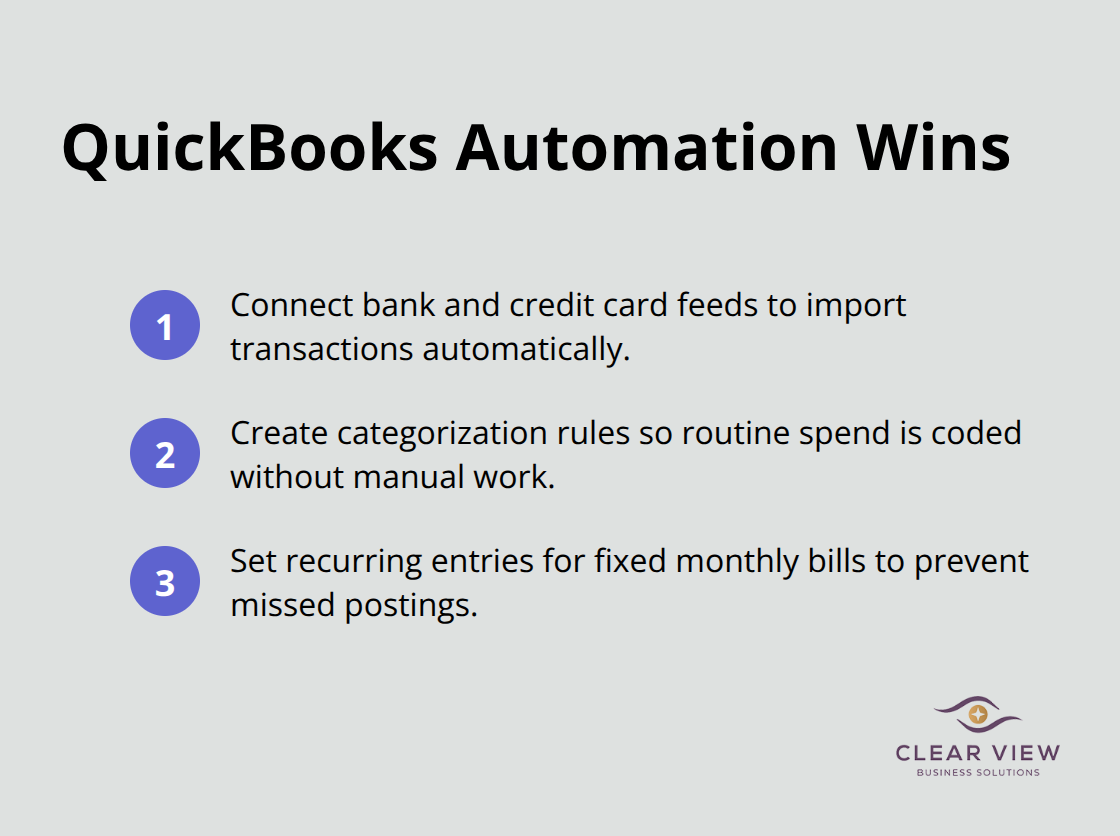
Recurring transactions are your second automation win. Monthly rent, insurance premiums, subscription services, payroll-these don’t change. Instead of recording them manually every month, set them up once in QuickBooks as recurring entries that post automatically on their due dates. This prevents late entries from throwing off your close timeline and eliminates the human error that happens when someone forgets to record a regular expense.
Automating recurring expenses saves time and eliminates missed entries entirely. The result is cleaner reconciliations and faster month-end closes. Your goal is to move toward what the accounting industry calls continuous accounting, where transactions flow into your system throughout the month rather than piling up for a frantic close period.
When your data is clean and current from day one, your final reconciliation takes hours instead of days. This shift from month-end scrambles to steady daily flows transforms how your team works. The next section shows you how to organize the documents and records you already have so that automation works even better.
Automation only works when your foundation is solid. If your documents scatter across email, filing cabinets, and sticky notes, even the best software will slow you down. You need a system that lets you find any receipt, invoice, or statement in seconds, not minutes. Start by building a centralized repository for all financial documents before month-end arrives.
Create a folder structure on your cloud storage or accounting software that mirrors your chart of accounts: separate folders for bank statements, credit card statements, invoices, receipts, payroll records, and loan documents. Name files consistently using the format YYYY-MM-DD-Description so older entries appear first and searches return results instantly. This matters because during close, you’ll need to verify specific transactions quickly. When a reconciliation doesn’t balance by $47, you need to locate that receipt in 30 seconds, not 30 minutes.
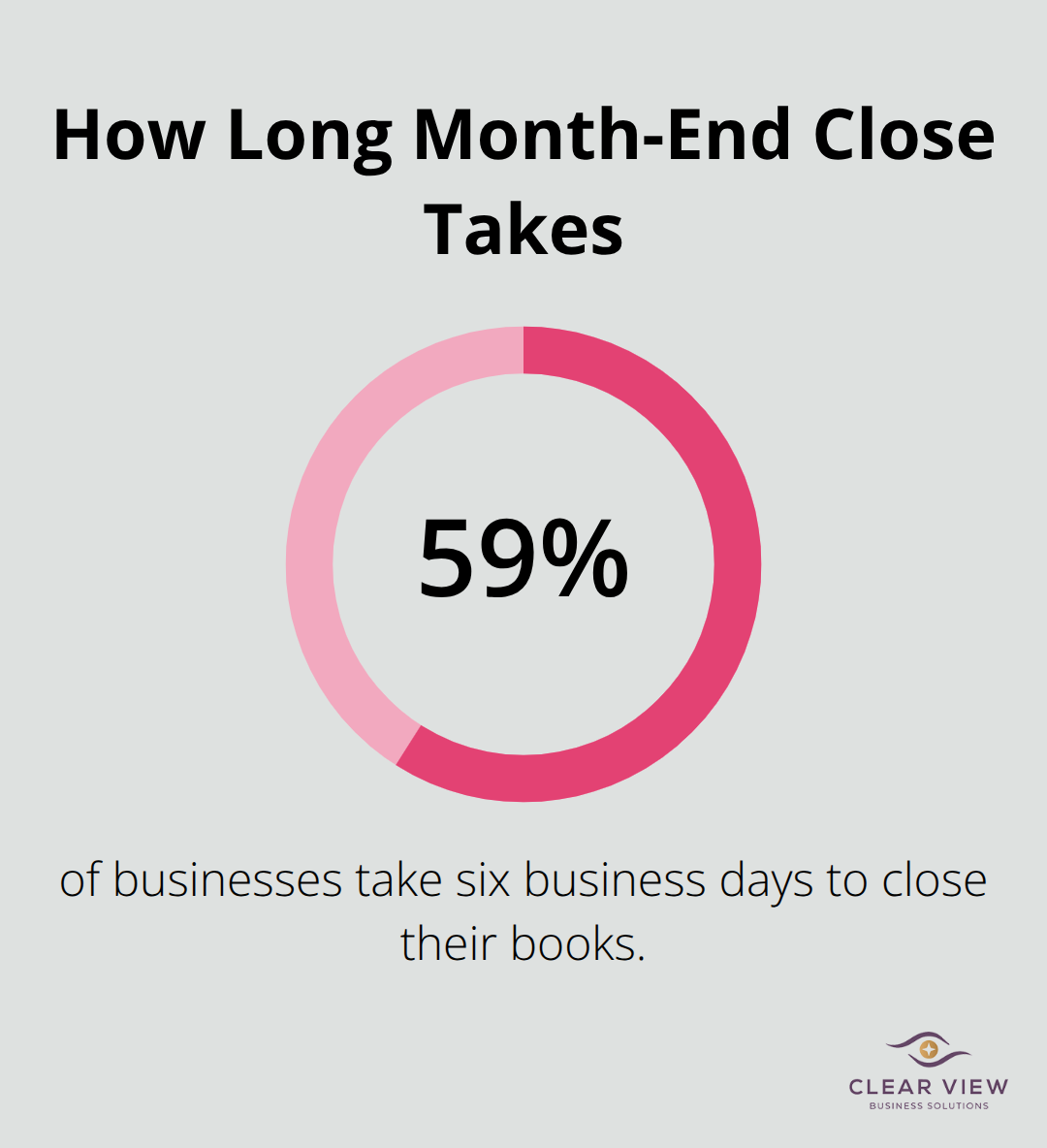
59% of businesses take six business days to close out their books come month-end, but many of those that exceed six days cite disorganized records as a primary bottleneck. The firms that close fastest maintain their documentation system throughout the month rather than scrambling to organize everything on the 25th.
Don’t wait until month-end to reconcile your bank and credit card accounts. Reconcile weekly or even daily to maintain real-time accuracy in financial records. This habit catches discrepancies while they’re fresh and prevents small errors from compounding into major headaches. When you reconcile frequently, you’ll notice if a transaction failed to import, if a duplicate charge appeared, or if an unauthorized expense slipped through. Catching these issues immediately means your month-end reconciliation takes one hour instead of five.
Create a checklist that includes your primary bank account, all credit cards, loan accounts, and any merchant accounts your business uses. For each account, verify that the balance in QuickBooks matches the bank statement balance, investigate any differences of more than a dollar, and flag recurring expenses that might be missing. If you have multiple locations or properties, prepare separate reconciliation workpapers for each entity so you can spot location-specific issues before they reach the general ledger. This approach transforms reconciliation from a painful month-end scramble into a manageable daily task that takes 15 minutes per account.
With organized documents and frequent reconciliations in place, you’ve eliminated two major sources of month-end friction. Your records are current, your discrepancies surface early, and your team knows exactly where to find what they need. The next section addresses the mistakes that still trip up many businesses-even those with solid systems in place.
The first mistake that wrecks your month-end timeline is mixing personal and business transactions in the same account. When you pay for office supplies with your personal credit card and then reimburse yourself later, or when business income lands in your personal bank account, your reconciliation becomes a detective hunt. You’ll spend hours matching transfers and trying to separate what belongs to the business from what doesn’t.
QuickBooks can’t automate what it can’t categorize correctly. When personal transactions pollute your books, your automation breaks down entirely. The fix is absolute: use separate accounts for business and personal expenses. Open a dedicated business checking account and business credit card if you haven’t already. This single decision cuts reconciliation time in half because every transaction that appears in those accounts belongs to your business.
The second mistake is postponing invoice and expense recording until the final week of the month. Many business owners let invoices pile up or delay recording expenses because they assume they’ll handle it all at once. What actually happens is that by the time month-end arrives, you’re scrambling to remember which expenses were in June and which were in July, whether that invoice was sent on the 28th or 31st, and whether that receipt even belongs to this month.
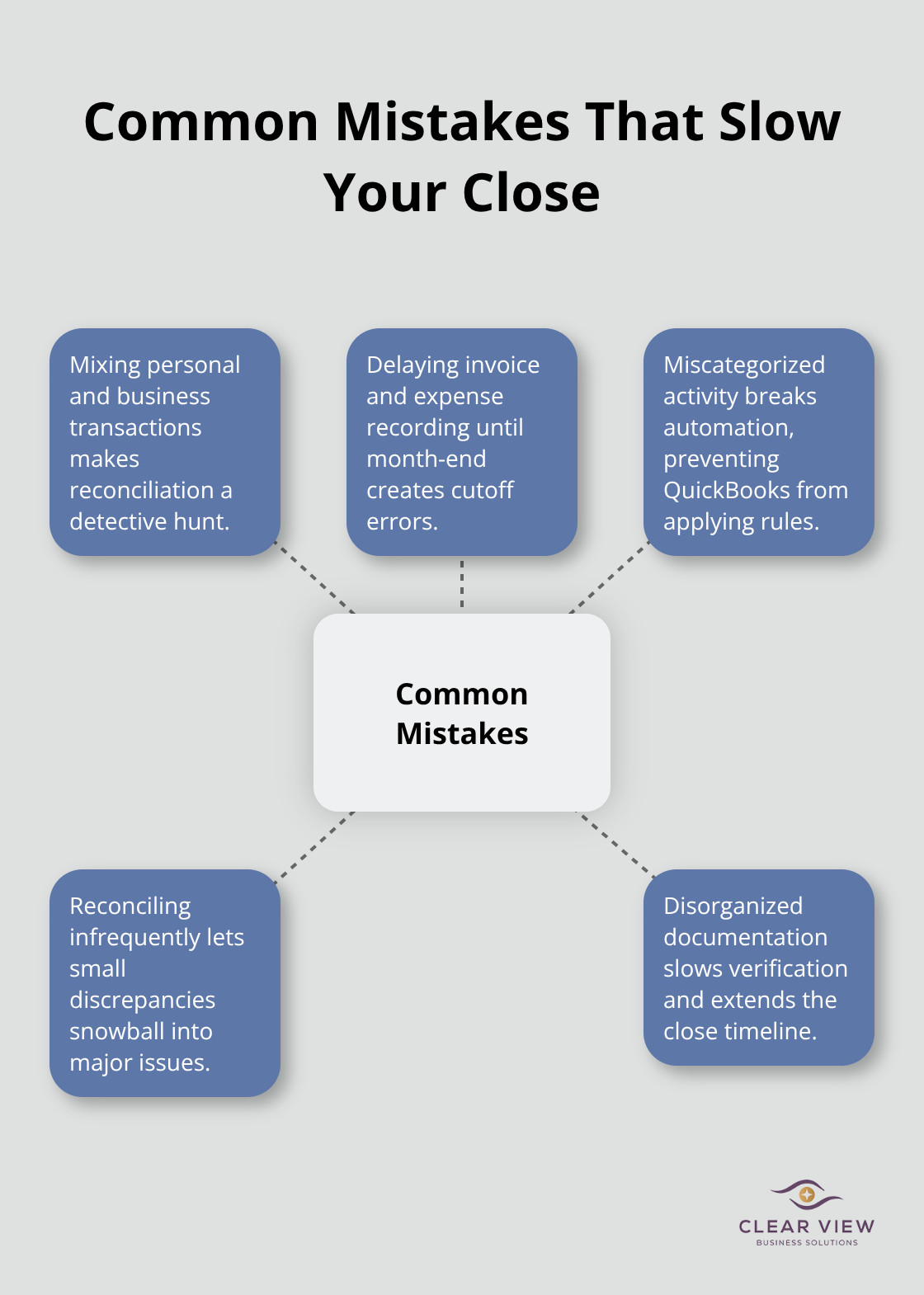
This timing confusion creates cutoff errors that throw off your financial statements and force you to make adjusting entries after the close is supposedly finished. Record transactions within two or three days of when they occur. This keeps your data current and prevents the frantic end-of-month data entry session that introduces mistakes. When you record expenses daily or weekly, your reconciliations stay accurate and your month-end close moves faster because there’s no backlog to process.
The accounting industry calls this continuous accounting for good reason: it works. Continuous accounting distributes accounting tasks throughout the month rather than concentrating them at month-end. This rhythm prevents the errors that compound when you try to process weeks of transactions in a single session.
The bookkeeping workflow tips we’ve covered-automating transactions, organizing documents, and avoiding common mistakes-work together to transform your month-end close from a stressful scramble into a predictable routine. Most businesses close their books within three to five days when their systems are solid, and that speed comes from consistency, not heroic effort. You’ve learned how to build that consistency by setting up automation, maintaining organized records, and recording transactions on time.
Professional bookkeeping support accelerates this process even further. When you work with experienced bookkeepers who understand your business, they handle the daily transaction recording, reconciliations, and documentation so your team focuses on running the company instead of managing spreadsheets. They catch errors before they become problems and maintain your systems between closes.
We at Clear View Business Solutions help small businesses in Tucson streamline their entire financial operation through full-cycle bookkeeping, QuickBooks training, and personalized accounting support. Contact Clear View Business Solutions to discuss how we can transform your close process and build workflows that fit your business.




At Clear View Business Solutions, we know you want your business to prosper without having to worry about whether you are paying more in taxes than you should or whether your business is set up correctly. The problem is it's hard to find a trusted advisor who can translate financial jargon to layman's terms and who can actually help you plan for better results.
We believe it doesn't have to be this way! No business owner should settle for working with a CPA firm that falls short of understanding what you want to achieve and how to help you get there.
Northwest Location:
7530 N. La Cholla Blvd., Tucson, AZ 85741
Central Location:
2933 N Campbell Avenue, Tucson, AZ 85719
© 2026 Clear View Business Solutions. All Rights Reserved.
At Clear View Business Solutions, we know you want your business to prosper without having to worry about whether you are paying more in taxes than you should or whether your business is set up correctly. The problem is it's hard to find a trusted advisor who can translate financial jargon to layman's terms and who can actually help you plan for better results.
We believe it doesn't have to be this way! No business owner should settle for working with a CPA firm that falls short of understanding what you want to achieve and how to help you get there. With over 20 years of experience serving hundreds of business owners like you, our team of experts combines financial expertise and proactive communication with our drive to help each client achieve results and have fun along the way.
Here's how we do it:
Discover: We start with a consultation to understand your specific goals, what's holding you back, and what success looks like for you.
Strategize & Optimize: Together, we design a customized strategy that empowers you to progress toward your goals, and we optimize our communication as partners.
Thrive: You enjoy a clear view of your business and your financial prosperity.
Schedule a consultation today, and take the first step toward being able to focus on your core business again without wondering if your numbers are right- or what they mean to your business.
In the meantime, download, "The Business Owner's Essential Guide to Tax Deductions" and make sure you aren't leaving money on the table.